How to split a worksheet into multiple panes in Excel?
When working with large datasets in Excel, it can be challenging to view and compare distant parts of your worksheet simultaneously. To make this easier, Excel offers a practical feature called Split Panes. By dividing the worksheet into separate viewing areas, you can scroll through different sections independently, which is especially helpful for comparing data side-by-side or across distant rows and columns without losing track of your headers or key information. This article will guide you through several methods to split a worksheet into multiple panes in Excel according to your specific needs, helping to improve efficiency and accuracy when analyzing or editing your data.
Split worksheet into panes with dragging split pane
Split worksheet into panes with Split button
Split worksheet into panes with dragging split pane
Splitting a worksheet into multiple panes by dragging the split bar is a quick and straightforward approach. This method gives you precise control over where the worksheet is divided. It's most suitable when you want to create a horizontal or vertical split at your preferred location without needing to select a specific cell in advance.
Split worksheet into panes horizontally
1. Move your cursor to the small split bar located just above the arrow at the top of the vertical scroll bar on the right-hand side of your Excel window. This bar may appear as a small rectangle or line; see the screenshot below for reference:

2. When your cursor changes to a double-headed arrow with a split in the middle, click and hold the mouse button, then drag the split bar downward to the row where you want your worksheet to be divided. Release the mouse button to create the horizontal split. This enables you to scroll through the upper and lower parts of your worksheet independently. See the following screenshot:

If you need to adjust or remove the split, simply drag the split bar back to its original position or double-click the split bar line.
Split worksheet into panes vertically
1. Position your cursor on the vertical split bar, which you'll find next to the arrow at the right end of the horizontal scroll bar at the bottom of your Excel window. Refer to the screenshot below for clarification:

2. When you see your cursor change to a double-headed arrow with a split in the center, click and drag the split bar leftwards to the column where you wish to create the split. Once you've positioned it, release the mouse button to establish a vertical split. This allows for independent scrolling between the left and right panes of your worksheet. See screenshot below:

You can further customize the split by dragging it to a different location or double-clicking the dividing line to remove the split when you no longer need it.
This drag-to-split method is highly flexible for visual comparison of distinct worksheet areas, but may be less suitable when you need to split precisely above a certain row or to the left of a certain column based on content locations.
In earlier versions of Excel (such as Excel 2013 and earlier), you could easily find a small split bar above the vertical scroll bar or next to the horizontal scroll bar. By dragging it, you could split the worksheet into multiple panes.
Split worksheet into panes with Split button
In addition to dragging split bars, Excel provides a direct option to split your worksheet with the Split button on the View tab. This approach is ideal when you want quick, precise splitting based on currently selected rows or columns, especially for complex sheets where positioning the split accurately is important.
1. Begin by selecting the row where you want to insert the split pane above. Click the row number on the left to highlight the entire row if you want to split horizontally, or click a cell in the column you prefer for a vertical split. See the example in the following screenshot:

Tip: To create a vertical split, select the entire column by clicking its header or select a cell in that column; the split will appear to the left of your selection. For horizontal splits, the bar appears above the highlighted row or above the cell you select.
2. Go to the View tab on the Ribbon, then click the Split button in the Window group. You will immediately see the worksheet divided at the row or column you selected, enabling you to scroll each part separately. See illustration below:
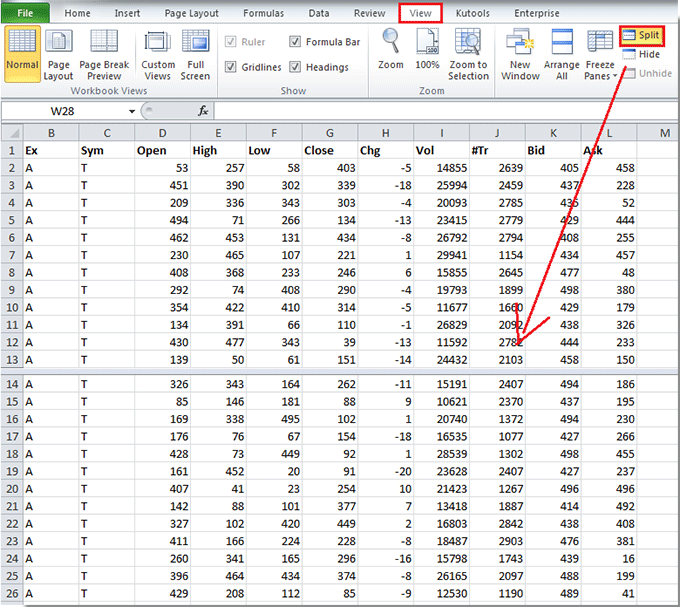
Tip: If you want to divide your worksheet into four distinct panes (both horizontally and vertically), select a cell — the horizontal split will appear above the selected cell, and the vertical split will be placed to the left. This method is especially useful for analyzing large tables with both row and column headers. Click View > Split once selected. See the screenshot below for reference:

Note: To remove any split pane created using either the drag method or the Split button, simply double-click the split bar, or select the Split button again under the View tab to toggle it off. Make sure the active cell or selection is inside the split area you want to remove. If you encounter unexpected behavior, such as unable to split, check if the worksheet is protected or if you are in the middle of an active cell editing session — splits cannot be applied until editing is complete.
Splitting with the Split button provides a fast and convenient way to synchronize scrolling or compare different data ranges at a glance; however, keep in mind that excessive splitting may make navigation more complex, so use splits according to your workflow needs.
If your Excel window appears too small or the split bars are difficult to see, try maximizing Excel or zooming in to make the split handles more visible.
Alternative approaches also exist for viewing and comparing Excel data — such as opening the same workbook in a new window and using the View Side by Side feature. To do this, go to View > New Window to open a second window for your workbook, then click View Side by Side to view and scroll each window independently. This is particularly applicable for referencing data across multiple sheets or for dual-monitor setups. For more information, refer to Microsoft's official guide to viewing multiple worksheets.
Best Office Productivity Tools
Supercharge Your Excel Skills with Kutools for Excel, and Experience Efficiency Like Never Before. Kutools for Excel Offers Over 300 Advanced Features to Boost Productivity and Save Time. Click Here to Get The Feature You Need The Most...
Office Tab Brings Tabbed interface to Office, and Make Your Work Much Easier
- Enable tabbed editing and reading in Word, Excel, PowerPoint, Publisher, Access, Visio and Project.
- Open and create multiple documents in new tabs of the same window, rather than in new windows.
- Increases your productivity by 50%, and reduces hundreds of mouse clicks for you every day!
All Kutools add-ins. One installer
Kutools for Office suite bundles add-ins for Excel, Word, Outlook & PowerPoint plus Office Tab Pro, which is ideal for teams working across Office apps.





- All-in-one suite — Excel, Word, Outlook & PowerPoint add-ins + Office Tab Pro
- One installer, one license — set up in minutes (MSI-ready)
- Works better together — streamlined productivity across Office apps
- 30-day full-featured trial — no registration, no credit card
- Best value — save vs buying individual add-in