How to sum or count the first n values in an Excel column or row?
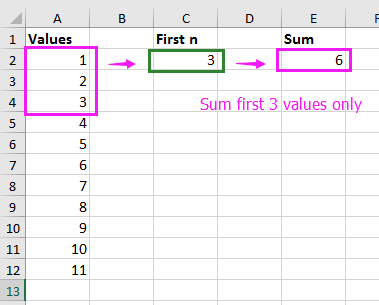
In practical Excel tasks, you may encounter situations where you need to sum or count only the first n values from a column or row, rather than performing calculations over the entire dataset. For instance, you might have a list of numbers and want to quickly sum just the first three values, as illustrated in the screenshot below. This need often arises when working with time series data, partial reports, or when testing calculation logic on sample sets. Efficiently handling such requests can save time and avoid manual selection errors. In this tutorial, we will explore several straightforward formula solutions to sum or count the first n values in either a column or a row in Excel, with parameter explanations, usage notes, and troubleshooting tips included.
Count or sum the first n values in a column with formulas
When you want to sum only the first n entries in a column—such as summing the top three sales figures or the initial few measurements—Excel formulas provide a concise solution that avoids manual selection and reduces mistakes. Below is a flexible approach using the OFFSET and SUM functions:
Select an empty cell where you wish to display the result, then enter the following formula (example shown for summing values):
=SUM(OFFSET($A$2,0,0,C2))Press Enter to instantly calculate the sum. Refer to the screenshot below to confirm where the cell reference and result appear:
This approach is particularly useful in scenarios where your data may change or where the number of items to sum (the n value) needs to be adjusted frequently. By changing the value in cell C2, you can quickly update the calculation to sum a different number of entries without rewriting the formula.
If your goal is to count how many first n cells contain numeric data—excluding text and blank cells—you can use the following formula in any blank cell:
=COUNT(OFFSET($A$2,0,0,C2))After inputting the formula, press Enter to view the count. The screenshot below demonstrates the expected result location:
Parameter explanations and practical tips:
- A2 should refer to the first cell in your data column. Adjust as needed if your list begins elsewhere.
- C2 is the cell where you specify the number n—the number of top values to sum or count. Change this cell to flexibly control the output.
- If you want to sum or count a different range, update these cell references accordingly.
Precautions: Ensure that the cell for n (such as C2) is not zero or negative, and the reference range does not exceed available data; otherwise, the formula may return zero or an error.
If you need to perform this operation on another column, copy the formula as needed, adjusting both your starting cell reference and your n value input.
Alternative solution (for advanced users): You can also use the SUMPRODUCT function if you do not want to use OFFSET, which may be preferable when working with dynamic table ranges or structured references. For example, to sum the first n values in column A starting at A2:
=SUMPRODUCT(A2:INDEX(A:A,C2+1))Enter this formula in a blank cell. Here, A2 is the starting cell, and C2 is the position of n. This solution avoids using OFFSET and works seamlessly with structured data ranges.

Unlock Excel Magic with Kutools AI
- Smart Execution: Perform cell operations, analyze data, and create charts—all driven by simple commands.
- Custom Formulas: Generate tailored formulas to streamline your workflows.
- VBA Coding: Write and implement VBA code effortlessly.
- Formula Interpretation: Understand complex formulas with ease.
- Text Translation: Break language barriers within your spreadsheets.
Count or sum the first n values in a row with formulas
When working with rows—such as analyzing survey responses where each respondent's data appears in order—it is sometimes necessary to calculate the sum or count for only the first n values. Excel formulas can quickly help you achieve this without manual selection, making your reports both consistent and automated.
To sum the first n values in a row, click into a blank cell where you want the result to appear, then enter the following formula:
=SUM(OFFSET(A20,0,0,1,A23))Confirm by pressing Enter. The calculated sum will show up instantly. You can see a visual example in the screenshot below:
This method works well when you may need to change n frequently—by altering the value in A23, you can instantly recalculate the output for any desired number of entries.
1. To count the number of numeric (not text) values among the first n items in a row, use the formula below in a blank cell:
=COUNT(OFFSET(A20,0,0,1,A23))Press Enter, and you will see the count. Copy the formula to other rows as needed by dragging the cell's fill handle.
2. In these formulas, A20 should be the first cell in the row from which you wish to start calculation. A23 is where you input the desired value of n (the number of values to count or sum). Adjust the references depending on where your data is located.
If your data set is large, or if you need to work with multiple rows, copy the formula to additional cells and modify the references for each row as necessary.
Alternative solution:
For those preferring a solution without OFFSET—particularly in cases where your rows contain dynamic references or structured tables—you might use SUMPRODUCT. Suppose you want to sum from A20 across the next n columns, you can do:
=SUM(A20:INDEX(20:20,A23))Enter the formula in any blank cell. A20 marks the starting cell in the row, and A23 determines the column position up to which to sum. This avoids relying on OFFSET, and works well for tables with clearly defined column headers.
Troubleshooting and suggestions: If the formulas return errors, such as #VALUE! or #REF!, please check that your specified n value does not exceed the number of actual columns in the row. Also, ensure that your cell references are correct and do not point to empty or non-numeric fields if you are using COUNT.
For both column and row methods, remember that you can use Excel's drag feature to quickly copy and adapt formulas to other areas of your worksheet. Always update your reference cells and n-value cell to match the target data range for accurate results.
Best Office Productivity Tools
Supercharge Your Excel Skills with Kutools for Excel, and Experience Efficiency Like Never Before. Kutools for Excel Offers Over 300 Advanced Features to Boost Productivity and Save Time. Click Here to Get The Feature You Need The Most...
Office Tab Brings Tabbed interface to Office, and Make Your Work Much Easier
- Enable tabbed editing and reading in Word, Excel, PowerPoint, Publisher, Access, Visio and Project.
- Open and create multiple documents in new tabs of the same window, rather than in new windows.
- Increases your productivity by 50%, and reduces hundreds of mouse clicks for you every day!
All Kutools add-ins. One installer
Kutools for Office suite bundles add-ins for Excel, Word, Outlook & PowerPoint plus Office Tab Pro, which is ideal for teams working across Office apps.





- All-in-one suite — Excel, Word, Outlook & PowerPoint add-ins + Office Tab Pro
- One installer, one license — set up in minutes (MSI-ready)
- Works better together — streamlined productivity across Office apps
- 30-day full-featured trial — no registration, no credit card
- Best value — save vs buying individual add-in