How to search (partial word) with wildcard in Outlook?
Many Outlook users have discovered that the Instant Search feature, although fast, does not support the use of wildcards for finding partial words within emails. For example, searching for *berry in Instant Search—hoping to match words like strawberry, blueberry, or cranberry—yields no results. This limitation can be inconvenient when you need to locate all emails that contain a certain pattern or fragment of a word, especially when you do not know the full word in advance.
This article introduces several practical methods to achieve wildcard-style partial word searches in Outlook. Whether you need to search inside a single email, scan entire folders, or even automate your searches with VBA, you'll find step-by-step solutions tailored to different needs and user preferences. Along with each solution, we highlight suitable scenarios, point out possible limitations, and provide troubleshooting suggestions to help you successfully find the information you need in Outlook.
Below are three effective workarounds you can try, with additional details for each approach:
Search for partial words using wildcards within a single email
Search for partial words in all emails within a mail folder
VBA code: Programmatically search for emails using wildcards or partial words
Search for partial words using wildcards within a single email
If you need to identify partial words or patterns using wildcards within the body of an individual email, Outlook provides a special search feature in the message window. This can be particularly useful when reviewing lengthy or complex emails, where it's difficult to visually scan for every occurrence of a fragment or variant of a specific word.
To perform a wildcard search within the content of a single email, follow these steps:
1. Switch to the Mail view, then double-click to open the email in which you need to search with wildcards. Searching within the reading pane does not offer this feature; make sure the email is in its own window.
2. On the ribbon menu, select Message > Find. This may appear as a magnifying glass or simply as “Find” depending on your Outlook version and window size.

3. In the “Find and Replace” dialog box that opens, click the “More” button to expand additional search options if they are not already visible. Expanding these options is essential to access the wildcard functionality.

4. Check the box labeled Use wildcards. Now, enter your partial word or wildcard pattern in the “Find what” box (for example, use *berry to match all words ending in “berry”). For best results, use the asterisk * to represent any string of characters, or the question mark ? for a single character. Then click Reading Highlight > Highlight All to visually highlight every match within the email body.

📌 Result: Outlook will instantly highlight all occurrences in the email that match your wildcard search term, making it easy to visually scan and review every instance.

Applicable scenario: This method is best when you want detailed and precise control over searching within the text of a single email, especially if you are auditing information or looking for specific patterns within a lengthy conversation. It is, however, limited to one email at a time and does not support searching multiple emails or folders in one go.
Additional tips: Make sure “Use wildcards” is checked, otherwise standard search will treat the asterisk or question mark as literal characters and not as wildcards. Some complex wildcard patterns (such as nested wildcards or advanced regular expressions) may not be supported in this dialog. Always check that the highlighted results match your intended search scope.
Troubleshooting advice: If you do not see the expected highlighted results, double-check your wildcard syntax. If nothing is highlighted, try a more general pattern or review for accidental spacing or typing errors in your search query. Remember, this search feature does not search email attachments or header fields, only the body content of the opened email.
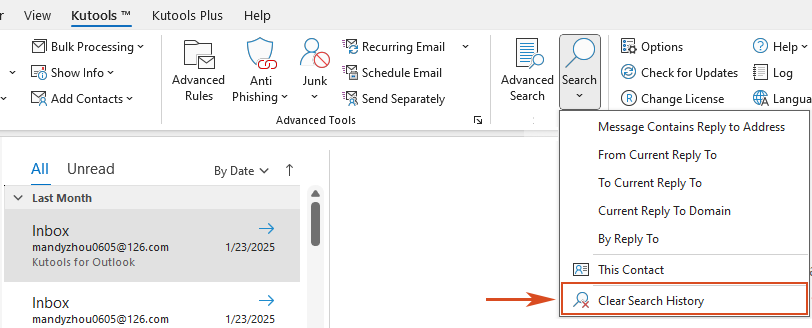
🔍 Instantly Clear Recent Search History in Outlook!
Is your Outlook search bar cluttered with old search terms? Keep your workspace clean and organized with Kutools for Outlook! The powerful Clear Search History feature lets you remove all recent search history **with just one click**, improving search efficiency and enhancing privacy.
Search for partial words in all emails within a mail folder
When you need to locate all emails containing certain partial keywords or word fragments across an entire folder, Outlook’s Instant Search does not permit wildcard characters in search queries. However, “Advanced Find” provides a way to perform similar searches using partial matches, making it practical to filter emails containing your target word pieces even if the full word varies between emails.
Here's how you can utilize Advanced Find to scan a mail folder for partial word matches:
1. Begin by opening the Mail view, then click to select the specific folder (such as Inbox, Sent Items, or a custom folder) where you want to perform the partial word search. For in-depth searches, repeat the process for each folder as needed.
2. To open the “Advanced Find” window, first place your cursor inside the Instant Search box. Then, from the ribbon, navigate to Search > Search Tools > Advanced Find.
If you prefer keyboard shortcuts, press Ctrl + Shift + F to quickly bring up Advanced Find from anywhere in Outlook.

3. Inside the “Advanced Find” dialog box, switch to the Advanced tab. To set up your search filter:
- 1). Click Field, point to All Mail fields, and choose the specific field you want to search, such as Subject, Message (the body of the email), or other available fields like From or To. For searching the email content, selecting "Message" is recommended.
- 2). Select contains from the “Condition” drop-down list. This allows the search to match emails that include your text fragment anywhere in the chosen field.
- 3). Enter the partial keyword (e.g., "berry" to match "strawberry," "blueberry," etc.) into the “Value” box. There is no need for wildcards; Advanced Find will look for the string wherever it appears within the target field.
- 4). Click Add to List to confirm and apply this search criterion.
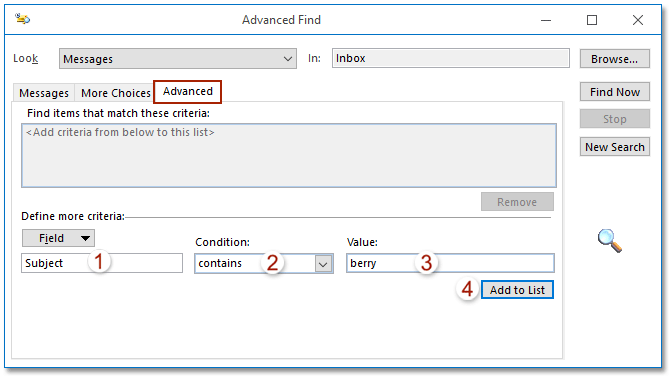
4. Now, click the Find Now button to execute your search. The results will populate in the lower section of the dialog box—a list of all emails within the folder that contain the specified partial word or text string.
📌 Result: All emails matching the partial keyword (regardless of where it appears within the chosen field) are displayed in the “Advanced Find” results pane. You may scroll through the results or double-click any email to open it for further review.

Applicable scenario: This approach is suitable for searching across a folder when you need to find every email that contains a specific text segment in the subject, message body, sender, or other fields. It is more comprehensive than the single-email method, but still does not use true wildcards; it simply matches any occurrence of the partial string.
Advantages and limitations: The filter is easy to set up and works well for most text searches, but will not respect advanced wildcard or regular expression syntax like * or ?. Also, if your search criteria are too broad, the results may be extensive, making it more time-consuming to manually review.
Precautions: Note that searching in large folders with hundreds or thousands of messages may take some time to process, and multi-field searches may return duplicate results if the same word appears in different fields.
Troubleshooting advice: If you see no results, double-check that the chosen field is correct (such as “Message” for body text). Typographical errors or search terms with unusual spacing can also lead to empty results. The search is case-insensitive by default, but check for hidden formatting or non-standard characters if you expect matches but see none.
VBA code: Programmatically search for emails using wildcards or partial words
In some cases, especially for users who frequently search for patterns, have repetitive search tasks across multiple folders, or need more flexible matching than Outlook’s built-in dialogs allow, using VBA (Visual Basic for Applications) in Outlook can offer an automated solution. A VBA macro makes it possible to search for emails containing partial words—simulating a wildcard search—across one or more folders, providing both flexibility and speed for advanced users or administrators.
Applicable scenario: VBA is particularly handy if you regularly need to perform the same search on a large number of emails or folders, automate and customize your search rules, or wish to extract and process results programmatically (for example, highlighting, listing, or reporting findings). The downside is that setting up and running the VBA macro requires basic familiarity with the VBA editor, and the solution is best suited for desktop Outlook installations (not web or mobile).
Follow these steps to use a VBA macro that finds emails containing a partial word match—effectively simulating wildcard-style searches:
1. Before running the macro, decide which Outlook folder you want to search. It is recommended to select the desired mail folder in the folder list so that the macro can process only its contents and not the entire mailbox (which can be slow and resource-intensive).
2. Press Alt + F11 to open the Microsoft Visual Basic for Applications (VBA) window in Outlook.
3. In the VBA window, click Insert > Module. Copy and paste the following VBA code into the new module window.
VBA code: Search all emails in the current folder for a partial word or pattern
Sub SearchEmailsWithPartialWord()
    Dim xFolder As Outlook.MAPIFolder
    Dim xMail As Outlook.MailItem
    Dim xItem As Object
    Dim xPattern As String
    Dim xResult As String
    Dim xMatched As Boolean
    Dim i As Integer

    On Error Resume Next
    Set xFolder = Application.ActiveExplorer.CurrentFolder
    xPattern = InputBox("Enter the keyword or partial word to search for (e.g., berry):", "KutoolsforOutlook")

    If xPattern = "" Then Exit Sub

    xResult = ""
    i = 0

    For Each xItem In xFolder.Items
        If xItem.Class = olMail Then
            xMatched = (InStr(1, xItem.Subject, xPattern, vbTextCompare) > 0) Or _
                       (InStr(1, xItem.Body, xPattern, vbTextCompare) > 0)

            If xMatched Then
                i = i + 1
                xResult = xResult & vbCrLf & i & ". " & xItem.Subject
            End If
        End If
    Next

    If xResult <> "" Then
        MsgBox "Found emails containing """ & xPattern & """:" & vbCrLf & xResult, vbInformation, "KutoolsforOutlook"
    Else
        MsgBox "No emails containing """ & xPattern & """ were found in this folder.", vbInformation, "KutoolsforOutlook"
    End If

    Set xFolder = Nothing
    Set xMail = Nothing
End Sub4. Press the F5 key to run the macro. When prompted, enter the partial word or fragment you wish to search for (for example, berry). The macro will scan all emails in the currently selected folder and return a list of subjects containing your search term, either in the subject or the body of each message. If matches are found, they will be listed in a dialog box titled “KutoolsforOutlook”; if not, you will also receive a notification.
Tips for use: For best results, select smaller or targeted folders. If you want to search multiple folders, run the macro while each one is selected or modify the code to loop through several folders.
While this macro matches any occurrence of the keyword or partial phrase, more advanced “wildcard” behaviors (like using asterisks or question marks to match multiple patterns) can be incorporated by expanding the code with regular expressions (RegExp) or custom logic if you are comfortable with VBA scripting.
Precautions and troubleshooting: Always save your Outlook work before running or editing macros. Be sure macros are enabled in your Outlook security settings (File > Options > Trust Center > Trust Center Settings > Macro Settings). The macro does not search attachments or conversation histories—just the subject and message body. If you receive errors, ensure you've selected a mail folder and that items in the folder are emails, not calendar items or other object types.
Related Articles
Search entire specific phrase in Outlook
Search for an exact match to character strings/phrase in Outlook
Search in email messages body/text in Outlook
Search words within attachment (content) in Outlook
Best Office Productivity Tools
Experience the all-new Kutools for Outlook with 100+ incredible features! Click to download now!
📧 Email Automation: Auto Reply (Available for POP and IMAP) / Schedule Send Emails / Auto CC/BCC by Rules When Sending Email / Auto Forward (Advanced Rules) / Auto Add Greeting / Automatically Split Multi-Recipient Emails into Individual Messages ...
📨 Email Management: Recall Emails / Block Scam Emails by Subjects and Others / Delete Duplicate Emails / Advanced Search / Consolidate Folders ...
📁 Attachments Pro: Batch Save / Batch Detach / Batch Compress / Auto Save / Auto Detach / Auto Compress ...
🌟 Interface Magic: 😊More Pretty and Cool Emojis / Remind you when important emails come / Minimize Outlook Instead of Closing ...
👍 One-click Wonders: Reply All with Attachments / Anti-Phishing Emails / 🕘Show Sender's Time Zone ...
👩🏼🤝👩🏻 Contacts & Calendar: Batch Add Contacts From Selected Emails / Split a Contact Group to Individual Groups / Remove Birthday Reminders ...
Use Kutools in your preferred language – supports English, Spanish, German, French, Chinese, and 40+ others!


🚀 One-Click Download — Get All Office Add-ins
Strongly Recommended: Kutools for Office (5-in-1)
One click to download five installers at once — Kutools for Excel, Outlook, Word, PowerPoint and Office Tab Pro. Click to download now!
- ✅ One-click convenience: Download all five setup packages in a single action.
- 🚀 Ready for any Office task: Install the add-ins you need, when you need them.
- 🧰 Included: Kutools for Excel / Kutools for Outlook / Kutools for Word / Office Tab Pro / Kutools for PowerPoint