Quickly convert between various measurement units without using formulas in Excel
Without building formulas or functions, Kutools for Excel provides a powerful Unit Conversion utility that helps you convert values between many measurement units in bulk—such as degrees to radians, minutes to hours, feet to inches, and more. With this utility, you can convert units quickly and consistently in Excel, with a live preview before you apply changes.
Why use Kutools' Unit Conversion feature
Location of the Unit Conversion tool
Note: The Unit Conversion utility supports many measurement categories, including Angle, Bits & Bytes, Distance, Energy, Force, Liquid, Mass, Surface, Temperature, Time, Volume, and Hex.
Why use Kutools' Unit Conversion feature
- 🧮 No formulas needed – convert values without building CONVERT() formulas or custom calculations.
- ⚡ Batch conversion in seconds – select a range and convert many cells at once for consistent results.
- 👀 Live preview before applying – review the converted values in the preview pane first to avoid mistakes.
- 📝 Keep original values if you want – choose Add results as comment to preserve the source numbers and store converted results as cell comments.
- 🔁 Apply continuously – use Apply to convert and keep the dialog open, or OK to convert and close the dialog.
- 🧰 Broad coverage – handle common office conversions (distance, temperature, time) and technical needs (energy, force, bits & bytes, and Hex).
- ↩️ Easy to rollback – you can press Undo (Ctrl+Z) after conversion if needed.
- 🧩 New flexibility – build custom conversion factors and quickly reuse recently used factors (see section below).
Location of the Unit Conversion tool
Click Kutools >> Content >> Unit Conversion. Or click Kutools >Conversion >Unit Conversion if you are using a Wide toolbar mode.

Common Unit Conversion Examples
Below are a few high-demand, formula-free conversions that people commonly search for in Excel. Each example follows the same workflow: select your values, choose a unit pair, preview the results, then apply.
Convert degrees to radians without using formula
Degrees are common for input, while radians are required in many math and engineering calculations. With Unit Conversion, you can convert a whole range from Degree to Radian in seconds—no formulas, no manual multipliers.
1. Select the degree values you want to convert.
2. Open the tool: click Kutools > Content > Unit Conversion.

3. In the Unit Conversion dialog box:
- 1) Choose Angle from the Units drop-down list.
- 2) Select Degree in the left list, and Radian in the right list.
- 3) Review the converted values in the Preview Pane.
- 4) Click OK or Apply.
- OK: applies the conversion and closes the dialog.
- Apply: applies the conversion but keeps the dialog open (useful for converting multiple ranges continuously).

Tips:
- If you want to keep the original numbers, select Add results as comment to store the converted results as cell comments.
- Conversion factor shows the ratio used to convert the source unit to the target unit (for example, Degree → Radian uses a specific factor). You can use it to quickly verify whether the selected unit pair is correct.
- Click the
 Swap button (the double-arrow icon between the two lists) to switch the source and target units for reverse conversion.
 - Under Angle, you can also convert between other angle units (for example, Degree to Minute, or Radian to Second).
 Swap button (the double-arrow icon between the two lists) to switch the source and target units for reverse conversion.
Convert meters to feet, inches, miles or yards without using formula
This is one of the most common Excel conversion needs: switching between metric and imperial units. With Unit Conversion, you can convert meters to feet—or to inches, miles, or yards—in bulk without writing any conversion formulas.
1. Select the meter values you want to convert.
2. Open the tool: click Kutools > Content > Unit Conversion.
3. In the Unit Conversion dialog box:
- 1) Choose Distance from the Units drop-down list.
- 2) Select Meters in the left list, and select your target unit in the right list (such as Feet, Inches, Miles, or Yards).
- 3) Review the converted values in the Preview Pane.
- 4) Click OK or Apply.
- OK: applies the conversion and closes the dialog.
- Apply: applies the conversion but keeps the dialog open (useful for converting multiple ranges continuously).

Tips:
- If you want to keep the original numbers, select Add results as comment to store the converted results as cell comments.
- Conversion factor shows the ratio used to convert the source unit to the target unit. It’s a quick way to confirm you’ve chosen the correct unit pair.
- Click the Swap button (the double-arrow icon between the two lists) to switch the source and target units for reverse conversion.
- Under Distance, you can also convert other length units (for example, feet to inches, yards to meters, or miles to kilometers).
Convert Celsius to Fahrenheit or Kelvin without using formula
Temperature conversion is frequently needed for reports, lab data, weather-related sheets, and international datasets. With Unit Conversion, you can convert Celsius to Fahrenheit or Kelvin in bulk without using formulas.
1. Select the Celsius values you want to convert.
2. Open the tool: click Kutools > Content > Unit Conversion.
3. In the Unit Conversion dialog box:
- 1) Choose Temperature from the Units drop-down list.
- 2) Select Celsius in the left list, and select Fahrenheit or Kelvin in the right list.
- 3) Review the converted values in the Preview Pane.
- 4) Click OK or Apply.
- OK: applies the conversion and closes the dialog.
- Apply: applies the conversion but keeps the dialog open (useful for converting multiple ranges continuously).

Tips:
- If you want to keep the original numbers, select Add results as comment to store the converted results as cell comments.
- Conversion factor shows the ratio used to convert the source unit to the target unit. It’s useful for quickly validating the selected units.
- Click the Swap button (the double-arrow icon between the two lists) to switch the source and target units for reverse conversion.
- Under Temperature, you can also convert between other temperature units (for example, Celsius to Kelvin) whenever needed.
New: Create a custom conversion factor and reuse recent factors
Not every conversion is a standard unit pair. Sometimes you need a business-specific multiplier (for example, “boxes to pieces”), a custom rate, or a special ratio. The updated Unit Conversion utility now supports custom conversion factors—and the factor drop-down list can save your recently used factors so you can reuse them quickly.
When custom factors are useful:
- Internal ratios: points to currency, credits to hours, package to units, etc.
- Non-standard units: cartons to items, pallets to cases, rolls to meters, and so on.
- Repeatable workflows: apply the same multiplier across multiple sheets without typing it again.
How to use a custom conversion factor (no formulas):
1. Select the values you want to convert, then open Kutools > Content > Unit Conversion.
3. In the Unit Conversion dialog box:
- 1) Switch to the Custom Conversion option from the Units drop-down list.
- 2) Enter your Conversion factor (the multiplier used to calculate the result) in the textbox.
- 3) Review the results in the Preview Pane.
- 4) Click OK or Apply.
- OK: applies the conversion and closes the dialog.
- Apply: applies the conversion but keeps the dialog open (useful for repeating conversions with different factors).

Tips:
- If you want to keep the original numbers, select Add results as comment to store the converted results as cell comments.
- Custom factors are ideal for non-standard conversions (for example, cartons to items, packs to units, or any internal ratio).
- Conversion factor is the multiplier used to convert the source value to the target value. To save time, open the conversion factor drop-down list and pick a recently used factor (so you can reuse it without retyping).
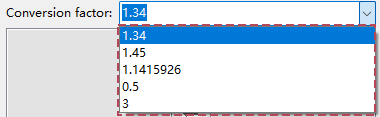
Notes:
- If you want to undo the conversion right away, press Undo (Ctrl+Z).
- The examples above are just a few. With Unit Conversion, you can convert many other measurement units across different categories.
Demo: Convert between various measurement units
Productivity Tools Recommended
Office Tab: Use handy tabs in Microsoft Office, just like Chrome, Firefox, and the new Edge browser. Easily switch between documents with tabs — no more cluttered windows. Know more...
Kutools for Outlook: Kutools for Outlook offers 100+ powerful features for Microsoft Outlook 2010–2024 (and later versions), as well as Microsoft 365, helping you simplify email management and boost productivity. Know more...
Kutools for Excel
Kutools for Excel offers 300+ advanced features to streamline your work in Excel 2010 – 2024 and Microsoft 365. The feature above is just one of many time-saving tools included.

Table of Contents
- Why use Kutools' Unit Conversion feature
- Location of the Unit Conversion tool
- Common Unit Conversion Examples
- Convert degrees to radians without using formula
- Convert meters to feet, inches, miles or yards without using formula
- Convert Celsius to Fahrenheit or Kelvin without using formula
- New: Create a custom conversion factor and reuse recent factors
- Demo: Convert between various measurement units
- The Best Office Productivity Tools
Kutools for Excel
Brings 300+ advanced features to Excel
- 🧩 Overview
- 📥 Free Download
- 🎁 30-Day Free Trial available