Super Filter – Easily Filter Data with Multiple and Complex Criteria in Excel
Filtering data in Excel is easy when you only need to show records that meet one or two simple conditions. However, when your worksheet contains multiple fields and you need to combine several AND and OR conditions, standard filtering can quickly become difficult to build and manage.
Super Filter provides a visual way to create advanced filtering rules without writing formulas or VBA code. You can filter text, numbers, dates, years, months, quarters, error values, and other types of data; combine conditions into groups; enable or disable individual criteria; and save frequently used filter settings as reusable scenarios.
Table of Contents
Understand AND and OR Relationships
Filter Data with a Single Criterion
Filter Data with Multiple AND Criteria
Filter Data with Multiple OR Criteria
Combine AND and OR Conditions with Multiple Criteria Groups
Filter Different Types of Data
- Filter Data by Text Criteria
- Filter Data by Number Criteria
- Filter Data by Date Criteria
- Filter Data by Year, Month, Day, Week, or Quarter
- Filter text by Uppercase or Lowercase
- Filter Data by Error Values
Add, Edit, Enable, Disable, or Delete Filter Criteria
Apply, Filter, and Clear Results
- Create, Open, or Import Filter Scenarios
- Save Filter Scenarios
- Close Filter Scenarios
- Move and Reorder Criteria or Criteria Groups
- Manage filter settings scenarios
- Configure Super Filter Settings
What Is Super Filter?
Super Filter is a filtering tool in Kutools for Excel designed for working with complex filtering conditions.
Unlike a simple filter that focuses primarily on individual columns, Super Filter lets you build a structured set of criteria and control how those criteria relate to one another.
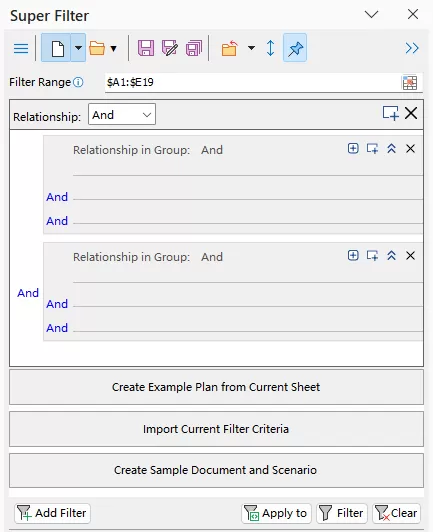
With Super Filter, you can:
- Filter data using one or multiple criteria.
- Combine criteria using AND or OR logic.
- Organize multiple criteria into separate groups.
- Combine AND and OR relationships in the same filter.
- Filter text, numbers, dates, years, months, weeks, quarters, and error values.
- Temporarily enable or disable individual criteria.
- Save complex filter settings for future use.
- Open and manage multiple filter scenarios.
- Import existing filter criteria from the current worksheet.
This makes Super Filter especially useful for large sales lists, order records, customer databases, project tracking sheets, inventory data, financial reports, and other worksheets that require repeated or complex filtering.
Advantages of Super Filter
Super Filter becomes particularly useful when normal Excel filtering begins to feel cumbersome.
1. Build complex criteria visually
Instead of constructing an Advanced Filter criteria table or repeatedly opening column drop-down menus, you can see your filtering conditions directly in the Super Filter pane.
2. Combine AND and OR relationships
You can define relationships between individual criteria as well as relationships between separate criteria groups. This makes it possible to create logic such as:
(Product = Laptop AND Sales > 5000) OR (Region = West AND Profit > 1000)Super Filter supports this type of grouped logic directly in the pane.
3. Filter different types of data
Super Filter provides filter types for text, numbers, dates, date components, text formats, errors, and other specialized conditions.
4. Keep complex conditions visible
The conditions remain displayed in the Super Filter pane while the filter is applied, making it much easier to understand why particular rows are being displayed.
5. Temporarily disable criteria
Individual conditions or condition groups can be disabled instead of deleted, allowing you to test different filtering combinations without rebuilding the rules.
6. Save and reuse complex filters
Frequently used filter criteria can be saved as scenarios and reopened later. Saved scenarios can also be organized and managed from the scenario manager.
Understand AND and OR Relationships
Before creating complex filters, it is important to understand the two levels of logical relationships available in Super Filter:
- Relationship
- Relationship in Group
They control different parts of the filtering logic.
Relationship in Group
Relationship in Group determines how the individual criteria inside one group are combined.
AND
When the relationship is set to And, every criterion in the group must be satisfied.
For example:
AND
Amount > 5000
AND
Deal Status = Open
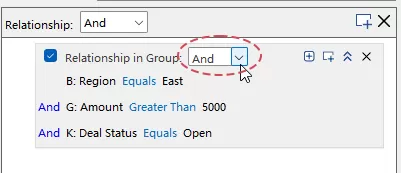
A row is displayed only when all three conditions are true.
OR
When the relationship is set to Or, a row only needs to satisfy one of the criteria in the group.
For example:
OR
Region = West
OR
Region = South
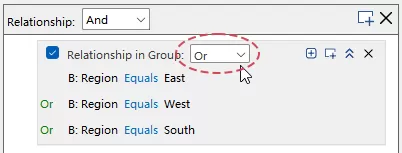
A record from any of these three regions will be included.
Relationship between groups
The Relationship option at the top of Super Filter controls how separate criteria groups are combined.
For example, suppose you have:
Region = East
Group 2
Forecast Category = Commit
OR
Probability > 0.7
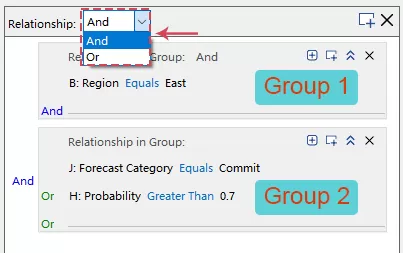
If the relationship between the two groups is And, the complete logic becomes:
AND
(Forecast Category = Commit OR Probability > 0.7)
If the relationship is Or, the logic becomes:
OR
(Forecast Category = Commit OR Probability > 0.7)
Tip:
Relationship in Group controls criteria inside a group, while Relationship controls the logical connection between separate groups.
Filter Data with a Single Criterion
When you only need to display records that meet one specific condition, Super Filter lets you create a simple filter without setting up multiple criteria groups.
For example, suppose you want to display only the orders where the Product is Laptop. You can create a single text criterion and apply it to the data range.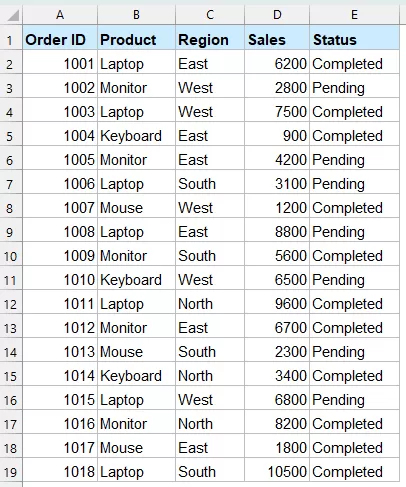
Steps:
- Click Kutools Plus > Super Filter to open the Super Filter pane.

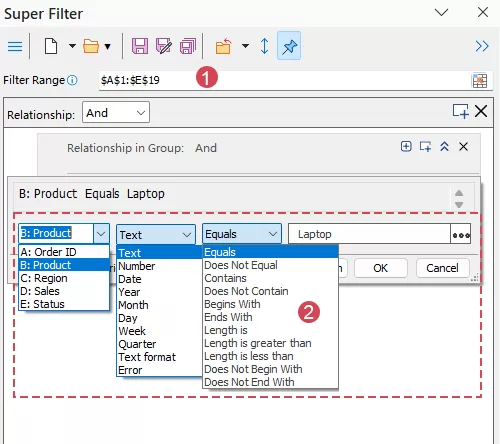
In the Super Filter pane, please configure the following operations:
1) Select the data range you want to filter.
2) Click a blank criterion row in the pane. Then, set the criteria as you need:
- Select Product as the column to filter.
- Choose Text as the filter type.
- Select Equals as the condition.
- Select or enter Laptop as the criterion value.
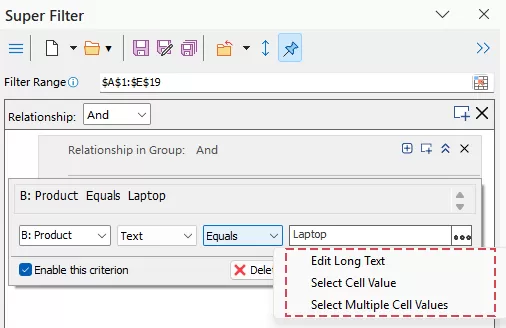
Tip: Three Ways to Specify the Filter Value
- Edit Long Text – Opens a larger text box for entering or editing long text criteria, which is useful when the filter value contains many characters.
- Select Cell Value – Lets you select a single cell from the worksheet and use that cell’s value as the filter criterion.
- Select Multiple Cell Values – Lets you select multiple cells and use their values as multiple filter criteria at once.
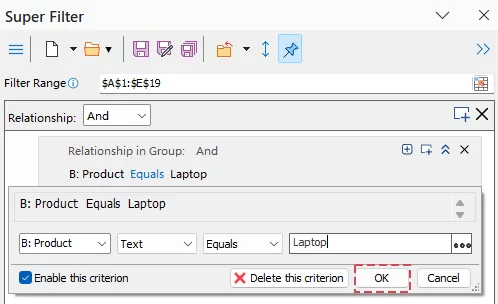
- After setting the criteria, click OK to confirm.
- Then, click the Filter button at the bottom of the pane to apply the criteria.
Result: Only rows where the Product column contains Laptop are displayed, while all other records are temporarily hidden. 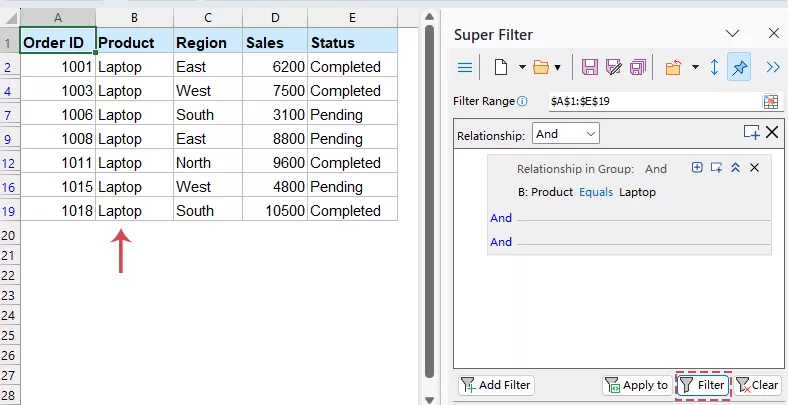
Filter Data with Multiple AND Criteria
When you need to display only the records that meet all specified conditions at the same time, use an AND relationship in Super Filter.
Using an AND relationship is especially useful when you need to narrow a large dataset based on several requirements, such as finding high-value orders for a specific product and region.
For example, suppose you want to find orders where:
- Product is Laptop
- Region is West
- Sales are greater than 5,000
The filter logic is:
Steps:
- Click Kutools Plus > Super Filter to open Super Filter pane, then select the data range you want to filter.
In the Super Filter pane, configure the following criteria:
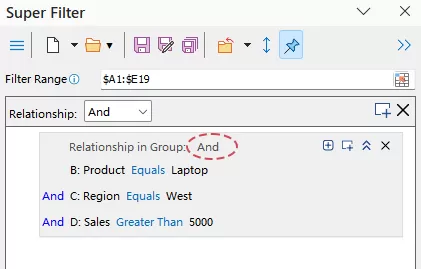
- Set Relationship in Group to And.
- Set the first criterion to Product > Text > Equals > Laptop >OK.
- Add a second criterion and set it to Region > Text > Equals > West >OK.
- Add a third criterion and set it to Sales > Number > Greater Than > 5000 >OK.
- Click the Filter button at the bottom of the pane to apply the criteria.
Result: Super Filter displays only the rows that satisfy all three conditions. Any record that fails even one of the criteria is excluded from the filtered results. 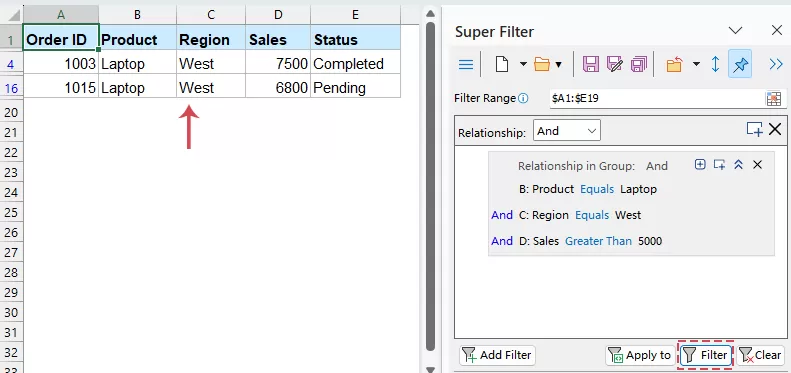
Filter Data with Multiple OR Criteria
When you want to display records that meet any one of several conditions, use an OR relationship in Super Filter. Unlike AND filtering, where every condition must be satisfied, OR filtering keeps a row as long as at least one specified condition is true.
Using an OR relationship is useful when several different values or conditions are acceptable, such as filtering multiple regions, products, statuses, or sales thresholds.
For example, suppose you want to display orders where:
- Region is East
- OR Region is West
- OR Sales are greater than 8,000
The filter logic is:
Steps:
- Click Kutools Plus > Super Filter to open Super Filter pane, then select the data range you want to filter.
In the Super Filter pane, configure the following criteria:
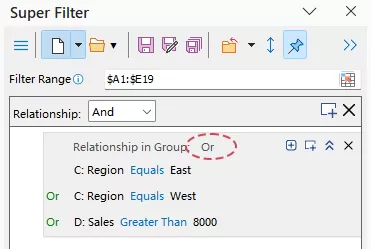
- Set Relationship in Group to Or.
- Set the first criterion to Region > Text > Equals > East > OK.
- Add a second criterion and set it to Region > Text > Equals > West > OK.
- Add a third criterion and set it to Sales > Number > Greater Than > 8000 > OK.
- Click the Filter button at the bottom of the pane to apply the criteria.
Result: Super Filter displays any row that matches at least one of the three conditions. For example, an order from the East or West region will be included even if its sales are below 8,000, while an order from another region will still be displayed if its sales exceed 8,000. 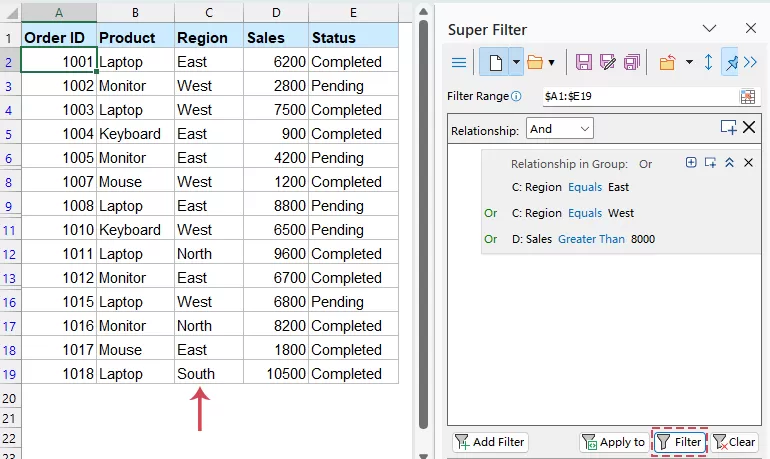
Combine AND and OR Conditions with Multiple Criteria Groups
For more complex filtering tasks, Super Filter allows you to create multiple criteria groups and combine them with both AND and OR relationships. This is useful when one set of conditions must all be met, while another alternative set can also qualify.
For example, suppose you want to display orders that meet either of the following requirements:
- Product = Laptop AND Sales > 5000
- OR Product = Monitor AND Region = East
The complete filter logic is:
Steps:
- Click Kutools Plus > Super Filter to open Super Filter pane, then select the data range you want to filter.
In the Super Filter pane, configure the following criteria:
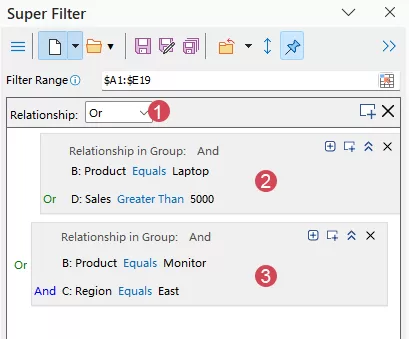
1) Set the relationship between the two criteria groups to Or.
2) Configure the first criteria group:
- Set Relationship in Group to And.
- Set the first criterion to Product > Text > Equals > Laptop > OK.
- Add a second criterion and set it to Sales > Number > Greater Than > 5000 > OK.
3) Add a second criteria group and configure it as follows:
- Set Relationship in Group to And.
- Set the first criterion to Product > Text > Equals > Monitor > OK.
- Add a second criterion and set it to Region > Text > Equals > East > OK.
- Click the Filter button at the bottom of the pane to apply the criteria.
Result: Super Filter displays rows that satisfy all conditions in the first group or all conditions in the second group. A row does not need to meet both groups—matching either complete group is enough. 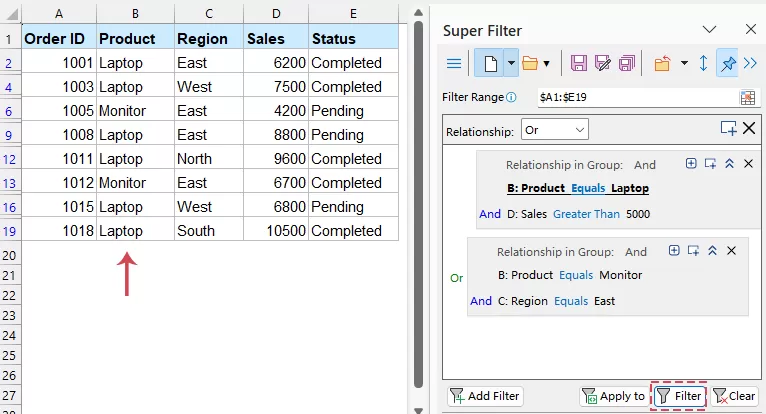
Filter Different Types of Data
Super Filter is not limited to basic text and number filtering. Different filter types are available depending on the type of data and condition you need to evaluate.
Filter Data by Text Criteria
For text columns, you can build criteria based on the text contained in each cell. Depending on the selected criterion, text filtering can include options such as:
- Equals
- Does Not Equal
- Contains
- Does Not Contain
- Begins With
- Ends With
- Length is
- Length is greater than
- Length is less than
- Does Not Begin With
- Does Not End With
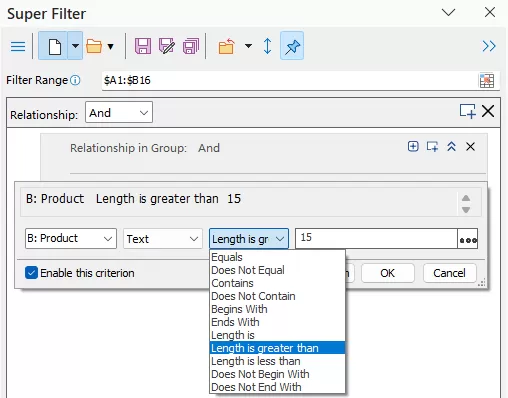
For example, if you want to filter rows based on the text length in a column, for example, you can display only rows where the text contains more than 15 characters.
Steps:
- Click Kutools Plus > Super Filter to open the Super Filter pane.
In the Super Filter pane, please configure the following operations:
1) Select the data range you want to filter.
2) Click a blank criterion row in the pane. Then, set the criteria as you need:
- Select Product as the column to filter.
- Choose Text as the filter type.
- Select Length is greater than as the condition.
- Enter 15 as the criterion value.
- Click OK to confirm the criterion.
- Click the Filter button at the bottom of the pane.
Result: Only rows where the selected column contains text longer than 15 characters are displayed. 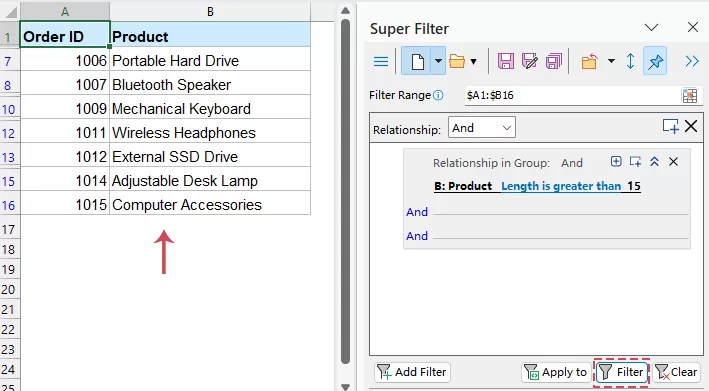
Filter Data by Number Criteria
For numeric columns, Super Filter allows you to filter records according to specific values, ranges, or comparison conditions. This is useful when you need to find values that are higher or lower than a threshold, equal to a particular number, or within a specified range.
Depending on the selected criterion, number filtering can include options such as:
- Equals
- Does Not Equal
- Greater Than
- Greater Than or Equal To
- Less Than
- Less Than or Equal To
For example, if you want to display only orders with Sales greater than 5,000, please do as this:
Steps:
- Click Kutools Plus > Super Filter to open the Super Filter pane.
In the Super Filter pane, please configure the following operations:
1) Select the data range you want to filter.
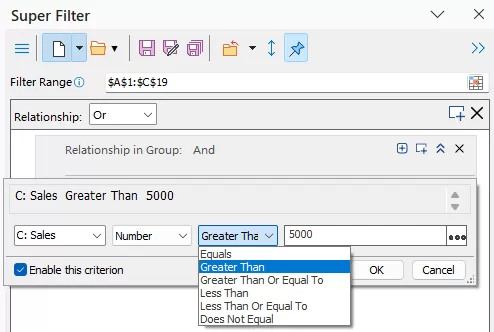
2) Click a blank criterion row in the pane. Then, set the criteria as you need:
- Select Sales as the column to filter.
- Choose Number as the filter type.
- Select greater than as the condition.
- Enter 5000 as the criterion value.
- Click OK to confirm the criterion.
- Click the Filter button at the bottom of the pane.
Result: Only rows where the Sales value is greater than 5,000 are displayed. 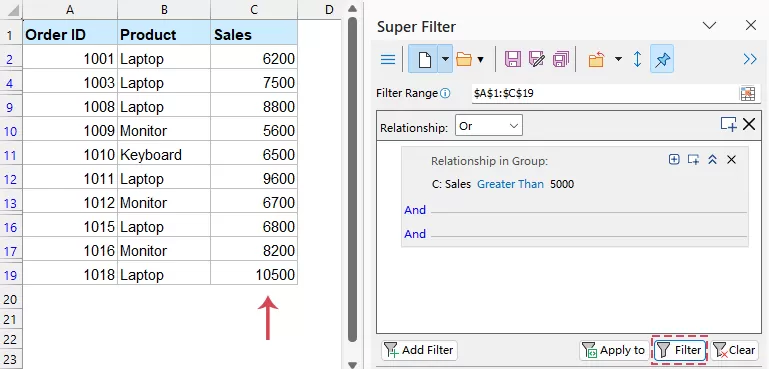
Tip: You can also combine numeric criteria across several columns.
For example:
This type of multi-column numeric filtering is easier to construct visually with Super Filter than by repeatedly configuring separate standard filter menus.
Filter Data by Date Criteria
For date columns, Super Filter allows you to filter records based on a specific date or a date range. This is useful when you need to find orders placed before or after a certain date, records that fall within a particular period, or entries that match an exact date.
Depending on the selected criterion, date filtering can include options such as:
- Equals
- Does Not Equal
- Greater Than
- Greater Than or Equal To
- Less Than
- Less Than or Equal To
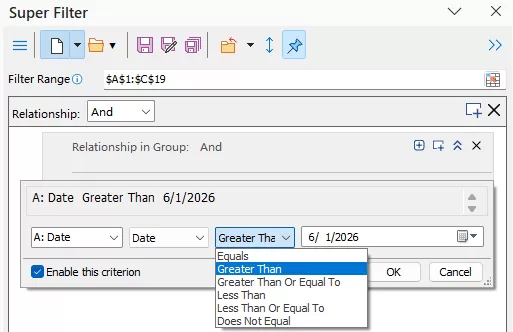
For example, if you want to display only orders placed after Jun 1, 2026, please do as this:
Steps:
- Click Kutools Plus > Super Filter to open the Super Filter pane.
In the Super Filter pane, please configure the following operations:
1) Select the data range you want to filter.
2) Click a blank criterion row in the pane. Then, set the criteria as you need:
- Select Date as the column to filter.
- Choose Date as the filter type.
- Select greater than as the condition.
- Enter 6/1/2026 as the criterion value.
- Click OK to confirm the criterion.
- Click the Filter button at the bottom of the pane.
Result: Only rows with an Order Date later than Jun 1, 2026 are displayed. 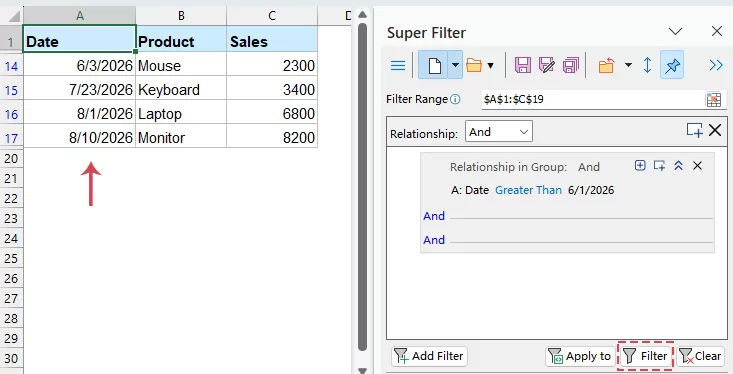
Filter Data by Year, Month, Day, Week, or Quarter
When your worksheet contains full date values but you only need to filter by a specific part of the date, Super Filter allows you to filter records by Year, Month, Day, Week, or Quarter.
This is especially useful for analyzing data by reporting period without creating helper columns to extract the year, month, or quarter.
Suppose you want to display only orders that fall in the second quarter of the year.
Steps:
- Click Kutools Plus > Super Filter to open the Super Filter pane.
In the Super Filter pane, please configure the following operations:
1) Select the data range you want to filter.
2) Click a blank criterion row in the pane. Then, set the criteria as you need:
- Select Date as the column to filter.
- Choose Quarter as the filter type.
- Select Equals as the condition.
- Enter 2 as the criterion value.
- Click OK to confirm the criterion.
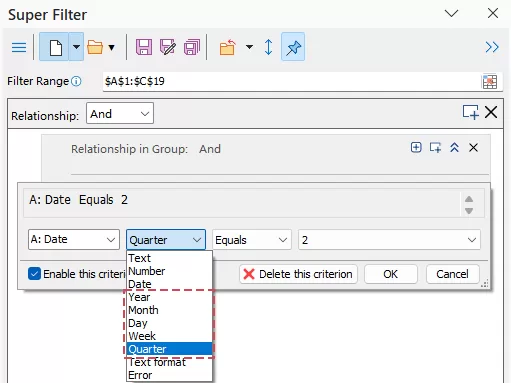
- Click the Filter button at the bottom of the pane.
Result: Only records with dates that fall in Quarter 2 are displayed. 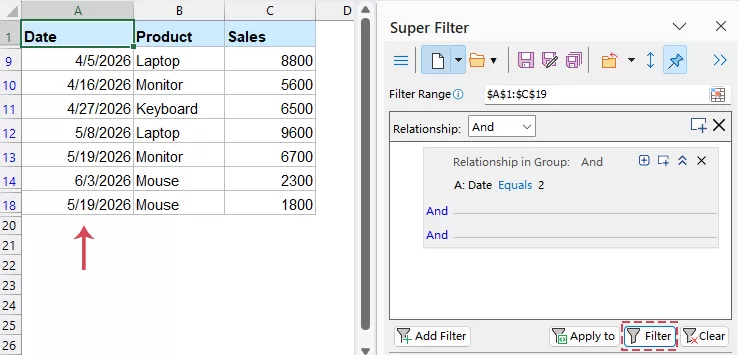
Tip: You can apply the same method to filter by Year, Month, Day, or Week. For example, choose Month = 7 to display records from July, or Year = 2026 to show only records from 2026.
Filter Text by Uppercase or Lowercase
Super Filter can also filter text based on letter case, making it easy to identify cells that contain uppercase or lowercase characters. This is useful for checking product codes, IDs, abbreviations, names, or other text that should follow a consistent capitalization format.
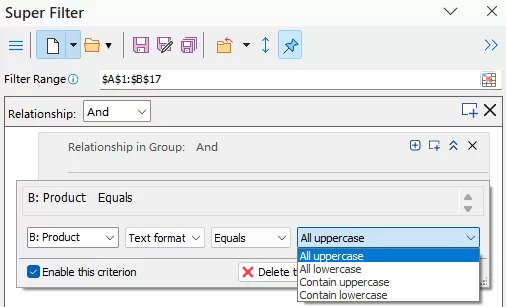
When you select Text format as the filter type, the following options are available:
- All uppercase – Displays cells in which all letters are uppercase, such as LAPTOP or ABC123.
- All lowercase – Displays cells in which all letters are lowercase, such as laptop or abc123.
- Contain uppercase – Displays cells containing at least one uppercase letter, such as Laptop, ABC123, or ProMax.
- Contain lowercase – Displays cells containing at least one lowercase letter, such as Laptop, abc123, or ProMax.
For example, to filter cells containing all uppercase text, please do as this:
Steps:
- Click Kutools Plus > Super Filter to open the Super Filter pane.
In the Super Filter pane, please configure the following operations:
1) Select the data range you want to filter.
2) Click a blank criterion row in the pane. Then, set the criteria as you need:
- Select Date as the column to filter.
- Choose Quarter as the filter type.
- Select Equals as the condition.
- Enter 2 as the criterion value.
- Click OK to confirm the criterion.
- Click the Filter button at the bottom of the pane.
Result: Only rows where the Product value is written entirely in uppercase are displayed. 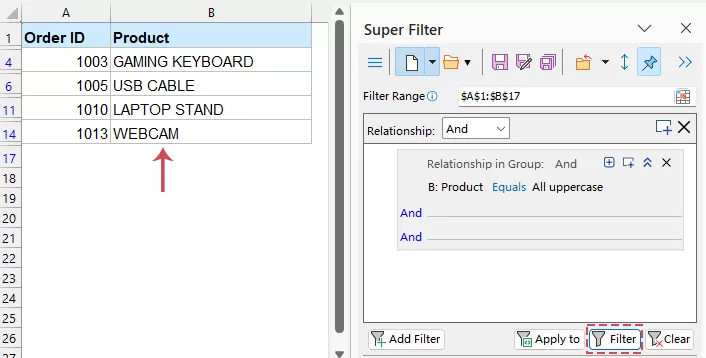
Filter Data by Error Values
When a worksheet contains formulas, some cells may return error values such as #N/A, #VALUE!, #DIV/0!, or #REF!. Super Filter can help you quickly isolate rows containing these errors, making it easier to locate and troubleshoot formula problems in large datasets.
For example, to filter rows containing all error or specific error values. Please do as this:
Steps:
- Click Kutools Plus > Super Filter to open the Super Filter pane.
In the Super Filter pane, please configure the following operations:
1) Select the data range you want to filter.
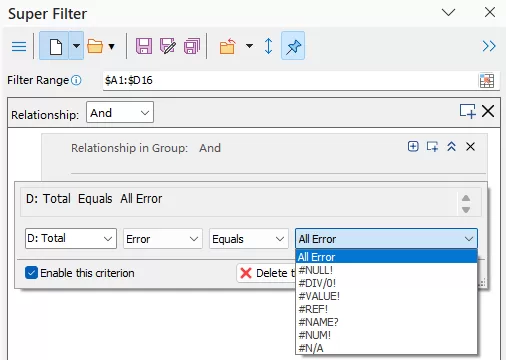
2) Click a blank criterion row in the pane. Then, set the criteria as you need:
- Select Total as the column to filter.
- Choose Error as the filter type.
- Select Equals as the condition.
- Select the required error type to filter out, here, I will choose All Error.
- Click OK to confirm the criterion.
- Click the Filter button at the bottom of the pane.
Result: All rows containing all error values in the Total column are displayed. 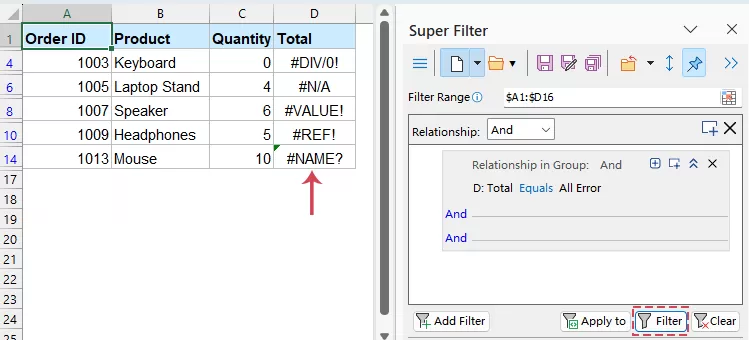
Add, Edit, Enable, Disable, or Delete Filter Criteria
After creating filter criteria in Super Filter, you can easily modify them without rebuilding the entire filter. Individual criteria can be added, edited, temporarily enabled or disabled, or deleted as your filtering requirements change.
Add a new criterion
Add Criterion
Adds a new filter criterion to the current criteria group. The new criterion is added to the current group and follows the AND or OR relationship defined for that group. 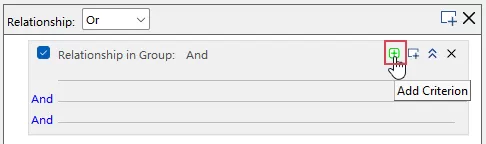
Add Criteria Group
The Add Criteria Group option adds a new nested criteria group within the current group, rather than adding a single filter condition.
Click Add Criteria Group creates a separate group highlighted in blue. This new group has its own Relationship in Group setting, so you can define an independent AND or OR relationship for the criteria inside it. 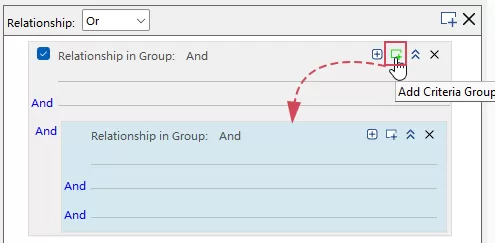
Tip: Super Filter supports up to three levels of nested criteria groups, allowing you to build more complex AND/OR filtering logic while keeping the conditions clearly organized. 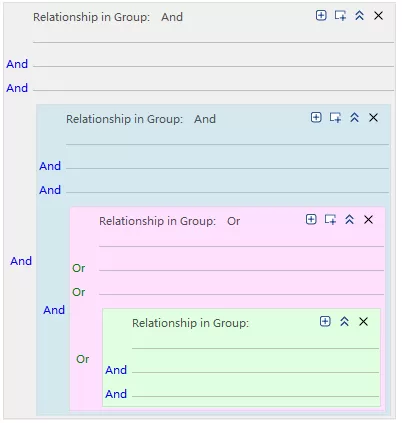
Edit an Existing Criterion
If you need to change a filter condition, simply select the existing criterion and modify its settings.
You can also change the selected column, filter type, comparison operator, or criterion value. After editing the condition, click OK to save the changes, and then click Filter again to refresh the results.
Enable or Disable a Criterion
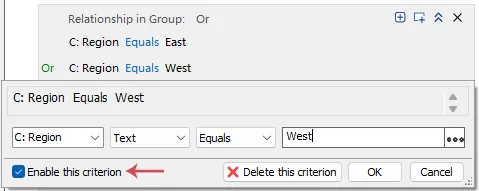
Each criterion includes an Enable this criterion option.
- Keep the option selected to include the criterion in the filter.
- Clear the option to temporarily exclude the criterion without deleting it.
Delete a Criterion or Criteria Group
If a filter condition is no longer needed, you can remove either an individual criterion or an entire criteria group.
Delete a criterion: Select the criterion you want to remove, and then click Delete this criterion. 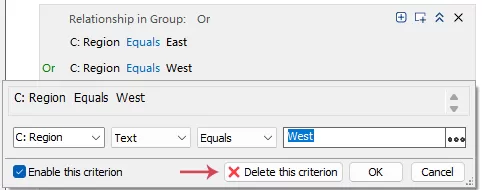
Delete a criteria group: Click the X button in the upper-right corner of the group to remove the entire group and all criteria contained within it. 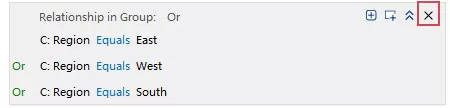
Deleting a criteria group also removes all nested criteria and subgroups inside that group, so make sure they are no longer needed before deleting it.
Apply, Filter, and Clear Results
After configuring the filter criteria, use the buttons at the bottom of the Super Filter pane to control where the filter settings apply, run the filter, or restore the original data.
Apply to
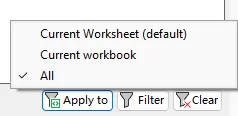
Click Apply to to specify the scope in which the current filter settings can be applied. Super Filter provides three options:
- Current Worksheet (default) – Applies the filter settings to the current worksheet only.
- Current workbook – Makes the filter settings applicable within the current workbook.
- All – Allows the filter settings to be applied more broadly across available workbooks.
Filter
After the criteria and application scope are set, click Filter to apply the current conditions to the selected data range.
Clear
Click Clear to cancel the current filtering result and restore the complete data range. The configured criteria remain available in the Super Filter pane, so you can modify them and apply the filter again if needed.
Manage Super Filter Scenarios
A complex filter may contain many criteria and groups. Rather than rebuilding the same filter repeatedly, Super Filter provides scenario-management tools for creating, opening, saving, and managing filter settings.
Create, Open, or Import Filter Scenarios
Create or Import Filter Scenarios
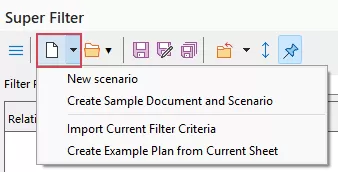
- New scenario – Creates a new blank filter scenario. Use this option when you want to build a new set of filter criteria from scratch. If unsaved filter settings already exist, Super Filter may prompt you before replacing them.
- Create Sample Document and Scenario – Creates a sample worksheet together with a predefined filter scenario, helping you quickly understand how Super Filter criteria and groups work.
- Import Current Filter Criteria – Imports the filter criteria currently applied to the active worksheet using Excel’s built-in Filter feature and converts them into a Super Filter scenario, so you can review, modify, and reuse the criteria in Super Filter.
- Create Example Plan from Current Sheet – Creates an example filter plan based on the data in the current worksheet. This is useful for learning how Super Filter can be configured for your existing data structure.
Open saved filter settings scenario
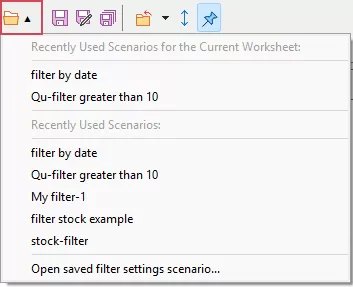
Click the Open saved filter settings scenario drop-down to quickly reopen and reuse previously saved filter scenarios.
- Recently Used Scenarios for the Current Worksheet – Displays filter scenarios recently used in the active worksheet, making it faster to reopen filters related to the current data.
- Recently Used Scenarios – Displays recently used filter scenarios from other worksheets or workbooks as well.
- Open saved filter settings scenario... – Opens the scenario selection window, where you can browse and open any saved Super Filter scenario. After opening a saved scenario, its filter criteria are loaded into the Super Filter pane, where you can review, modify, and apply them again.
Save Filter Scenarios
Super Filter provides three options for saving filter scenarios, depending on whether you want to update the current scenario, create a copy, or save all available scenarios. 
Save Current Filter Settings: Saves the current filter criteria and updates the active scenario with the latest changes.
Current Filter Settings Save As: Saves the current filter settings as a new scenario. This is useful when you want to keep the original scenario and create another version with different criteria.
Save All Scenarios: Saves all currently available Super Filter scenarios at once, helping ensure that changes made to multiple scenarios are preserved.
Close Filter Scenarios
When you finish working with a filter scenario, Super Filter provides two options for closing scenarios: 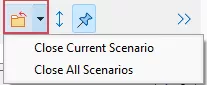
- Close Current Scenario – Closes only the currently active filter scenario. Other opened scenarios remain available.
- Close All Scenarios – Closes all currently opened Super Filter scenarios at once.
If a scenario contains unsaved changes, Super Filter may prompt you to save them before closing.
Tip: Closing a scenario does not delete it. Saved scenarios can be reopened later from the Open saved filter settings scenario menu.
Move and Reorder Criteria or Criteria Groups
Use Move Criterion/Criteria Group to reorganize the order of existing filter conditions without recreating them.
Click the  icon at the top of the Super Filter pane. In the dialog box, select a criterion or criteria group, and then either drag it to the desired position or right-click it to move it up or down. Click OK to apply the new order.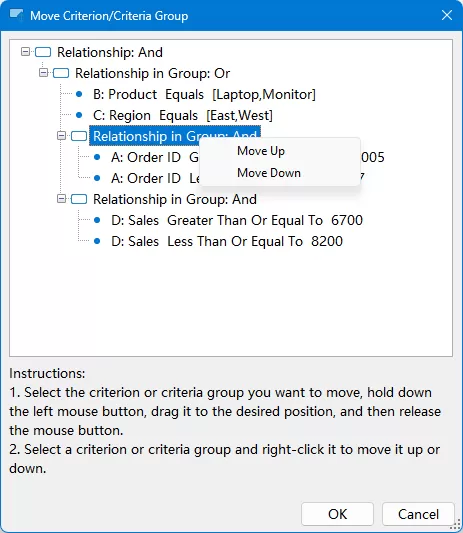
Manage filter settings scenarios
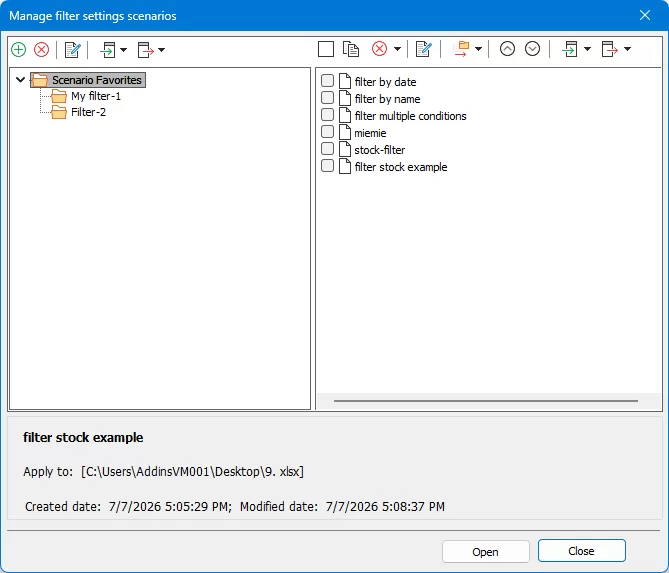
Use Manage filter settings scenarios to organize and maintain your saved Super Filter scenarios in one place. Click the Menu icon at the top of the Super Filter pane, and choose Manage filter settings scenarios. 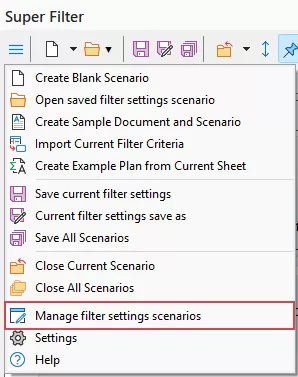
In the Manage filter settings scenarios window:
- The left pane displays scenario folders, such as Scenario Favorites, where you can create folders to organize related scenarios.
- The right pane lists the saved filter scenarios in the selected folder.
- Use the toolbar commands to add, delete, rename, move, import, export, or otherwise organize scenario folders and saved scenarios.
- Select a scenario to view its details at the bottom of the dialog box, including its Apply to range, created date, and modified date.
- Select a scenario and click Open to load it into Super Filter for further use or editing.
Configure Super Filter Settings
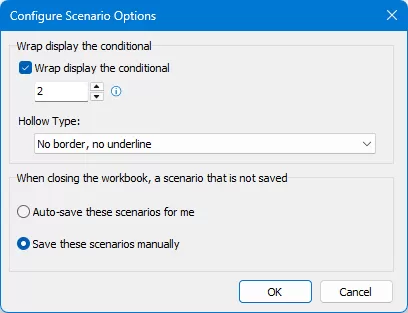
Use Configure Scenario Options to customize how filter criteria are displayed in the Super Filter pane and how unsaved scenarios are handled when you close a workbook. Click Settings from the Menu icon at the top of the Super Filter pane.
The dialog box includes the following options:
- Wrap display the conditional – Enables wrapped display for long or complex filter criteria. Use the number box to specify how many lines are used to display the conditions, helping keep lengthy criteria easier to read.
- Hollow Type – Specifies the visual style used when displaying wrapped criteria, such as No border, no underline or Underline.
- Auto-save these scenarios for me – Automatically saves unsaved Super Filter scenarios when the workbook is closed.
- Save these scenarios manually – Does not save them automatically. You can decide whether to save the scenarios yourself before closing the workbook.
Super Filter vs Excel Built-in Filter
Excel's built-in filtering tools are suitable for many everyday tasks, while Super Filter is particularly useful when the filtering logic becomes more complicated.
| Feature | Excel Built-in Filter | Super Filter |
|---|---|---|
| Simple text, number, and date filtering | Yes | Yes |
| Filter multiple columns | Yes | Yes |
| Combine multiple AND/OR conditions | Limited | Yes |
| Create nested criteria groups | No | Yes, up to three levels |
| Keep all criteria visible in one pane | No | Yes |
| Filter by text length | Limited | Yes |
| Filter by uppercase or lowercase text | No direct option | Yes |
| Filter by year, month, day, week, or quarter | Partially supported | Yes |
| Filter error values | Limited | Yes |
| Enable or disable individual criteria | No | Yes |
| Move and reorganize criteria | No | Yes |
| Save filter settings as scenarios | No | Yes |
| Reuse saved filter scenarios | No | Yes |
| Import existing Excel filter criteria | Not applicable | Yes |
| Best for | Quick and simple filtering | Multiple, complex, or reusable filtering tasks |
For simple filters such as displaying one category or filtering a single numeric range, Excel's built-in filter is usually sufficient.
When you frequently work with several conditions, mixed AND/OR relationships, or reusable filtering configurations, Super Filter provides a more structured approach.
Tips for Using Super Filter
 button at the top of the Super Filter pane to control whether the pane stays fixed beside the worksheet.
Frequently Asked Questions (FAQs)
Relationship controls how separate criteria groups are connected.
Relationship in Group controls how individual criteria inside one group are connected.
For example:
AND
Group 2:
Forecast Category = Commit
OR
Probability > 0.7
Here, AND connects the groups, while OR connects the criteria inside Group 2.
Yes. Open the criterion and clear Enable this criterion. The criterion remains in the configuration but is ignored until you enable it again.
Check the following:
- The correct Filter Range is selected.
- AND and OR relationships are configured correctly.
- The correct data type is selected.
- The criterion value is entered correctly.
- Numeric values are stored as numbers.
- Date values are recognized as valid Excel dates.
- Required criteria are enabled.
A single incorrect AND condition can eliminate every row from the result.
Yes. Criteria can be created for different columns and combined using AND or OR relationships. For example:
Yes. Frequently used Super Filter settings can be saved as filter scenarios, allowing you to reopen and reuse the same filtering configuration without rebuilding all the criteria.
Yes. One advantage of Super Filter is that the criteria remain visible in the pane, making it easier to review the conditions currently being used.
Clearing the filtering result and deleting criteria are different operations. Use Clear when you want to remove the current filtering effect. Delete a criterion only when you no longer want that condition in the filter configuration.
Conclusion
Super Filter provides a flexible way to handle both simple and complex filtering tasks in Excel. You can filter text, numbers, dates, date components, text formats, and error values, while combining multiple criteria with AND and OR relationships.
For more advanced requirements, criteria groups make it easier to organize nested conditions, and individual rules can be added, edited, disabled, moved, or deleted as needed. Frequently used filter settings can also be saved as scenarios, reopened later, and managed from one place.
Compared with Excel’s built-in Filter, Super Filter is especially useful when you need to work with multiple conditions, complex AND/OR logic, specialized filter types, or reusable filter scenarios. By keeping the criteria visible and manageable in the Super Filter pane, you can build, review, and reuse advanced filters more efficiently.
Best Office Productivity Tools
Supercharge Your Excel Skills with Kutools for Excel, and Experience Efficiency Like Never Before. Kutools for Excel Offers Over 300 Advanced Features to Boost Productivity and Save Time. Click Here to Get The Feature You Need The Most...
Office Tab Brings Tabbed interface to Office, and Make Your Work Much Easier
- Enable tabbed editing and reading in Word, Excel, PowerPoint, Publisher, Access, Visio and Project.
- Open and create multiple documents in new tabs of the same window, rather than in new windows.
- Increases your productivity by 50%, and reduces hundreds of mouse clicks for you every day!
All Kutools add-ins. One installer
Kutools for Office suite bundles add-ins for Excel, Word, Outlook & PowerPoint plus Office Tab Pro, which is ideal for teams working across Office apps.





- All-in-one suite — Excel, Word, Outlook & PowerPoint add-ins + Office Tab Pro
- One installer, one license — set up in minutes (MSI-ready)
- Works better together — streamlined productivity across Office apps
- 30-day full-featured trial — no registration, no credit card
- Best value — save vs buying individual add-in