Excel: How to expand a cell to show all contents when clicking
In day-to-day Excel work, it's common to encounter cells that contain information exceeding the cell's visible width, especially when adjacent cells also contain data. As illustrated in the screenshot below, the long text is partially hidden, making it difficult to view the complete content in the worksheet directly. For users who prefer not to adjust cell widths or row heights — perhaps to maintain a specific table design — the usual workaround is to click the cell and read its full contents in the formula bar.
However, if the formula bar is set to a limited height or is not displayed, viewing the entire cell content becomes a challenge. This is a typical issue for users needing to review or copy long entries efficiently without rearranging their worksheet layout. Below, you will find several practical solutions to display the entire contents of a cell upon clicking or hovering, without altering cell size. Each method offers a different approach, from built-in Excel features to VBA and useful add-ins, allowing you to choose according to your workflow and Excel version.

Expand the cell to show all contents by inserting a textbox Active X Controls
Expand the cell to show all contents by using the Bigger Formula Bar of Kutools for Excel
Excel Formula: Use helper cell formulas to display expanded cell content
Other Built-in Excel Methods: Use Wrap Text to show all cell contents
Other Built-in Excel Methods: Use comments or notes to view full cell contents on hover
Note: The approaches demonstrated here use Excel 2021 for reference; minor interface or functionality differences may appear in other Excel versions. Please check your Excel version’s feature set before proceeding with each solution.
Method Comparison
| Method | Difficulty | Speed | Best For | Recommended |
|---|---|---|---|---|
| ActiveX Text Box + VBA | Advanced | ⭐⭐⭐ | Displaying full cell contents dynamically when a cell is selected | Best for VBA users |
| Kutools – Bigger Formula Bar | Very Easy | ⭐⭐⭐⭐⭐ | Viewing and editing long cell contents without changing worksheet layout | ⭐ Best overall |
| Helper Formula | Moderate | ⭐⭐⭐ | Displaying cell contents in a separate helper area | Useful for simple worksheets |
| Wrap Text | Easy | ⭐⭐⭐⭐ | Showing all text directly in the cell | Good when row height can change |
| Comments / Notes | Easy | ⭐⭐⭐ | Viewing additional information on hover | Suitable for annotations |
This method allows the complete contents of a selected cell to appear immediately in a floating textbox next to the cell, whenever you click it. It's suitable for users comfortable with basic VBA and ActiveX controls, and useful when you want dynamic, clickable expansion without changing your worksheet’s layout.
1. Activate the worksheet where you want to be able to expand cell content. Click Developer > Insert > Text Box (ActiveX Controls).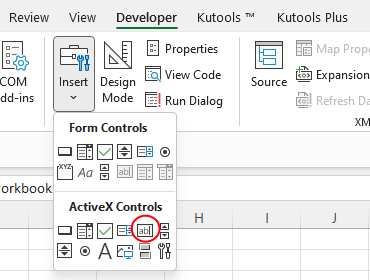
Tip: If you do not see the Developer tab on your Ribbon, you can enable it by following the steps in: How To Show/Display Developer Tab In Excel Ribbon
2. Next, drag to draw a textbox on your worksheet that’s wide and tall enough to accommodate the longest expected cell entry. Be sure to remember the name assigned to this textbox (the default is TextBox1 unless changed in Properties).
3. Right-click the textbox and select Properties from the context menu. In the Properties pane, set MultiLine and WordWrap to True by choosing them from the dropdown lists. This ensures that long text wraps within the box and displays across multiple lines. >>>
>>> 
Alternatively, you may set AutoSize to True as well. Doing so lets the textbox automatically adjust its size according to the content length, helping avoid unnecessary blank space while always fitting the full text.
4. Right-click the sheet name tab at the bottom of Excel and select View Code from the menu to open the worksheet’s VBA code window.
5. Enter the following VBA script into the code window. This code makes the textbox appear next to the selected cell, displaying its full contents. The textbox only appears when you click within the specified cell range, which you can adjust as needed.
VBA: Expand cell to show contents
Private Sub Worksheet_SelectionChange(ByVal Target As Range)
'UpdatebyExtendoffice
Dim xRgAddress As String
xRgAddress = "A1:B4" 'the range this VBA work, if you leave it is blank, it work for whole sheet
If xRgAddress = "" Then
  With TextBox1
        .Top = Target.Top
        .Left = Target.Offset(, 1).Left
        .Text = Target.Text
        .Visible = True
    End With
Else
    If Intersect(Target, Range(xRgAddress)) Is Nothing Then
        TextBox1.Visible = False
    Else
        With TextBox1
            .Top = Target.Top
           .Left = Target.Offset(, 1).Left
            .Text = Target.Text
            .Visible = True
        End With
    End If
End If
End Sub
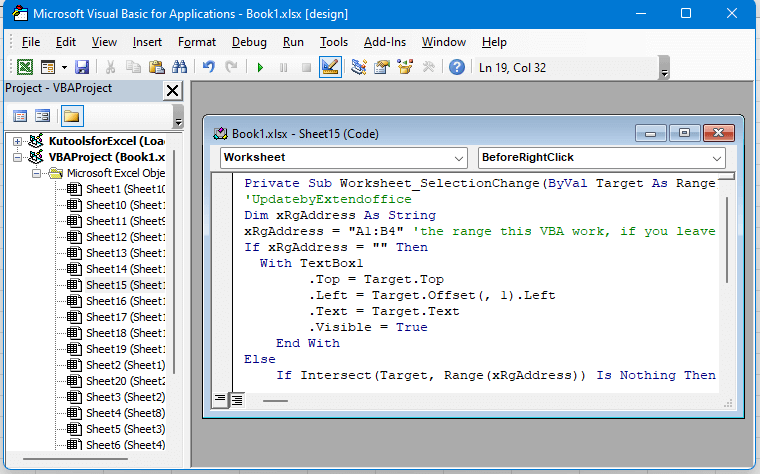
Important: TextBox1 in the above code refers to the name of the textbox you just created. Update A1:B4 to the range where you want this feature active, or set it blank to apply to the whole sheet. Verify the textbox name in the properties pane for accuracy.
6. Return to your worksheet and exit Design Mode by clicking Developer > Design Mode (make sure it's unselected).
Now, whenever you click on a cell within the defined range, the textbox will automatically display the full contents next to the cell.
Additional Tips:
- This solution is practical when you wish to view or copy entire cell contents quickly, but it requires that macros be enabled in your workbook for the code to function.
- Remember, changes made through VBA and ActiveX controls may not display as intended on Excel for web or mobile versions.
- If you experience errors, double-check your textbox name and the defined range for typographical mistakes.
If you have Kutools for Excel installed, you can use its Bigger Formula Bar feature to instantly view all contents of any cell you click, displayed in a resizable pop-up box. This saves time and avoids any change to your worksheet structure, making cell reading and editing especially convenient for long or complex formulas or entries.

Tips:
1. The Bigger Formula Bar doesn't just display the current cell’s contents; you can also edit the content directly within the pop-up, and all changes will be applied to the cell in the worksheet.
2. The bar is resizable — drag the bottom right corner to make it wider or taller based on your viewing preference.
3. When selecting multiple cells, only the content of the first selected cell is shown in the Bigger Formula Bar.
For more details about the Bigger Formula Bar and its additional functionalities, please consult this tutorial.
This solution uses Excel formulas in a separate helper cell to reconstruct and reveal the entire content of a target cell, regardless of length. It is especially suitable for displaying, printing, or exporting complete cell information, and can help in reviewing or sharing data without relying on the formula bar or altering the worksheet’s design.
Common formulas for combining, displaying, or wrapping cell content:
1. Suppose your long text is in cell A2. Enter this formula in an adjacent cell, such as B2:
=A2This simply displays the same content, allowing you to adjust the width or format as needed. For extra-long entries, apply Excel’s Wrap Text formatting to this helper cell to enable full display on multiple lines.
To apply text wrapping: Click the helper cell, then click Home > Wrap Text on the ribbon.
If you need to combine multiple cells:
=CONCATENATE(A2," ",B2," ",C2)Or, in newer Excel versions, use the more flexible TEXTJOIN function:
=TEXTJOIN(" ",TRUE,A2:C2)- TEXTJOIN lets you join ranges or arrays with a specified delimiter, and the TRUE parameter skips blank cells.
- After entering the above formula in your desired cell (e.g., D2), press Enter. If you wish to apply this logic to a list, drag the fill handle down from your helper cell.
Practical Tips:
- Always check that any referenced cells are not empty, to avoid unnecessary blank spaces appearing in the final output.
- Formatting the helper cell with Wrap Text preserves all content visibility despite cell width.
- If your formula does not display all content, verify you have set row height to auto-adjust or manually increase it for full visibility.
Troubleshooting:
If your formula does not display all the text, ensure:
- The helper cell’s column is wide enough, or Wrap Text is enabled.
- Your worksheet is not set to restrict row heights or has been modified in a way that blocks multi-line display.
Excel’s built-in Wrap Text feature allows users to display complete cell contents in place by wrapping long text onto multiple lines within the same cell. This method is suitable if you’re able to adjust row height, and you want a native, quick solution without VBA or add-ins.
Operation steps:
- Select the cell or range of cells containing long text.
- Go to the Home tab on the Ribbon, then click Wrap Text in the Alignment group.
- Excel will automatically adjust the cell to show all contents over multiple lines. If necessary, increase the row height manually for optimal visibility.
Pros:
- Fast and uses standard Excel functionality; works in all modern Excel versions.
- No coding or external tools required.
- Requires row height adjustment, which can impact worksheet formatting.
- Not suitable if you wish to keep row height fixed for layout reasons.
Another built-in feature in Excel is the ability to add comments or notes to a cell. By placing the full content of the cell into its comment or note, you can view the complete text by hovering your mouse or clicking the comment icon. This method is especially useful for long explanations or annotations that need to be displayed without affecting the worksheet’s structure.
Operation steps:
- Right-click the cell containing long contents.
- Choose Insert Comment (or New Note in Excel 2016 and later).
- Paste the full text from the cell into the comment or note box.
- Click outside the box to save. The comment indicator appears in the corner of the cell.
- To view, simply hover over or click the comment indicator; the complete text will be displayed in a pop-up.
Notes:
- This method is suitable for occasional use and for content you may want to annotate separately.
- Comments and notes persist regardless of cell dimensions, but do not alter worksheet printing unless "print comments" is enabled in the settings.
Tips for optimal usage:
- Use comments/notes when sharing annotated data with others for review or explanation.
- If you need to extract comments or notes for summary or reporting, Excel allows exporting them via the "Review" tab under "Show All Comments".
Summary Advice:
- If your worksheet is frequently updated or shared, methods that avoid VBA or add-ins (such as formulas or built-in features) will minimize compatibility issues.
- For persistent visibility, helper cell formulas and Wrap Text are best, provided you can adjust cell dimensions. For instant expansion while clicking, consider ActiveX control or the Bigger Formula Bar with Kutools.
- Be mindful of worksheet design and printing needs; comments/notes do not print by default unless specifically enabled.
- If you experience problems after implementing any method (e.g., text still cut off, pop-ups not working), review cell formatting, software add-in status, or macro security settings.
- Always save your workbook to preserve formatting and control changes, especially if using VBA or custom features.
Other Operations (Articles)
How To Turn Off Auto Complete
Here is an option in Excel that can stop the auto complete.
How To Reduce Excel File Size?
Sometimes, it will take minutes to open or save if the Excel file is too large. For solving this problem, here in this tutorial, it tells you how to reduce the Excel file size by removing the contents or formats which are unnecessary or never used.
How To Auto Complete Cells From Another Table
In this tutorial, it is talking about how to auto complete other column cells from a table in another sheet after entering one column value.
How to apply shading to odd or even (alternative) rows/columns in Excel?
While designing a worksheet, many people tend to apply shading to odd or even (alternative) rows or columns in order to make the worksheet more visual. This article will show you two methods to apply shading to odd or even rows/columns in Excel.
Best Office Productivity Tools
Supercharge Your Excel Skills with Kutools for Excel, and Experience Efficiency Like Never Before. Kutools for Excel Offers Over 300 Advanced Features to Boost Productivity and Save Time. Click Here to Get The Feature You Need The Most...
Office Tab Brings Tabbed interface to Office, and Make Your Work Much Easier
- Enable tabbed editing and reading in Word, Excel, PowerPoint, Publisher, Access, Visio and Project.
- Open and create multiple documents in new tabs of the same window, rather than in new windows.
- Increases your productivity by 50%, and reduces hundreds of mouse clicks for you every day!
All Kutools add-ins. One installer
Kutools for Office suite bundles add-ins for Excel, Word, Outlook & PowerPoint plus Office Tab Pro, which is ideal for teams working across Office apps.





- All-in-one suite — Excel, Word, Outlook & PowerPoint add-ins + Office Tab Pro
- One installer, one license — set up in minutes (MSI-ready)
- Works better together — streamlined productivity across Office apps
- 30-day full-featured trial — no registration, no credit card
- Best value — save vs buying individual add-in