Save emails as PDF files in Outlook: a step-by-step guide
Saving important emails as PDF files in Outlook is a common need for users who want to archive crucial correspondence, share specific messages as secure documents, or ensure files are preserved for legal or compliance reasons. While Microsoft Outlook does not have a dedicated “Save as PDF” option within its interface, there are several practical methods you can use to convert your email messages into PDF files. This guide provides detailed instructions, helps you choose the most suitable method for your situation, and includes troubleshooting and practical suggestions to ensure a smooth process.
Save an email as PDF file using Print feature
Save selected emails as PDF file using VBA code
Save selected emails as PDF file or other file formats using Kutools for Outlook
Save an email as PDF file using Print feature
If your goal is to save a single email as a PDF file with minimal setup, the Print feature built into Outlook offers a straightforward way to accomplish this. This method is especially suitable if you do not need to process emails in bulk. Utilizing the built-in "Microsoft Print to PDF" printer, you can quickly convert emails into PDF format, preserving their formatting and attachments (as print references only).
To use this approach:
1. In Outlook, navigate to the email folder and select the message you want to save as a PDF.
2. Click on "File" > "Print". This will open the print options for your selected email.
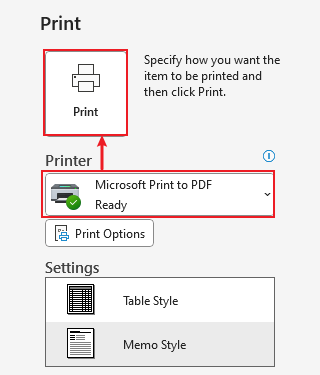
3. In the Printer dropdown menu, choose "Microsoft Print to PDF". Make sure that this printer is available on your computer — it is present by default in most modern versions of Windows. Then, click the "Print" button to proceed.
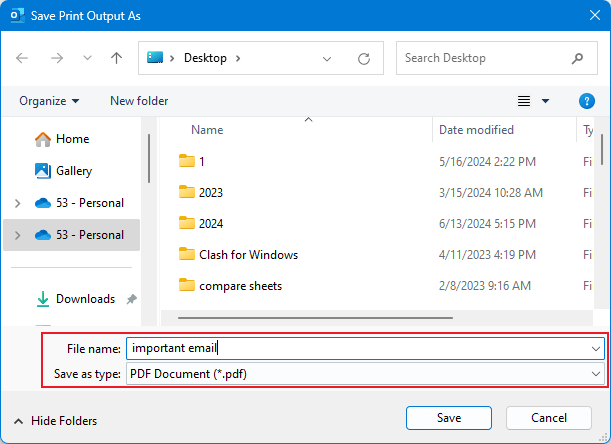
4. When the "Save Print Output As" window appears, choose the folder where you want to save your PDF file, enter a filename, and click "Save". Be sure to remember the location you chose for easy retrieval later.
Tips and notes: The Print to PDF method is simple and requires no extra plugins, but it is best suited for saving individual emails. This method does not directly export attachments along with the email—only the email body and formatting are included in the resulting PDF. Additionally, the print layout may slightly differ from how the message appears in your inbox, especially if your email contains wide tables or images. If you need to save multiple messages at once or require more control over output options, consider one of the other solutions below.
Save selected emails as PDF file using VBA code
If you often need to convert emails into PDF format in bulk or would like to automate the process, using VBA (Visual Basic for Applications) code can greatly streamline your workflow. This solution is particularly helpful for users comfortable with Outlook’s developer features and is ideal when frequently archiving or converting emails for business processes or case management.
Before running any VBA code in Outlook, please make sure macros are enabled (File > Options > Trust Center > Trust Center Settings > Macro Settings). Also, ensure that Microsoft Word is installed, since the code automates Word to accomplish the conversion.
Follow these steps to use VBA for saving a selected email as a PDF file:
1. First, select the emails that you wish to convert into a PDF.
2. Press Alt + F11 to open the Microsoft Visual Basic for Applications window.
3. In the VBA editor, click on Insert > Module to create a new module. Then copy and paste the following VBA code into the module window. 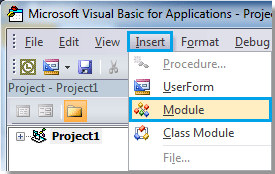
VBA code: Save an Outlook email as PDF file
Public Sub SaveSelectedMailsAsPDF()
'Updated by extendoffice.com
    Dim sel As Selection
    Dim itm As Object, mail As Object
    Dim outFolder As String
    Dim fso As Object
    Dim tempPath As String, tempFile As String
    Dim wrdApp As Object, wrdDoc As Object
    Dim startedWord As Boolean
    Dim fileName As String, fullPath As String
    Dim counter As Long

    Set sel = Application.ActiveExplorer.Selection
    If sel Is Nothing Or sel.Count = 0 Then
        MsgBox "Please select one or more emails first.", vbExclamation
        Exit Sub
    End If

    outFolder = PickFolderPath("Select a folder to save PDFs")
    If Len(outFolder) = 0 Then Exit Sub

    Set fso = CreateObject("Scripting.FileSystemObject")
    tempPath = fso.GetSpecialFolder(2)

    On Error Resume Next
    Set wrdApp = GetObject(, "Word.Application")
    On Error GoTo 0
    If wrdApp Is Nothing Then
        Set wrdApp = CreateObject("Word.Application")
        startedWord = True
    End If
    wrdApp.Visible = False

    For Each itm In sel
        If TypeName(itm) = "MailItem" Then
            Set mail = itm

            tempFile = fso.BuildPath(tempPath, "oltmp_" & SafeStamp() & "_" & SanitizeID(mail.EntryID) & ".mht")
            mail.SaveAs tempFile, 10

            Set wrdDoc = wrdApp.Documents.Open(tempFile, False, True, False, _
                                               "", "", False, "", "", 0, 0, False)

            fileName = SafeFileName(mail.Subject)
            If Len(fileName) = 0 Then fileName = "Message"
            fullPath = outFolder & "\" & fileName & ".pdf"
            counter = 1
            Do While fso.FileExists(fullPath)
                fullPath = outFolder & "\" & fileName & "_" & counter & ".pdf"
                counter = counter + 1
            Loop

            wrdDoc.ExportAsFixedFormat fullPath, 17, False, 0, 0, 0, 0, 0, True, True, 0, True, True, False

            wrdDoc.Close False

            On Error Resume Next
            Kill tempFile
            On Error GoTo 0
        End If

        DoEvents
    Next

    If startedWord Then wrdApp.Quit
    Set wrdDoc = Nothing
    Set wrdApp = Nothing

    MsgBox sel.Count & " email(s) saved as PDF in:" & vbCrLf & outFolder, vbInformation
End Sub

Private Function PickFolderPath(ByVal prompt As String) As String
    Dim sh As Object, fol As Object
    Set sh = CreateObject("Shell.Application")
    Set fol = sh.BrowseForFolder(0, prompt, 0)
    If Not fol Is Nothing Then
        PickFolderPath = fol.Self.Path
    Else
        PickFolderPath = ""
    End If
End Function

Private Function SafeFileName(ByVal s As String) As String
    Dim bad As Variant, i As Long
    bad = Array("\", "/", ":", "*", "?", """", "<", ">", "|", vbCr, vbLf)
    For i = LBound(bad) To UBound(bad)
        s = Replace(s, bad(i), " ")
    Next
    s = Trim$(s)
    If Len(s) > 150 Then s = Left$(s, 150)
    SafeFileName = s
End Function

Private Function SafeStamp() As String
    SafeStamp = Format(Now, "yyyymmdd_hhnnss")
End Function

Private Function SanitizeID(ByVal s As String) As String
    SanitizeID = Replace(Replace(s, "\", ""), "/", "")
End Function
4. To run the code, return to the VBA editor window and click  or press the F5 key with the module active.
5. While the code is running, a dialog will prompt you to choose a location for your PDF output.
6. Once complete, the code will automatically export your selected emails as individual PDF files to the chosen location. You can open the folder to check your PDF file.
Troubleshooting and tips:
- If you encounter an error stating that Microsoft Word could not start, ensure Word is installed and properly licensed.
- Attachments are not included directly in the PDF; only email content is saved.
- Always save your work before running VBA code to prevent accidental data loss.
Save selected emails as PDF file or other file formats using Kutools for Outlook
If you need a more efficient way to save multiple emails to PDF or other file formats with just a few clicks, Kutools for Outlook provides a convenient utility. This method is recommended when you want to export numerous messages at once, batch process emails, or require additional export formats beyond PDF, such as Excel, CSV, HTML, and more. Using a specialized add-in like Kutools can save significant time and reduce manual effort. It is particularly valuable for office workers or administrators who regularly archive emails or share them in standardized formats.
Say goodbye to Outlook inefficiency! Kutools for Outlook makes batch email processing easier - now with a 30-day free trial! Download Kutools for Outlook Now!!
1. In an Outlook email folder, select one or more messages you want to export as PDF files. (You can use Shift or Ctrl to select multiple messages.)
2. Click "Kutools" > "Bulk Processing" > "Save Emails as PDF and Other Formats".
3. In the "Save Messages as Other Files" dialog, specify the destination path where you want to store the files. Check the "PDF format" option, and configure other options as needed—for example, you can choose which parts of the email to save (headers or message body). This flexibility is useful if you want to produce concise or detailed PDF records.
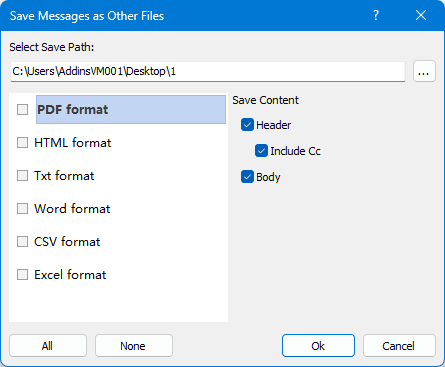
3. Click "Ok". Kutools will process your selected emails and save each email as a separate PDF file in the folder you selected. The process is rapid—even when handling dozens or hundreds of messages.
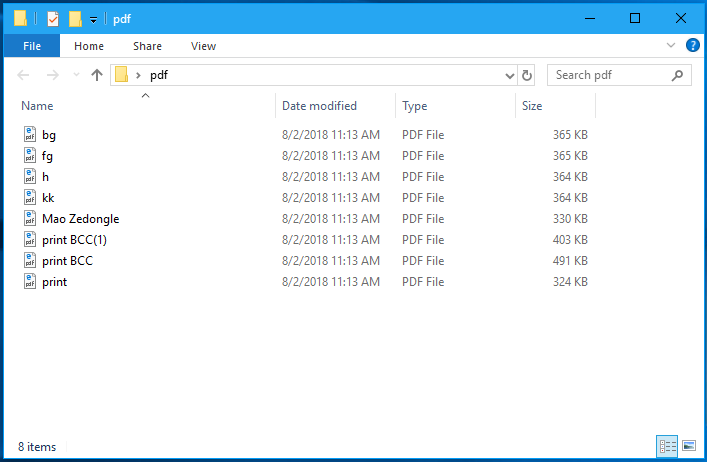
Advantages: Kutools for Outlook streamlines mass conversion, supports more output formats, and requires fewer manual steps compared to built-in solutions. It is especially recommended if you frequently need to save batches of emails or require advanced export features (such as preserving email list structure or saving metadata). Using Kutools reduces the potential for formatting inconsistencies and ensures archived PDFs are well-organized.
Limitations and reminders: Kutools is an add-in and requires installation. Be sure you have the most recent version installed for the best performance and compatibility with newer versions of Outlook. Attachments are typically exported as embedded files or as references depending on output settings—check your preferences in the dialog for the desired result.
Best Office Productivity Tools
Experience the all-new Kutools for Outlook with 100+ incredible features! Click to download now!
📧 Email Automation: Auto Reply (Available for POP and IMAP) / Schedule Send Emails / Auto CC/BCC by Rules When Sending Email / Auto Forward (Advanced Rules) / Auto Add Greeting / Automatically Split Multi-Recipient Emails into Individual Messages ...
📨 Email Management: Recall Emails / Block Scam Emails by Subjects and Others / Delete Duplicate Emails / Advanced Search / Consolidate Folders ...
📁 Attachments Pro: Batch Save / Batch Detach / Batch Compress / Auto Save / Auto Detach / Auto Compress ...
🌟 Interface Magic: 😊More Pretty and Cool Emojis / Remind you when important emails come / Minimize Outlook Instead of Closing ...
👍 One-click Wonders: Reply All with Attachments / Anti-Phishing Emails / 🕘Show Sender's Time Zone ...
👩🏼🤝👩🏻 Contacts & Calendar: Batch Add Contacts From Selected Emails / Split a Contact Group to Individual Groups / Remove Birthday Reminders ...
Use Kutools in your preferred language – supports English, Spanish, German, French, Chinese, and 40+ others!


🚀 One-Click Download — Get All Office Add-ins
Strongly Recommended: Kutools for Office (5-in-1)
One click to download five installers at once — Kutools for Excel, Outlook, Word, PowerPoint and Office Tab Pro. Click to download now!
- ✅ One-click convenience: Download all five setup packages in a single action.
- 🚀 Ready for any Office task: Install the add-ins you need, when you need them.
- 🧰 Included: Kutools for Excel / Kutools for Outlook / Kutools for Word / Office Tab Pro / Kutools for PowerPoint