How to add holidays into default/second/public calendars in Outlook?
Have you ever noticed that your Outlook calendar may not automatically display your country's holidays? For many users, keeping track of national holidays—such as public celebrations, bank holidays, or important cultural dates—can be crucial for planning both personal and professional schedules. Outlook provides a built-in feature to add holidays from a wide variety of countries directly into your default calendar efficiently. For organizations or individuals who manage multiple calendars—for example, a personal calendar, company calendar, or public/shared calendars—it's also possible to copy these holidays to other calendars as needed. Mastering these options helps ensure you never miss an important date and aids in clear scheduling when collaborating across teams or regions.
- Add holidays in the default calendar in Outlook
- Add holidays in second/public/all calendars in Outlook
- VBA code to bulk-import holiday events to any calendar
Add holidays in the default calendar in Outlook
Outlook allows you to bulk add holidays for a selected country into your primary calendar with a simple built-in workflow. This feature is suitable for personal users and most professionals, as it ensures important public dates appear automatically without the need to manually enter each event. The holidays added are specific to the regional selection, so you can target the most relevant calendar entries for your location.
1. At the main Outlook interface, click File > Options to access the Outlook Options dialog box. The Options is usually located near the lower-left corner of the File backstage menu.
2. In the Outlook Options dialog box, select Calendar in the left panel. Inside the Calendar options section, find and click the Add Holidays button.
Tip: If you don't see the Add Holidays option, make sure your Outlook version is updated, as older versions may have a slightly different layout or may require additional configuration.
3. In the Add Holidays to Calendar dialog, a list of available countries appears. Check the box for the country (or countries) whose holidays you want to add. You can select more than one if needed. Then click OK to confirm.
Note: Carefully review your selections. Adding holidays from multiple countries will result in more entries in your calendar, which might make it busier or harder to read. It's best to choose only the most relevant regions.
4. After confirming, Outlook will import the selected holidays. You’ll see a Microsoft Outlook confirmation dialog. Click OK repeatedly as prompted to close all dialog boxes once the process finishes.
All chosen country holidays are now imported directly into your default calendar, ensuring your main work or personal calendar reflects essential national events. The holidays are added as all-day, recurring events, and are typically categorized under "Holiday".
Practical Tip: If you accidentally add the wrong set of holidays or wish to clear out duplicate holiday entries, you may need to remove them manually or see related steps in this article: remove public holiday entries in Outlook.
Precautions: This process will only affect the selected default calendar associated with your primary email account in Outlook. If you have multiple accounts or calendars, you may need to repeat the procedure for each one.
Troubleshooting: If you notice holidays appear twice or do not show up after following these steps, try restarting Outlook and verify you are looking at the correct calendar. For missing options, ensure that your Outlook installation is up-to-date.
Scenario Analysis: This solution works best for users who only need national holiday events in a single personal or work calendar. The main downside is that it doesn’t automatically add holidays to secondary or public calendars.
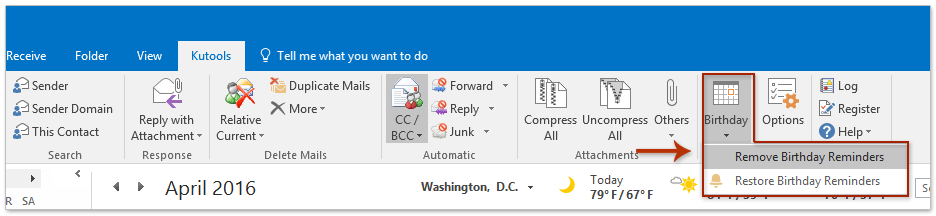
One click to remove (or restore) all birthday reminders in Outlook
Using Kutools for Outlook’s Remove Birthday Reminders function, you can swiftly clear all birthday reminders from Outlook in just one click. If needed, its Restore Birthday Reminders capability lets you bring back deleted reminders just as easily. This saves you time and effort when managing personal and shared calendar notifications in Outlook.
Add holidays in second/public/all calendars in Outlook
While the Add Holidays feature directly adds events only to your default calendar, many users need these holiday events in other calendars—such as a second personal calendar, a company-wide shared calendar, or public organization calendars. Achieving this involves a manual process that essentially copies existing holiday items from your default calendar to any desired calendar.
Note: Make sure you have already added holidays to the default calendar following the steps above, before proceeding.
1. Switch to Calendar view in Outlook, open your default calendar, and then on the ribbon, select View > Change View > List. This displays all calendar entries in a single list, making it much easier to find and select holidays.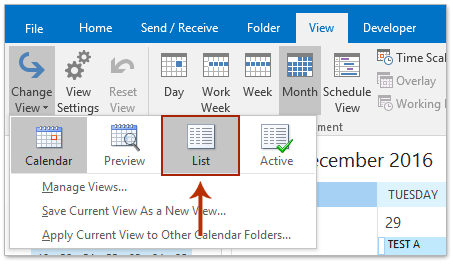
Tip: The "List" view is the best way to manage bulk entries, as it shows holidays, meetings, and appointments as sortable items. You can switch back to your normal calendar view after the operation.
2. On the View tab, select Categories from the Arrangement group. This will organize items by category—for instance, holidays usually appear under the "Holiday" category.
3. Locate and right click the "Holiday" category, choose Move > Copy to Folder from the context menu.
Tips:
- Double-check you're copying, not moving, if you wish to retain the originals in your default calendar.
- If the "Holiday" category appears empty, see troubleshooting below.
4. In the Copy Items dialog, select the target calendar where you want these holidays. This could be another personal calendar, a team/shared calendar, or a public calendar. Click OK to confirm.
5. A Microsoft Outlook warning dialog may appear, usually confirming the copy operation for multiple items. Click OK to proceed.
The selected holiday events are now being copied to your destination calendar. If you have permission to modify public calendars, this method works exactly the same way—allowing swift distribution of national or company holidays across teams.
Precautions: When copying items to shared or public calendars, ensure you have the correct permissions; otherwise, the process may fail or items may not appear. It’s also recommended to copy (not move) to avoid accidental loss of original entries.
Scenario Analysis: This copying workflow is ideal for team leaders, HR staff, or anyone managing multiple Outlook calendars who wishes to synchronize holiday events. The main limitation is that manual intervention is needed each year for newly added holidays or updates.
Practical Tips: If you find holidays are not showing in the List view, make sure they are properly categorized. Also, if copying events to a calendar throws an error, verify the folder type and permissions.
Troubleshooting: Should copied holidays not appear, try refreshing the destination calendar or restarting Outlook. If duplicate entries arise, refer to this article Remove duplicate public holiday entries in Outlook for clean-up advice.
VBA code to bulk-import holiday events to any calendar
For advanced users or administrators, automating the addition of holiday events to any calendar—including shared or public folders—is sometimes necessary, especially in large organizations. The following VBA approach allows you to customize and bulk-import holidays using a programmable routine.
1. In Outlook, select the calendar (such as a secondary or public calendar) where you want to bulk-import holiday events. Then press Alt + F11 to open the Microsoft Visual Basic for Applications window.
2. In the VBA window, click Insert > Module to create a new module. Copy and paste the following code.
VBA code: Bulk-create country holiday events in any selected calendar
Sub AddCountryHolidaysToSelectedCalendar()
    Dim objCalendar As Folder
    Dim objApp As Outlook.Application
    Dim objNS As Outlook.NameSpace
    Dim holidaysArr As Variant
    Dim i As Integer
    Dim xApt As AppointmentItem
    Dim holidayName As String
    Dim holidayDate As Date

    On Error Resume Next
    xTitleId = "KutoolsforOutlook"

    Set objApp = Outlook.Application
    Set objNS = objApp.GetNamespace("MAPI")
    Set objCalendar = objApp.ActiveExplorer.CurrentFolder

    ' Example: Add US holidays for 2024. You can replace or add more.
    holidaysArr = Array( _
        Array("New Year's Day", #1/1/2024#), _
        Array("Independence Day", #7/4/2024#), _
        Array("Thanksgiving Day", #11/28/2024#), _
        Array("Christmas Day", #12/25/2024#) _
    )

    For i = LBound(holidaysArr) To UBound(holidaysArr)
        Set xApt = objCalendar.Items.Add(olAppointmentItem)
        xApt.Subject = holidaysArr(i)(0)
        xApt.Start = holidaysArr(i)(1)
        xApt.AllDayEvent = True
        xApt.Categories = "Holiday"
        xApt.Save
        Set xApt = Nothing
    Next

    MsgBox "Finished adding holidays to selected calendar!", vbInformation, "KutoolsforOutlook"

    Set objCalendar = Nothing
    Set objNS = Nothing
    Set objApp = Nothing
End Sub3. Press the F5 key while the module is open to execute the code. All holidays defined in the array will be added as events into your currently selected calendar folder.
Selection requirement: Before running the code, make sure you have selected the correct calendar in Outlook (e.g. a secondary, shared, or public calendar). The code will add events only to the currently active calendar folder.
Customizing: Modify the holidaysArr array to include desired holidays and dates as needed. Avoid duplicating holidays if they've already been added—check your calendar first.
Precautions: Running this script multiple times will create duplicate holiday events. If you need to delete duplicates, refer to relevant Outlook clean-up guides.
Error reminders: If you receive an error about permissions or folder type, ensure you are selecting a standard calendar folder and that you have "edit" rights.
Summary suggestions: When managing holidays across multiple Outlook calendars, review your entries regularly for duplicates or outdated events. Consider combining manual and automated approaches for best results, especially in organizational contexts.
Related Articles
Best Office Productivity Tools
Experience the all-new Kutools for Outlook with 100+ incredible features! Click to download now!
📧 Email Automation: Auto Reply (Available for POP and IMAP) / Schedule Send Emails / Auto CC/BCC by Rules When Sending Email / Auto Forward (Advanced Rules) / Auto Add Greeting / Automatically Split Multi-Recipient Emails into Individual Messages ...
📨 Email Management: Recall Emails / Block Scam Emails by Subjects and Others / Delete Duplicate Emails / Advanced Search / Consolidate Folders ...
📁 Attachments Pro: Batch Save / Batch Detach / Batch Compress / Auto Save / Auto Detach / Auto Compress ...
🌟 Interface Magic: 😊More Pretty and Cool Emojis / Remind you when important emails come / Minimize Outlook Instead of Closing ...
👍 One-click Wonders: Reply All with Attachments / Anti-Phishing Emails / 🕘Show Sender's Time Zone ...
👩🏼🤝👩🏻 Contacts & Calendar: Batch Add Contacts From Selected Emails / Split a Contact Group to Individual Groups / Remove Birthday Reminders ...
Use Kutools in your preferred language – supports English, Spanish, German, French, Chinese, and 40+ others!


🚀 One-Click Download — Get All Office Add-ins
Strongly Recommended: Kutools for Office (5-in-1)
One click to download five installers at once — Kutools for Excel, Outlook, Word, PowerPoint and Office Tab Pro. Click to download now!
- ✅ One-click convenience: Download all five setup packages in a single action.
- 🚀 Ready for any Office task: Install the add-ins you need, when you need them.
- 🧰 Included: Kutools for Excel / Kutools for Outlook / Kutools for Word / Office Tab Pro / Kutools for PowerPoint