How to change default dictionary in Outlook?
The spell check feature in Outlook helps ensure your messages are free from typographical errors by automatically highlighting misspelled words, using the default dictionary configured in your account settings. However, for users working with specialized terminology, different languages, or custom words relevant to their professional field, relying on the default dictionary may not be sufficient. In such cases, knowing how to change the default dictionary to a custom one in Outlook becomes essential for improving spelling accuracy and communication efficiency. This guide takes you through a practical, step-by-step approach to customizing your Outlook dictionary settings so emails better reflect your language preferences and work requirements.
Change default dictionary in Outlook
Change default dictionary in Outlook
If you regularly encounter words or terminology that are incorrectly flagged by Outlook’s spellchecker, adjusting your default dictionary can help minimize unwanted alerts and streamline your email composition. The following method is applicable across most Outlook versions and can be especially useful for multilingual users or those who need to work with industry-specific vocabulary.
1. Open Outlook and click File in the top left corner, then select Options from the menu to open the Outlook Options dialog box.
2. In the Outlook Options dialog box, select Mail in the navigation pane on the left side. Next, locate the Compose messages section and click the Spelling and Autocorrect button to access advanced editor settings. 
3. The Editor Options dialog box will open. Here, click the Custom Dictionaries button to manage your dictionary lists and settings. 
4. In the Custom Dictionaries dialog, you will see a list of available dictionaries in the Dictionary List. Select the dictionary you wish to set as the new default—this could be a language-specific dictionary (e.g., English United States, English United Kingdom), or a custom dictionary if you’ve previously added one. After making your selection, click Change Default. 
5. After setting your preferred default, click OK in each open dialog box to confirm and apply your changes. This step is essential for saving your configuration and activating your selected dictionary.
Once these steps are complete, Outlook will reference the new dictionary whenever performing spell check on your emails and items. If you later notice words being flagged incorrectly, you can revisit these settings and either switch back to the previous dictionary or adjust custom word entries as needed.
Tip: If you work in a shared or corporate environment, ensure that the selected dictionary aligns with your company's language policy to avoid confusion in team communications. It's also a good idea to periodically update custom dictionaries, especially if new terminology or acronyms are introduced in your workflow.
Note: Sometimes, changes may not seem applied immediately—restart Outlook after making modifications to ensure the new settings take effect. Avoid selecting an empty or improperly formatted dictionary file, as this can interrupt the spellchecking process or display error messages.
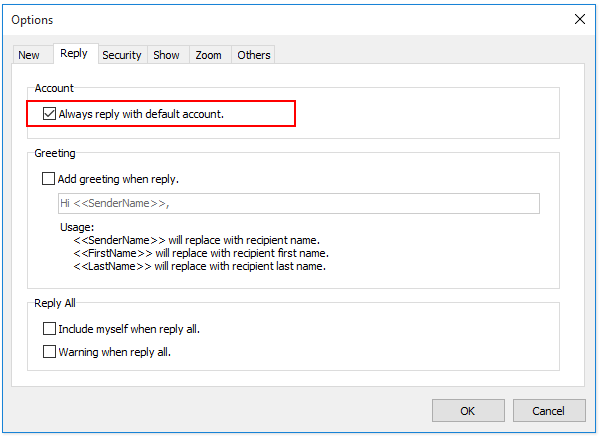
Automatically reply with the default email account in Outlook
Typically, Outlook will use the account associated with the active email for replies. If you need every reply to automatically send from your default email account—regardless of which mailbox the message belongs to—Kutools for Outlook offers the Always reply with default account option. This feature can be beneficial if you manage multiple email addresses but want all responses to originate from your primary account for coherence and consistency. Simply enable this option, and all replies will be sent from your designated default account.
Related Articles
Best Office Productivity Tools
Experience the all-new Kutools for Outlook with 100+ incredible features! Click to download now!
📧 Email Automation: Auto Reply (Available for POP and IMAP) / Schedule Send Emails / Auto CC/BCC by Rules When Sending Email / Auto Forward (Advanced Rules) / Auto Add Greeting / Automatically Split Multi-Recipient Emails into Individual Messages ...
📨 Email Management: Recall Emails / Block Scam Emails by Subjects and Others / Delete Duplicate Emails / Advanced Search / Consolidate Folders ...
📁 Attachments Pro: Batch Save / Batch Detach / Batch Compress / Auto Save / Auto Detach / Auto Compress ...
🌟 Interface Magic: 😊More Pretty and Cool Emojis / Remind you when important emails come / Minimize Outlook Instead of Closing ...
👍 One-click Wonders: Reply All with Attachments / Anti-Phishing Emails / 🕘Show Sender's Time Zone ...
👩🏼🤝👩🏻 Contacts & Calendar: Batch Add Contacts From Selected Emails / Split a Contact Group to Individual Groups / Remove Birthday Reminders ...
Use Kutools in your preferred language – supports English, Spanish, German, French, Chinese, and 40+ others!


🚀 One-Click Download — Get All Office Add-ins
Strongly Recommended: Kutools for Office (5-in-1)
One click to download five installers at once — Kutools for Excel, Outlook, Word, PowerPoint and Office Tab Pro. Click to download now!
- ✅ One-click convenience: Download all five setup packages in a single action.
- 🚀 Ready for any Office task: Install the add-ins you need, when you need them.
- 🧰 Included: Kutools for Excel / Kutools for Outlook / Kutools for Word / Office Tab Pro / Kutools for PowerPoint