How to automatically move subsequent conversations to a folder in Outlook?
After using Outlook for some time, your Inbox can quickly become filled with a wide variety of messages, making it increasingly difficult to manage and locate specific threads. For example, when collaborating on a project with colleagues where communication occurs within ongoing conversations, constantly searching or scrolling through your Inbox to find these important threads can be inconvenient and inefficient. This article introduces practical methods for organizing threads and conversations in Outlook, helping you keep your mailbox tidy and ensuring you can easily access the conversations that matter most.
Organize conversations with folders in Outlook
Suppose you have multiple conversations in your Outlook Inbox and the related projects have been completed, so you no longer send or receive emails within those threads. Archiving and organizing these finished conversations by moving them to dedicated folders is a useful strategy for clearing out your main Inbox and maintaining easy access to project records.
To create a folder or subfolder for your conversations, do the following:
1. Right-click your mail account in the navigation pane to open the context menu, then select "New Folder." Enter a name for the new folder to create it within your account. Alternatively, right-click an existing folder (such as Inbox), choose "New Folder," and name the subfolder as needed.
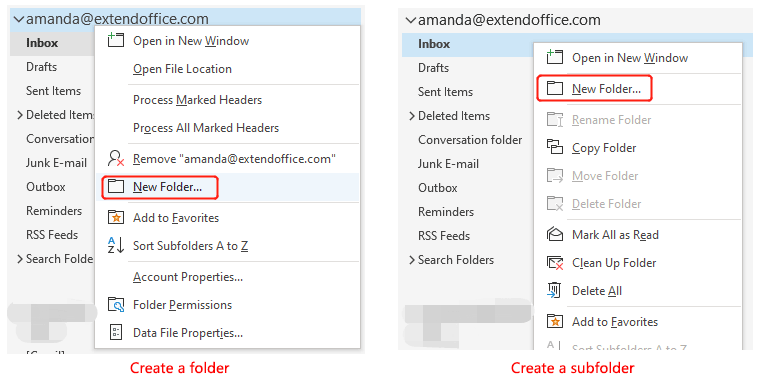
- Drag and drop the selected messages into the newly created folder or subfolder.
- Right-click the chosen messages, select "Move," then pick the destination folder from the menu.
These methods are suitable for manual archiving or grouping of finished conversations. This not only keeps your Inbox focused on active matters but also helps in future referencing, especially when projects need to be reviewed or audited. When using batch selection and movement, double-check you haven’t left behind any relevant messages to ensure thorough organization.
AI Mail Assistant in Outlook: Smarter Replies, Clearer Communication (one-click magic!)
Streamline your daily Outlook tasks with the AI Mail Assistant from Kutools for Outlook. This powerful tool learns from your past emails to offer intelligent and accurate responses, optimize your email content, and help you draft and refine messages effortlessly.

This feature supports:
- Smart Replies: Get responses crafted from your past conversations—tailored, precise, and ready to go.
- Enhanced Content: Automatically refine your email text for clarity and impact.
- Effortless Composition: Just provide keywords, and let AI handle the rest, with multiple writing styles.
- Intelligent Extensions: Expand your thoughts with context-aware suggestions.
- Summarization: Get concise overviews of long emails instantly.
- Global Reach: Translate your emails into any language with ease.
This feature supports:
- Smart email replies
- Optimized content
- Keyword-based drafts
- Intelligent content extension
- Email summarization
- Multi-language translation
Don’t wait—download AI Mail Assistant now and enjoy!
Automatically move subsequent conversations to a folder in Outlook
For ongoing conversations where new messages continue to arrive, manually sorting incoming emails can quickly become time-consuming. Automating the movement of related conversations or messages is essential for maintaining organization and ensuring important threads do not get lost in a busy Inbox. Below are several efficient solutions that can be applied in different scenarios, catering to both standard and advanced needs:
Always Move Messages in selected Conversations to a Folder
For a simple way to automatically relocate both existing and future messages in a selected conversation, Outlook provides a built-in function. Just select one or multiple threads in your Inbox whose continued and incoming messages you wish to move to a specific folder. Right-click any of the selected threads to open the context menu, then choose "Move" > "Always Move Messages in This Conversation." In the dialog that appears, select an existing folder or opt to create a new one as the destination for these emails. Going forward, all emails belonging to these conversations will be routed directly to your chosen folder instead of staying in the Inbox.
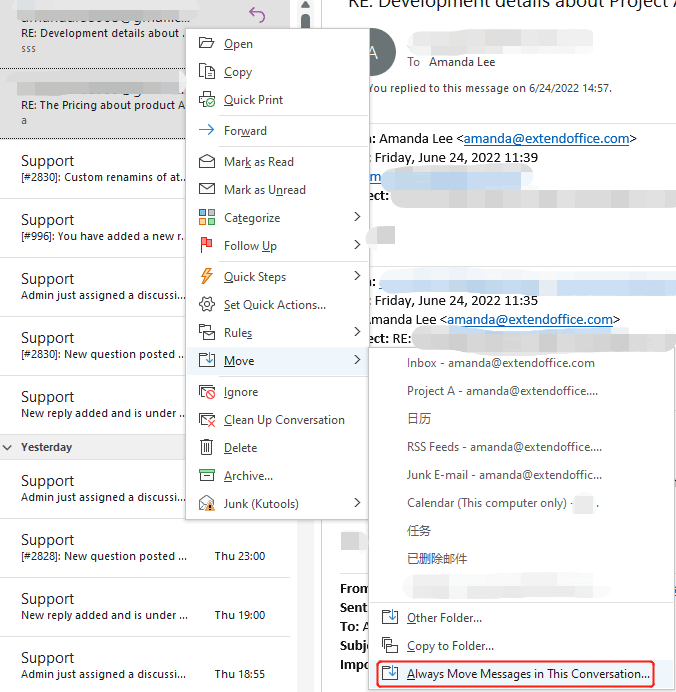
This approach is best for straightforward scenarios where you want continuous management of selected threads. Keep in mind that if conversation subjects change or if emails are forwarded with modified headers, not all related messages may be captured. Periodically review your folders for completeness and ensure your rules fit evolving communication patterns.
Automatically Move Messages with a Key Word to a Folder
In situations requiring more specific filtering—especially where conversation threads share common keywords or project names but are not formally grouped—Outlook's rule system can automate sorting based on customized criteria. This solution works well for ongoing projects, newsletter subscriptions, or any scenario where predictable keywords allow effective categorization.
1. Inside Outlook, go to "File" > "Manage Rules and Alerts." Click "New Rule" to start the setup process.
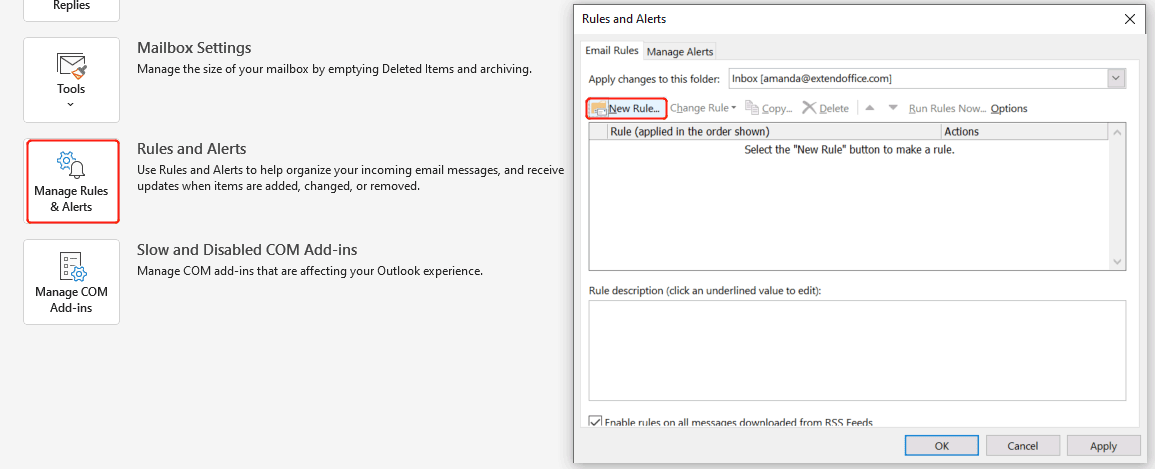
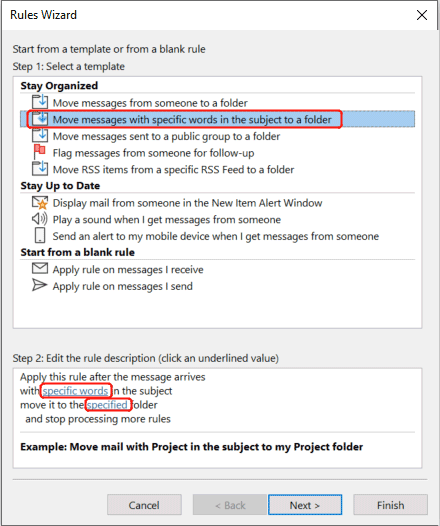
- For Step 1, pick "Move messages with specific words in the subject to a folder."
- For Step 2, click "specific words" and enter the terms or phrases you want Outlook to use for filtering messages. Click "specified" to set the folder where filtered messages will be delivered.
- After customizing keywords and the destination folder, click "Next."
3. You can add more conditions to refine how messages are automatically moved. Consider combining criteria for sender, subject, and other properties to target only relevant conversations. When all conditions are set, click "Next."
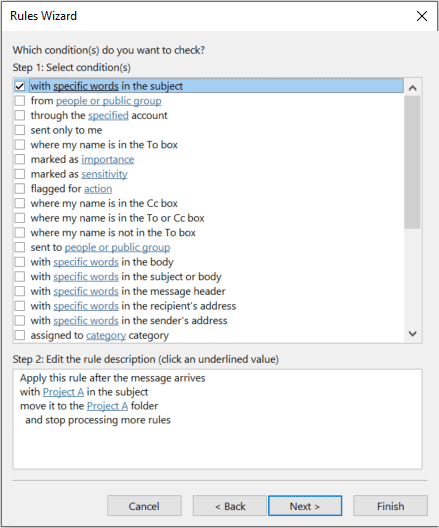
4. Specify the actions to perform on emails that meet your chosen conditions, such as moving them, marking as read, or categorizing. When you have finished setting up actions, click "Next."
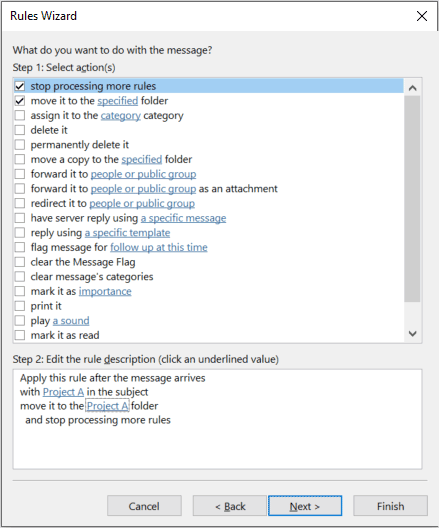
5. Add exceptions if there are email types you want to exclude from the rule. For instance, you may wish to ignore automated notifications or messages from certain senders. Once you have defined any exceptions, click "Next."
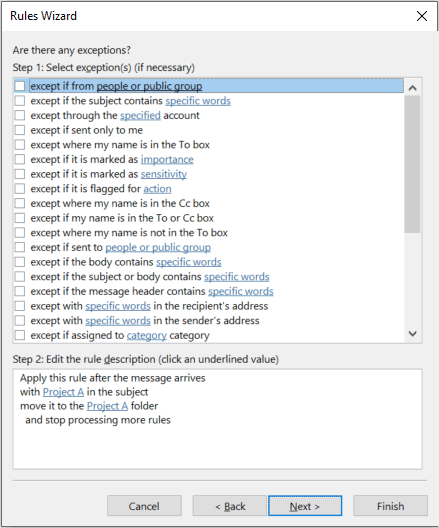
6. Finally, give your rule a descriptive name in Step1. Use Step2 to select additional options, such as running the rule immediately or applying it to existing messages. Preview the rule setup in Step3 to confirm everything is correct. Click "Finish" to apply the rule.
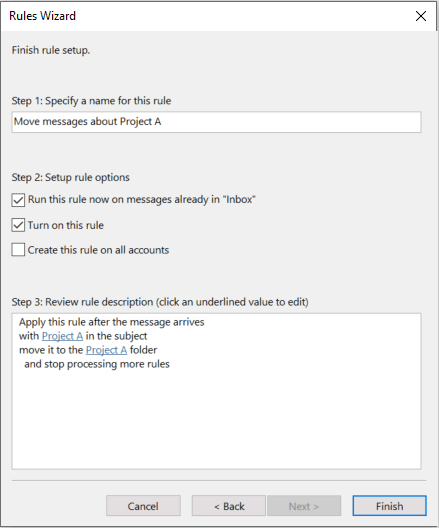
7. The new rule will appear in the "Rules and Alerts" dialog box. Confirm your changes by clicking "OK" to activate it. Outlook will now begin automatically moving incoming messages that meet your criteria to the specified folder.
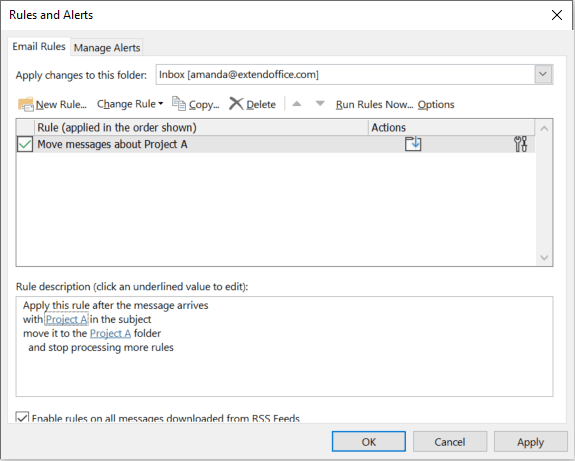
Applying custom rules improves long-term organization for ongoing work streams, repeated topics, or specific distribution lists. For best results, periodically review and update your rules to ensure that newly emerging keywords or sender addresses are incorporated, and avoid missing relevant communications due to overly restricted filters.
Be careful not to create rules that are too complex or overlap with other existing ones, as this may result in messages being moved unexpectedly or skipped from certain actions.
Related articles
Outlook: How To Show Email Message By Conversation
In Outlook, sometimes, there are some emails that are in the same thread with the same subject line. Normally, these emails are shown separately, as the below screenshot1 shows. Actually, you can show these emails as a conversation, as the below screenshot2 shows. Now go ahead, the tutorial will tell you how to show the email messages by conversation.
How To Search For Emails By Conversation In Outlook?
Normally, it’s easy to search for emails by subject in Outlook. But do you know how to search by conversation? Conversations group emails by subject, but ignore subject prefixes RE:, FW:, etc. Therefore, is there any way to search by conversation? This article will complete your puzzle easily!
How To Save Outlook Conversation As PDF?
You may be familiar with saving one email to a PDF file in Outlook, but do you know how to save an entire conversation to a PDF file? And what if saving every email of a conversation to an individual PDF file in bulk? This article will show the solution.
How To Count The Total Number Of Conversations In A Folder In Outlook?
Let’s say you discuss technique problems with fellows by email in Outlook, and there are many replies and forwards about a topic. In general, one conversation covers one technical problem. We can show the emails in Conversation view, but how to count the total number of all conversations in Outlook? Try workaround below:
Best Office Productivity Tools
Experience the all-new Kutools for Outlook with 100+ incredible features! Click to download now!
📧 Email Automation: Auto Reply (Available for POP and IMAP) / Schedule Send Emails / Auto CC/BCC by Rules When Sending Email / Auto Forward (Advanced Rules) / Auto Add Greeting / Automatically Split Multi-Recipient Emails into Individual Messages ...
📨 Email Management: Recall Emails / Block Scam Emails by Subjects and Others / Delete Duplicate Emails / Advanced Search / Consolidate Folders ...
📁 Attachments Pro: Batch Save / Batch Detach / Batch Compress / Auto Save / Auto Detach / Auto Compress ...
🌟 Interface Magic: 😊More Pretty and Cool Emojis / Remind you when important emails come / Minimize Outlook Instead of Closing ...
👍 One-click Wonders: Reply All with Attachments / Anti-Phishing Emails / 🕘Show Sender's Time Zone ...
👩🏼🤝👩🏻 Contacts & Calendar: Batch Add Contacts From Selected Emails / Split a Contact Group to Individual Groups / Remove Birthday Reminders ...
Use Kutools in your preferred language – supports English, Spanish, German, French, Chinese, and 40+ others!


🚀 One-Click Download — Get All Office Add-ins
Strongly Recommended: Kutools for Office (5-in-1)
One click to download five installers at once — Kutools for Excel, Outlook, Word, PowerPoint and Office Tab Pro. Click to download now!
- ✅ One-click convenience: Download all five setup packages in a single action.
- 🚀 Ready for any Office task: Install the add-ins you need, when you need them.
- 🧰 Included: Kutools for Excel / Kutools for Outlook / Kutools for Word / Office Tab Pro / Kutools for PowerPoint