How to prevent from changing sheet name in Excel?
In Microsoft Excel, it is very straightforward to rename a worksheet by simply double-clicking on its sheet tab and typing a new name. However, in collaborative environments or when sharing sensitive workbooks, you may need to ensure that specific sheet names are not altered, either to maintain data integrity or to avoid confusion among users. In such cases, it becomes important to know how to prevent others from changing sheet names. Below, we present practical methods to protect sheet names in Excel, explain when each approach is suitable, and offer troubleshooting suggestions to help you choose the best solution for your scenario.
➤ Prevent sheet name changes using VBA
Prevent changing sheet names by protecting the workbook
One of the most reliable ways to stop users from renaming any worksheet within an Excel workbook is by applying the Protect Workbook feature. This method locks the workbook’s structure so that not only sheet names but also actions like inserting, deleting, and hiding sheets are restricted. This is especially useful in environments where you want to keep the workbook structure fixed, such as shared reports or templates. Please follow these steps:
1. On the ribbon, click Review, then select Protect Workbook. Refer to the following screenshot:

2. In the protection dialog (modern Excel shows Protect Structure), enter a password if you wish (using a password is highly recommended for secure protection). Make sure the Structure box is checked under Protect workbook for, and then confirm your password by re-entering it. This step ensures that only users with the password can change workbook structure, including sheet naming. See the screenshot below:
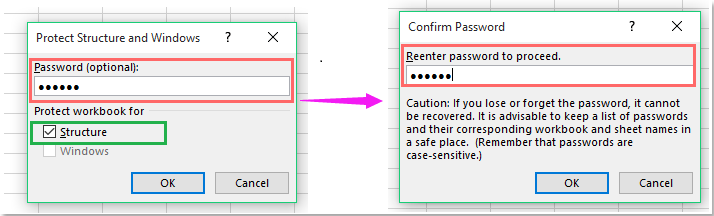
3. After clicking OK, if anyone tries to rename a sheet by double-clicking its tab, Excel will display a warning message notifying them that the sheet name cannot be changed. This helps prevent accidental or unauthorized changes to sheet names. Visual example:


If you ever need to restore the ability to change sheet names and manage sheet structure, you can remove workbook protection by returning to Review > Unprotect Workbook and entering the set password if prompted. It is a good practice to keep your password recorded in a secure place to avoid being locked out of editing your workbook structure.
This method is best used when you want to secure all worksheets from any renaming, regardless of which sheet is selected, and prevent changes to the overall workbook layout. However, if you require flexibility for users to manage sheets while only preventing renaming of specific sheets, consider using a VBA approach below.

Unlock Excel Magic with Kutools AI
- Smart Execution: Perform cell operations, analyze data, and create charts—all driven by simple commands.
- Custom Formulas: Generate tailored formulas to streamline your workflows.
- VBA Coding: Write and implement VBA code effortlessly.
- Formula Interpretation: Understand complex formulas with ease.
- Text Translation: Break language barriers within your spreadsheets.
Prevent changing a sheet name using VBA code
If you need more granular control and want to prevent the renaming of only a specific worksheet—while still allowing other sheets to be renamed, deleted, or added—a VBA solution is ideal. This method suits workbooks where only certain sheets hold critical identifiers (such as “Master Data” or “Dashboard”) and you want to ensure their names stay unchanged. Follow these steps:
1. Locate the sheet tab you wish to protect from renaming, then right-click on it and choose View Code from the menu. This action opens the Microsoft Visual Basic for Applications editor associated with that worksheet. In the editor, copy and paste the following code into the blank code window (it does not need to be placed in a separate Module for sheet-specific protection):
VBA code: Prevent from changing sheet name:
Private Sub worksheet_SelectionChange(ByVal Target As Excel.Range)
'Updateby Extendoffice
If ActiveSheet.Name <> "Master" Then
ActiveSheet.Name = "Master"
End If
End Sub
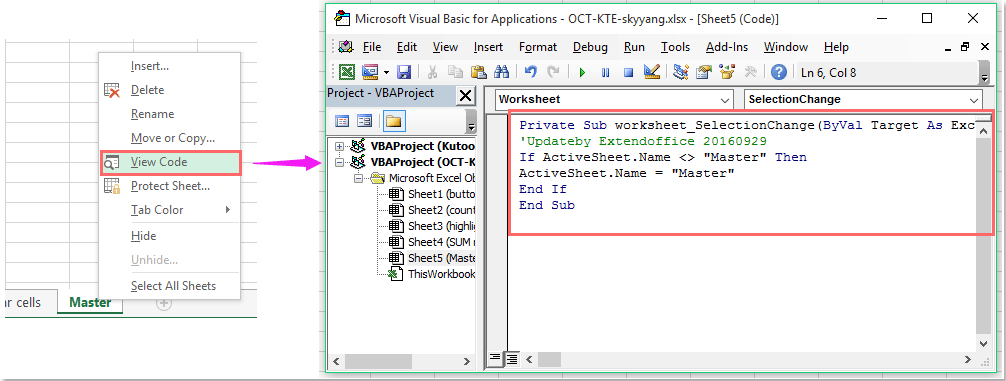
2. After pasting the code, save your work and close the VBA editor. From now on, if anyone tries to rename this particular worksheet, Excel will instantly revert the name back to the original, so the change is not applied. This provides a discrete but direct way to enforce naming standards for key sheets. Example screenshot:

This VBA method only impacts the specified worksheet and does not restrict other sheets from being renamed. For best results, communicate to users that certain sheet names should remain unchanged; otherwise, repeated attempts to rename may confuse users who notice the name reverting. Remember to save the workbook as a macro-enabled file (.xlsm) for the VBA code to function. Users need to enable macros for this solution to work.
Best Office Productivity Tools
Supercharge Your Excel Skills with Kutools for Excel, and Experience Efficiency Like Never Before. Kutools for Excel Offers Over 300 Advanced Features to Boost Productivity and Save Time. Click Here to Get The Feature You Need The Most...
Office Tab Brings Tabbed interface to Office, and Make Your Work Much Easier
- Enable tabbed editing and reading in Word, Excel, PowerPoint, Publisher, Access, Visio and Project.
- Open and create multiple documents in new tabs of the same window, rather than in new windows.
- Increases your productivity by 50%, and reduces hundreds of mouse clicks for you every day!
All Kutools add-ins. One installer
Kutools for Office suite bundles add-ins for Excel, Word, Outlook & PowerPoint plus Office Tab Pro, which is ideal for teams working across Office apps.





- All-in-one suite — Excel, Word, Outlook & PowerPoint add-ins + Office Tab Pro
- One installer, one license — set up in minutes (MSI-ready)
- Works better together — streamlined productivity across Office apps
- 30-day full-featured trial — no registration, no credit card
- Best value — save vs buying individual add-in