How to convert inches to feet, cm, or mm in Excel?
In many work scenarios, especially those involving engineering, construction, design, manufacturing, or data reporting, it is often necessary to convert measurements expressed in inches to other common units such as feet, centimeters (cm), or millimeters (mm). Manually recalculating these values each time is prone to errors and can be time-consuming, particularly with large datasets. Fortunately, Excel offers several practical methods to convert inch values efficiently, ensuring consistency and accuracy in your data manipulation. Below, you’ll find step-by-step solutions suitable for one-time conversions as well as regular, high-volume tasks.
➤ Convert inches to feet, cm, or mm with formulas
➤ Convert inches to feet or meters with Kutools for Excel

➤ Batch convert inches to other units via Paste Special multiplication
➤ Convert inches to other units using VBA code
Comparison of Methods for Converting Inches to Feet, Centimeters, or Millimeters
When working with engineering drawings, construction measurements, or manufacturing data, you may need to convert inches into feet, centimeters, millimeters, or other distance units. The following table compares the methods introduced in this article.
| Feature | Excel CONVERT Function | Kutools Unit Conversion |
|---|---|---|
| Convert inches to feet | ✔ | ✔ |
| Convert inches to centimeters | ✔ | ✔ |
| Convert inches to millimeters | ✔ | ✔ |
| Supports additional distance units | Limited to supported CONVERT unit codes | ✔ |
| Batch conversion | Requires filling formulas | ✔ |
| Requires formulas | ✔ | ✘ |
| Requires unit codes | ✔ (in, ft, cm, mm) | ✘ |
| Select units from drop-down lists | ✘ | ✔ |
| Preview results before applying | ✘ | ✔ |
| Keep original values by adding converted results as comments | ✘ | ✔ |
| Setup process | Enter the CONVERT formula with the appropriate unit codes, then fill the formula across the required range. | Select the range, choose the Distance category, specify the source and destination units, preview the results, then click OK or Apply. |
| Best for | Formula-based conversions that update automatically | Fast batch conversions without remembering formulas or unit codes |
| Ease of use | Moderate | Very easy |
Convert inches to feet, cm, or mm with formulas
Excel's built-in CONVERT function provides a simple and direct way to convert measurements from inches to a variety of other units, making it ideal for one-off conversions or when you want results in adjacent columns for easy comparison. This approach is particularly useful when you want the converted values to update automatically if the original inch values change.
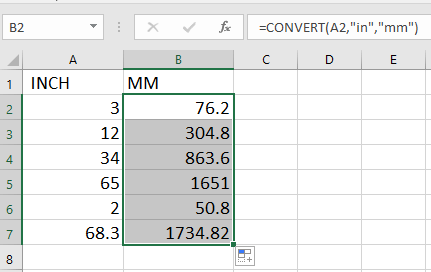
Select a blank cell, typically next to your original value (for example, if your original inch value is in cell A2, select cell B2), and enter the appropriate formula according to your conversion needs:
Convert inches to feet:
=CONVERT(A2,"in","ft")Convert inches to cm:
=CONVERT(A2,"in","cm")Convert inches to mm:
=CONVERT(A2,"in","mm")Here, A2 refers to the cell containing your inch value. Make sure to adjust the cell reference as necessary if your data is in a different cell.
After entering the formula, press Enter to see the result. If you have a list of inch values you wish to convert, simply drag the fill handle (the small square at the bottom-right corner of the selected cell) downward or across to apply the formula to adjacent cells. This ensures that each corresponding inch value is converted automatically.
Parameter notes and tips
- Unit codes are case-sensitive. Use the exact abbreviations
"in"(inch),"ft"(foot),"cm"(centimeter), and"mm"(millimeter); do not use full unit names. - Error guide:
#N/Aappears if units are misspelled or incompatible (e.g., converting a length to a weight).#VALUE!appears if the number argument isn’t numeric. In older Excel versions without the add-in,#NAME?may appear. - Version availability: CONVERT is built-in in Excel 2007 or later. In Excel 2003 and earlier, enable the Analysis ToolPak add-in to use it.
- You can apply standard number formatting to control decimal places for clearer presentation.
Convert inches to feet or meters with Kutools for Excel
For users who frequently handle unit conversions or process large sets of measurement data, Kutools for Excel's Unit Conversion utility offers a convenient and efficient batch processing solution. This tool is particularly suitable when you need to convert a whole range of inch values to other units at once, or wish to use additional features such as outputting results as cell comments for reference without changing the original data.
To use this method:
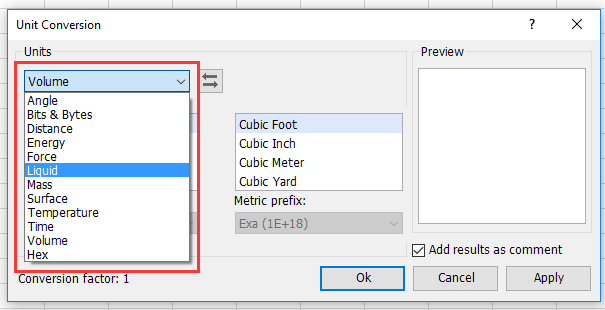
1. Select the range of cells containing the inch values you want to convert. Go to the Kutools tab on the ribbon, click Content, and then choose Unit Conversion. See screenshot below:

2. In the Unit Conversion dialog, set Unit type to Distance. In From, choose Inch; in To, choose your target unit, e.g., Foot or Meter. If you want to keep the original values and show converted results as comments, tick Add results as comment.

3. Click OK. Kutools will process the entire selection: by default, converted values replace the originals; if Add results as comment is ticked, the original values remain and the converted results are added as cell comments.
| Convert inch (in) to meter (m) | Add results as comment |
 |  |
Practical notes
- The tool supports a wide range of unit categories (e.g., length, area, volume, weight, temperature, speed, pressure).
- Overwrite vs. comment: By default, conversions replace original values. If Add results as comment is ticked, results are written to comments and existing comments may be overwritten.
- You can immediately undo with Ctrl+Z if you converted the wrong range. Always double-check the selection before clicking OK.
Demo: Convert inches to feet or meters with Kutools for Excel
Batch convert inches to other units via Paste Special multiplication
Another quick method suitable for batch conversion from inch to mm or cm is to use Excel’s Paste Special feature. This approach multiplies each inch value by the correct conversion factor, making it handy for situations where formulas are not preferred or where you want to overwrite the original values without extra columns.
For example, to convert inches to millimeters (1 inch = 25.4 mm):
- Enter 25.4 in a blank cell, then copy this cell (Ctrl+C).
- Select the range containing your inch values (preferably numeric cells only).
- Right-click the selection, choose Paste Special…, under Operation select Multiply, and click OK.
This will directly replace all inch values with their millimeter equivalents. You can use 2.54 as the multiplication factor to convert inches to centimeters, or use 1/12 (or 0.0833333333) to convert inches to feet for better precision.
NOTE
- Overwrites original values: Multiply replaces existing numbers in-place. Back up your data or work on a copy.
- Formulas become values: If the selection contains formulas, the results will be overwritten by multiplied values.
- Select numeric cells only: To avoid surprises, use Home ▸ Find & Select ▸ Go To Special ▸ Constants (Numbers) to target numbers only.
- Precision: For inches → feet, prefer
1/12(or0.0833333333) rather than rounded0.083333. - Undo immediately: Use Ctrl+Z right after the operation to revert if needed. Repeated steps are harder to roll back.
Convert inches to other units using VBA code
For advanced users or those managing bulk conversions with specific workflow requirements, automating the conversion process with a VBA macro can provide maximum flexibility and efficiency. This approach is ideal when you need to frequently convert different ranges between units, customize conversion factors, or integrate conversions into larger Excel automation tasks.
1. Press Alt+F11 (or click Developer > Visual Basic) to open the VBA editor. In the editor, click Insert > Module, then paste the following code into the module:
Option Explicit

Sub ConvertInchToMM_Cm_Ft()
    Dim rng As Range
    Dim unitChoice As Variant
    Dim factor As Double
    Dim arr As Variant
    Dim r As Long, c As Long
    Dim xTitleId As String

    xTitleId = "KutoolsforExcel"

    ' Ask user for target range
    On Error Resume Next
    Set rng = Application.InputBox( _
        Prompt:="Select the range to convert (inches):", _
        Title:=xTitleId, Type:=8)
    On Error GoTo 0

    If rng Is Nothing Then
        MsgBox "No range selected. Operation cancelled.", vbInformation
        Exit Sub
    End If

    ' Ask user for target unit
    unitChoice = Application.InputBox( _
        Prompt:="Enter 1 for mm, 2 for cm, 3 for ft", _
        Title:=xTitleId, Default:=1, Type:=1)
    If VarType(unitChoice) = vbBoolean Then
        ' User pressed Cancel
        MsgBox "Operation cancelled.", vbInformation
        Exit Sub
    End If
    If unitChoice < 1 Or unitChoice > 3 Then
        MsgBox "Invalid choice. Please enter 1, 2, or 3.", vbExclamation
        Exit Sub
    End If

    Select Case CLng(unitChoice)
        Case 1: factor = 25.4          ' inch → mm
        Case 2: factor = 2.54          ' inch → cm
        Case 3: factor = 1# / 12#      ' inch → ft (precise)
    End Select

    ' Bulk convert via array for speed; only numeric cells are multiplied
    arr = rng.Value2
    Application.ScreenUpdating = False
    Application.Calculation = xlCalculationManual

    If IsArray(arr) Then
        For r = 1 To UBound(arr, 1)
            For c = 1 To UBound(arr, 2)
                If IsNumeric(arr(r, c)) Then
                    arr(r, c) = CDbl(arr(r, c)) * factor
                End If
            Next c
        Next r
        rng.Value2 = arr
    Else
        ' Single cell
        If IsNumeric(arr) Then rng.Value2 = CDbl(arr) * factor
    End If

    Application.Calculation = xlCalculationAutomatic
    Application.ScreenUpdating = True

    MsgBox "Conversion completed.", vbInformation
End Sub
2. Return to Excel, select the range you want to convert (if you didn’t already pick it in the prompt). To run the macro, press Alt+F8 in Excel, choose ConvertInchToMM_Cm_Ft, and click Run. Alternatively, in the VBA editor press F5. Follow the prompts to enter 1 for mm, 2 for cm, or 3 for ft. The selected inch values will be updated accordingly.
NOTE
- Overwrite behavior: The macro multiplies numeric cells in-place and overwrites original values. If the selection contains formulas, their results become fixed numbers.
- Precision: Use the precise factor
1/12for inches → feet to avoid cumulative rounding errors. - Non-numeric cells: Text, blanks, and errors are left unchanged. For best results, select numeric cells only (e.g., Home ▸ Find & Select ▸ Go To Special ▸ Constants (Numbers)).
- Safety: Work on a copy or save before running. You can Ctrl+Z immediately after the run to undo the last conversion.
- Macro settings: Ensure macros are enabled for the workbook; otherwise the code won’t run.
When performing unit conversions in Excel, always choose the approach that matches your project size and workflow requirements. Formula-based methods are excellent for small to moderate datasets and situations where automatic updates are needed. Kutools for Excel is well-suited for anyone doing repeated or large-scale conversions, and its user interface helps eliminate errors for those less comfortable with formulas or VBA. The Paste Special and VBA options can be useful for quick, bulk conversions—just remember that they overwrite data. If you encounter errors such as #VALUE! or unintended results, check for non-numeric entries, incorrect formulas, or improper range selections. If you need to reverse a conversion, use the undo shortcut (Ctrl+Z) immediately or keep backups before processing.
Best Office Productivity Tools
Supercharge Your Excel Skills with Kutools for Excel, and Experience Efficiency Like Never Before. Kutools for Excel Offers Over 300 Advanced Features to Boost Productivity and Save Time. Click Here to Get The Feature You Need The Most...
Office Tab Brings Tabbed interface to Office, and Make Your Work Much Easier
- Enable tabbed editing and reading in Word, Excel, PowerPoint, Publisher, Access, Visio and Project.
- Open and create multiple documents in new tabs of the same window, rather than in new windows.
- Increases your productivity by 50%, and reduces hundreds of mouse clicks for you every day!
All Kutools add-ins. One installer
Kutools for Office suite bundles add-ins for Excel, Word, Outlook & PowerPoint plus Office Tab Pro, which is ideal for teams working across Office apps.





- All-in-one suite — Excel, Word, Outlook & PowerPoint add-ins + Office Tab Pro
- One installer, one license — set up in minutes (MSI-ready)
- Works better together — streamlined productivity across Office apps
- 30-day full-featured trial — no registration, no credit card
- Best value — save vs buying individual add-in