How to Extract File Extensions from Filenames in Excel
When working with file lists in Excel, you may need to identify file types by extracting their extensions, such as .xlsx, .docx, .pdf, or .jpg. This can be useful for organizing files, filtering specific file types, creating reports, or preparing data for further analysis. While extracting extensions manually from a few filenames is manageable, doing so for hundreds or thousands of filenames can be tedious and time-consuming.
In this tutorial, we'll show you three practical methods to extract file extensions from filenames in Excel: using a formula, a VBA function, and the powerful Extract Text feature of Kutools for Excel.
Extract file extensions from filenames with a formula
If you prefer a built-in Excel solution, you can use a formula to extract file extensions directly from filenames. The formula you use depends on your Excel version.
For Excel 365, Excel 2021, and later versions
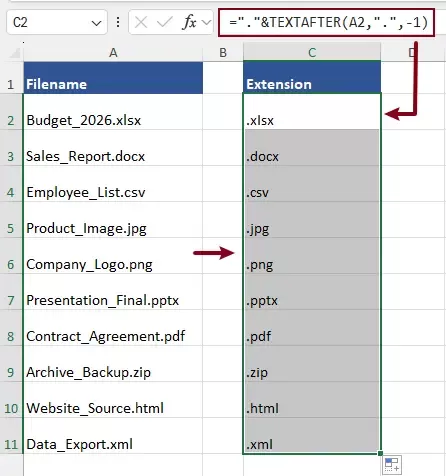
Modern Excel versions include the TEXTAFTER function, which makes extracting file extensions much easier.
Steps
- Select a blank cell next to your filename list and enter the following formula:
="."&TEXTAFTER(A2,".",-1)Note: Replace A2 with the cell containing your filename. - Press Enter to get the result for the first filename.
- Then drag the Fill Handle down to copy the formula to the remaining cells.
For Excel 2019, Excel 2016, and earlier versions
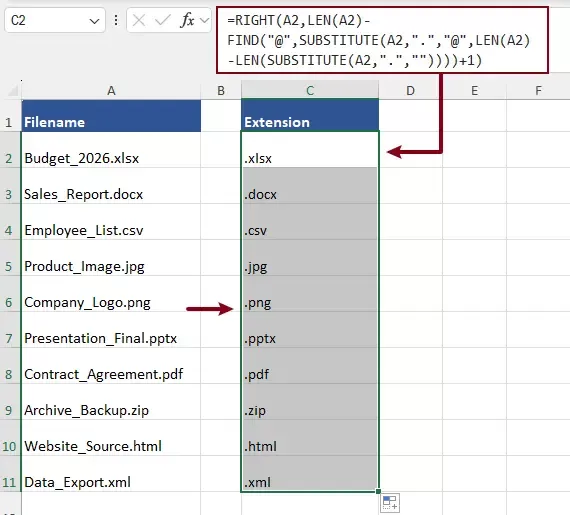
If your version of Excel does not support TEXTAFTER, you can use the following formula instead.
Steps
- Select a blank cell next to your filename list and enter the following formula:
=RIGHT(A2,LEN(A2)-FIND("@",SUBSTITUTE(A2,".","@",LEN(A2)-LEN(SUBSTITUTE(A2,".",""))))+1)Note: Replace A2 with the cell containing your filename. - Press Enter to get the result for the first filename.
- Then drag the Fill Handle down to copy the formula to the remaining cells.
Advantages of the formula methods
- No VBA required
- No additional tools required
- Suitable for quick extraction tasks
- Works well for most filename lists
However, formulas can become difficult to remember and maintain, especially when working with large datasets.
Extract file extensions from filenames with VBA
If you prefer using a custom function instead of a worksheet formula, you can extract file extensions with VBA. By creating a simple user-defined function, you can return the extension from a filename directly in a worksheet cell.
Steps
- Press Alt + F11 to open the Microsoft Visual Basic for Applications window.
- Click Insert > Module.
- Copy and paste the following code into the module window:
Function GetExtension(FileName As String) As String
    Dim Pos As Long
    Pos = InStrRev(FileName, ".")
    If Pos > 0 Then
        GetExtension = Mid(FileName, Pos)
    Else
        GetExtension = ""
    End If
End Function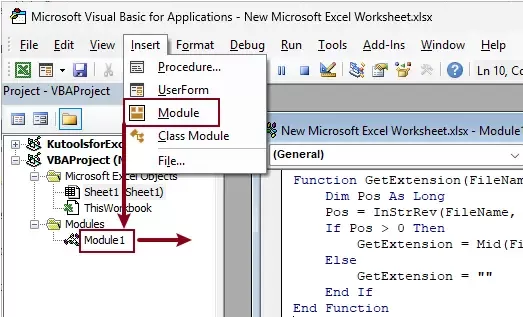
- Close the VBA Editor and return to your worksheet.
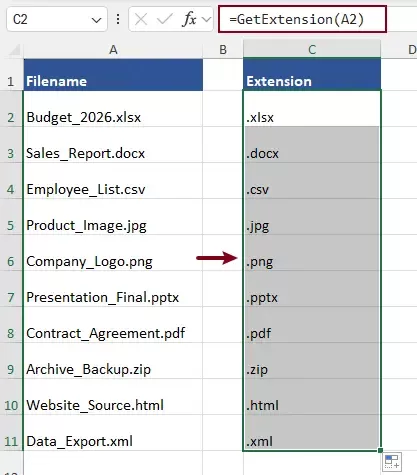
- In a blank cell, enter the following formula and press Enter.
=GetExtension(A2) - Drag the Fill Handle down to apply the function to the remaining rows.
The custom function extracts the file extension including the period as shown in the screenshot below.
Extract file extensions from filenames with Kutools for Excel
For the fastest and most user-friendly solution, Kutools for Excel provides the Extract Text feature, allowing you to extract file extensions without writing formulas or VBA code. With its rule-based extraction capability, you can process large filename lists in just a few clicks.
Kutools for Excel - Packed with over 300 essential tools for Excel. Make Excel tasks faster, easier, and more efficient. Download now!
Steps
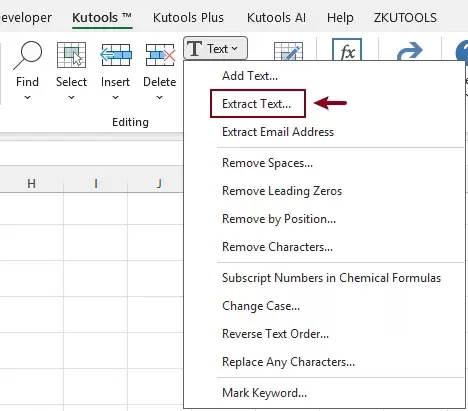
- Click Kutools > Text > Extract Text.
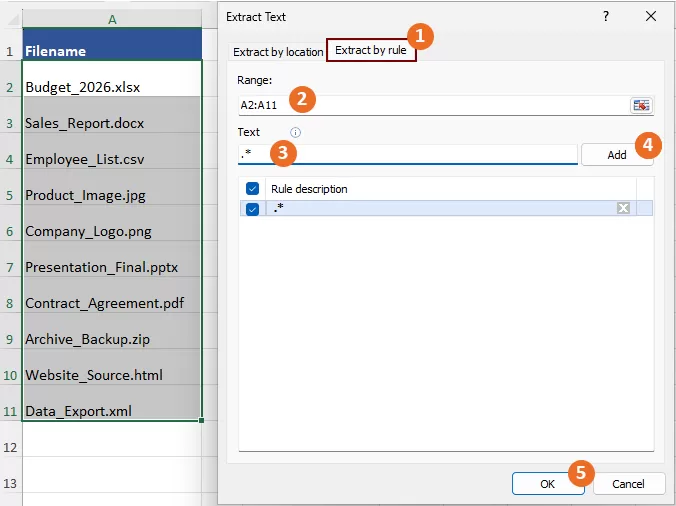
- In the Extract Text dialog box:
- Switch to the Extract by rule tab.
- Select the cells containing the filenames from which you want to extract extensions.
- Enter the following rule in the Text box:
.*
- Click Add to add the rule.
- Click OK.
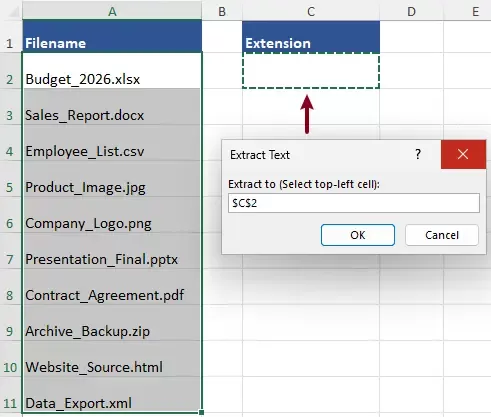
- In the dialog box that appears, specify the output range and click OK.
- This rule uses wildcard matching. The period (.) matches the dot that separates the filename from its extension, while the asterisk (*) matches any number of characters that follow the dot. As a result, the rule extracts the file extension, including the period, from each filename.
- The Extract by rule feature also supports other wildcard characters:
* — Matches any number of characters.? — Matches any single character.For example, if you use this rule .???, Kutools extracts only file extensions consisting of exactly three characters after the period, such as .jpg, .png, and .txt.
Kutools for Excel - Supercharge Excel with over 300 essential tools, making your work faster and easier, and take advantage of AI features for smarter data processing and productivity. Get It Now
Result
Kutools immediately extracts all file extensions, including the period (.), from the selected filenames and outputs them into the specified range.

Even large filename lists can be processed instantly without any formulas or manual editing.
Conclusion
Extracting file extensions can help you organize, analyze, and manage file-related data more efficiently. While formulas provide a quick worksheet-based solution and VBA offers a reusable custom function, both methods require either formula knowledge or coding skills.
If you're looking for the simplest and most efficient approach, Kutools for Excel's Extract Text feature is the best choice. Its rule-based extraction process eliminates the need for formulas and VBA, allowing you to extract file extensions from large filename lists quickly and accurately with just a few clicks.
Best Office Productivity Tools
Supercharge Your Excel Skills with Kutools for Excel, and Experience Efficiency Like Never Before. Kutools for Excel Offers Over 300 Advanced Features to Boost Productivity and Save Time. Click Here to Get The Feature You Need The Most...
Office Tab Brings Tabbed interface to Office, and Make Your Work Much Easier
- Enable tabbed editing and reading in Word, Excel, PowerPoint, Publisher, Access, Visio and Project.
- Open and create multiple documents in new tabs of the same window, rather than in new windows.
- Increases your productivity by 50%, and reduces hundreds of mouse clicks for you every day!
All Kutools add-ins. One installer
Kutools for Office suite bundles add-ins for Excel, Word, Outlook & PowerPoint plus Office Tab Pro, which is ideal for teams working across Office apps.





- All-in-one suite — Excel, Word, Outlook & PowerPoint add-ins + Office Tab Pro
- One installer, one license — set up in minutes (MSI-ready)
- Works better together — streamlined productivity across Office apps
- 30-day full-featured trial — no registration, no credit card
- Best value — save vs buying individual add-in
Table of contents
- Extract file extensions from filenames with a formula
- For Excel 365, 2021 and later
- For Excel 2019, 2016 and earlier
- Extract file extensions from filenames with VBA
- Extract file extensions from filenames with Kutools
- The Best Office Productivity Tools
Kutools for Excel
Brings 300+ powerful features to streamline your Excel tasks.
- ⬇️ Free Download
- 🛒 Purchase Now
- 📘 Feature Tutorials
- 🎁 30-Day Free Trial