How to save just one worksheet in a workbook in Excel?
In many Excel projects, you might encounter situations where you only need to share or archive a single worksheet, rather than the entire workbook. For example, you could be preparing a focused report to distribute to a colleague, or wanting to back up just one dataset from a multi-sheet file. Saving just one worksheet as a separate file not only helps keep your information organized but also helps protect privacy and reduces file size when you only need to share part of your data. Fortunately, Excel provides a variety of practical methods to accomplish this. In this tutorial, we’ll guide you through the most effective ways to extract and save an individual worksheet, let you know where each method is most suitable, and help you avoid common pitfalls along the way.
➤ Save just one worksheet as new Excel file with Kutools for Excel
➤ Save just one worksheet as new Excel file with VBA code
➤ Alternative Solution: Save a Worksheet As a PDF File Using Excel's Built-in Export
Save just one worksheet as new Excel file with Move or Copy
When you need a quick, built-in way to save a single sheet from your Excel file as a new document, the Move or Copy feature is particularly straightforward. This is especially useful for users who might not have additional add-ins or prefer not to use code. However, while this method is ideal for occasional tasks with relatively simple sheets, it does not let you save directly to formats beyond Excel’s standard file types, and some advanced worksheet elements (like linked charts to external sheets) may lose functionality upon separation.
To use this method:
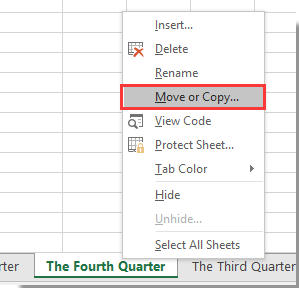
1. Right-click on the sheet tab of the worksheet you wish to save as an independent file (found at the bottom of your Excel window in the sheet tab bar). From the context menu that appears, choose Move or Copy.
2. In the Move or Copy dialog box, open the To book drop-down menu and select (new book). Be sure to check the Create a copy box; if you don’t check this, the worksheet will be moved out of the original file instead of copied, which could result in unintended data loss. Then, click the OK button to continue. See screenshot below:

3. Your selected worksheet will now open in a brand new workbook as the only sheet. Remember, this new workbook is unsaved by default—go to File > Save As, choose your preferred name, file type, and location for saving.
Note: Formulas that reference other sheets in the original file will show #REF! errors after copying, because those referenced sheets won’t exist in the new file. Double-check and adjust any formulas after saving. Also, worksheet-specific formatting and basic data will transfer, but any code modules or workbook-level macros must be exported separately if needed.
Save just one worksheet as new Excel file with Kutools for Excel
When you regularly need to split workbooks or save individual worksheets—especially with complex files or in bulk—Kutools for Excel offers a highly efficient approach. Instead of copying and pasting or managing one sheet at a time, Kutools combines several steps into one operation, helping you quickly isolate and export worksheets into multiple formats.
Here are the steps to follow:
1. In your Excel workbook, go to the Kutools Plus tab and click Split Workbook. See screenshot below:

2. Within the Split Workbook dialog box, select the checkbox next to the worksheet you want to save. You can select one or multiple sheets here if needed. Optionally, you can also determine whether to include hidden or password-protected sheets. Next, specify the desired file format—Kutools supports exporting to Excel (*.xlsx, *.xls), PDF, TXT, and other formats. Once ready, click the Split button. See screenshot:

3. A prompt will then appear allowing you to select the destination folder for saving your new file(s). Confirm your choice, and the tool will automatically generate your new workbook or file.
Advantages of this method include the ability to batch export multiple worksheets at once, support for a variety of file formats, and retention of original formatting. However, Kutools is a third-party add-in, so you’ll need to have it installed. It’s ideal for users working with large or complicated workbooks, or anyone repeatedly needing to perform this task.
Tip: Before completing the export, you can adjust specific settings in the Split Workbook dialog to preserve or discard certain worksheet features, such as comments or hidden sheets, for greater control over the output.
Demo: Save just one worksheet as Excel file
Save just one worksheet as new Excel file with VBA code
If you frequently need to save individual worksheets, especially in a recurring workflow, automating the process with a simple VBA macro can significantly boost efficiency. This solution is flexible: you can quickly adapt it to save sheets with custom names or automate the process for multiple sheets. VBA is perfect for advanced users or those who want a repeatable solution without manual navigation.
However, you should note that VBA macros must be enabled for use, and this method is best suited for personal or internal workbooks due to macro security considerations. Also, always save your work before executing new code to avoid accidental data loss.
Follow these steps to use VBA for saving just one worksheet as a new Excel file:
1. Open the worksheet you want to save as a standalone file and make it the currently active sheet by clicking its tab.
2. Press Alt + F11 at the same time. This opens the Microsoft Visual Basic for Applications window.
3. In the VBA editor, go to Insert > Module. Then copy and paste the following VBA code into the Module window.
VBA code: Save just one worksheet as new Excel file
Sub SaveWorksheetAsNewWorkbook()
'Updateby Extendoffice
    Dim ws As Worksheet
    Dim newBook As Workbook
    Set ws = ActiveSheet
    Set newBook = Workbooks.Add
    ws.Copy Before:=newBook.Sheets(1)
    newBook.SaveAs Application.GetSaveAsFilename(InitialFileName:=ws.Name & ".xlsx", FileFilter:="Excel Files (*.xlsx), *.xlsx")
    newBook.Close
End Sub
4. Press the F5 key, or click the Run button ( ), to execute the code. A file dialog window will appear; use this to specify the file name and location where you want to save the new workbook. Only the currently active worksheet will be saved into the new Excel file.

Precautions: If your worksheet contains formulas linked to other sheets, data validation, or external references, these may break in the saved file. Always test your exported file to ensure all data and formatting are preserved as needed. In shared or corporate environments, check your macro security level before running new VBA code.
Alternative Solution: Save a Worksheet As a PDF File Using Excel's Built-in Export
Sometimes, you might want to share only the content of a worksheet, without allowing others to edit the file. Exporting as a PDF is suitable for reporting and fixed-format sharing scenarios. Note, however, that PDF files are not editable in Excel and advanced interactive features will not be preserved.
1. Click to select the worksheet you want to save.
2. Go to File > Export or File > Save As, then choose PDF (*.pdf) as the file type.
3. In the Save As dialog, under Options, set Publish what to Active sheet(s) to ensure only the current sheet is saved.
4. Click Save to export your worksheet as a PDF file.
Tip: This solution is best for distributing static, read-only versions of your worksheet and is ideal for printable reports.
For further Excel tutorials and troubleshooting, visit our knowledge base for thousands of practical tips.
Best Office Productivity Tools
Supercharge Your Excel Skills with Kutools for Excel, and Experience Efficiency Like Never Before. Kutools for Excel Offers Over 300 Advanced Features to Boost Productivity and Save Time. Click Here to Get The Feature You Need The Most...
Office Tab Brings Tabbed interface to Office, and Make Your Work Much Easier
- Enable tabbed editing and reading in Word, Excel, PowerPoint, Publisher, Access, Visio and Project.
- Open and create multiple documents in new tabs of the same window, rather than in new windows.
- Increases your productivity by 50%, and reduces hundreds of mouse clicks for you every day!
All Kutools add-ins. One installer
Kutools for Office suite bundles add-ins for Excel, Word, Outlook & PowerPoint plus Office Tab Pro, which is ideal for teams working across Office apps.





- All-in-one suite — Excel, Word, Outlook & PowerPoint add-ins + Office Tab Pro
- One installer, one license — set up in minutes (MSI-ready)
- Works better together — streamlined productivity across Office apps
- 30-day full-featured trial — no registration, no credit card
- Best value — save vs buying individual add-in