How to limit cell entry to numeric values or a list in Excel?
When working with Excel, you may need to control what users can enter into specific cells. For example, you may want to allow only whole numbers within a specified range, restrict entries to predefined text values, block unwanted characters, or prevent duplicate entries. This tutorial introduces several practical ways to control cell input in Excel.
- Limit cell entry to whole numbers or numbers in a given range
- Limit cell entry to numeric characters or block specified characters with Kutools for Excel
- Limit cell entry to a predefined list of text values
- Prevent duplicate entries in a column or list with Kutools for Excel
- Flag values outside a numeric range with a formula
- Restrict cell entry to a predefined list with VBA
- Frequently Asked Questions
| Method | What it does | Best for |
|---|---|---|
| Data Validation: numbers | Blocks entries outside a specified whole-number or decimal range | Age, scores, quantities, budgets, and other numeric limits |
| Kutools: Prevent Typing | Allows or blocks specific characters without building a formula | Numeric-character input, IDs, and character restrictions |
| Data Validation: list | Restricts entries to items in a predefined list | Departments, categories, names, and status values |
| Kutools: Prevent Duplicates | Rejects repeated values in the selected range | Invoice numbers, IDs, registration codes, and unique records |
| Formula | Flags values outside a numeric range but does not block entry | Auditing or monitoring existing data |
| VBA | Applies a predefined Data Validation list to a selected range | Reusable or automated list restrictions |
Limit cell entry to whole numbers or numbers in a given range
Excel's Data Validation feature can restrict entries to whole numbers or decimal values that meet specific conditions, such as between two limits, greater than a minimum, or less than a maximum.
- Select the range where you want to restrict numeric entries, for example B2:B20. Then click Data > Data Validation.

- In the Data Validation dialog box, on the Settings tab, configure the rule:

- Choose Whole number from the Allow list if only integers are permitted, or choose Decimal if decimal values are allowed.
- Choose a condition from the Data list, such as between, greater than, or less than.
- Enter the required minimum, maximum, or comparison value.
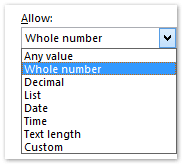
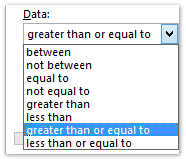
- Click OK.


Excel will reject values that do not meet the rule. You can also customize the Input Message and Error Alert tabs to explain what users are allowed to enter.
Limit cell entry to numeric characters or block specified characters with Kutools for Excel
With Kutools for Excel, the Prevent Typing feature lets you specify which characters can or cannot be entered. This is useful when you want to allow only digits or block letters and special characters without creating a custom Data Validation formula.
- Select the cells where you want to restrict input. Then click Kutools > Prevent Typing > Prevent Typing.
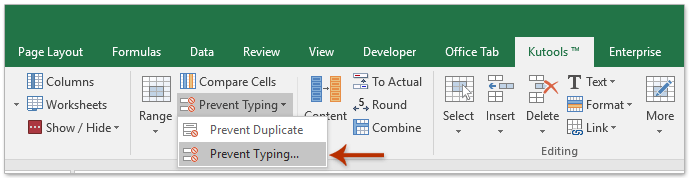
- To allow only numeric characters, select Allow to type in these chars and enter the permitted characters directly. For example, enter 0123456789 for digits only. Add a decimal point or minus sign if those characters should also be allowed.
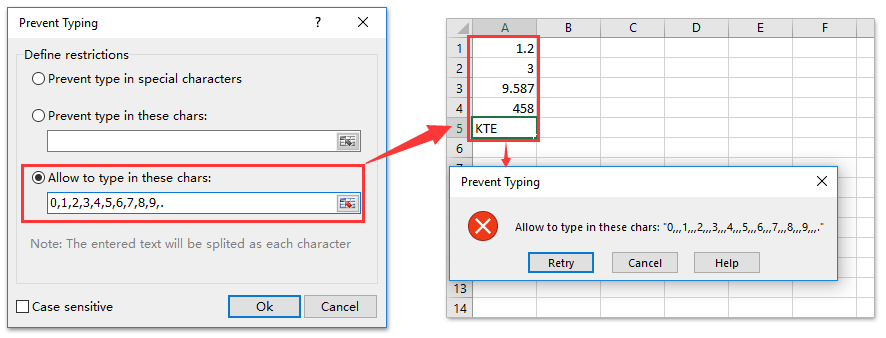
- To block specific letters or symbols instead, select Prevent type in these chars and enter the characters you want to prevent.
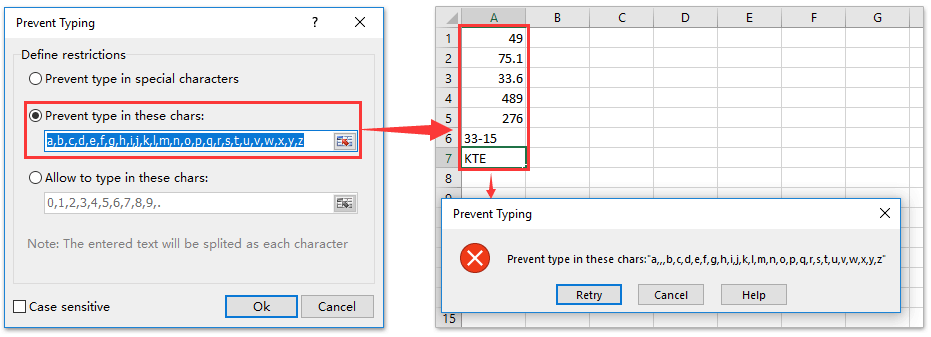
- Click OK.
📝 Note:
This feature has been updated. You no longer need to separate characters with commas. Enter the characters directly, such as 0123456789 or abcdefg.
When the rule is active, Kutools blocks disallowed characters and displays a warning when a user tries to enter them.
Kutools for Excel - Supercharge Excel with over 300 essential tools, making your work faster and easier, and take advantage of AI features for smarter data processing and productivity. Get It Now
Limit cell entry to a predefined list of text values
If only specific text entries are allowed, such as department names, project codes, or status values, use a Data Validation list to create a drop-down.
- Prepare the allowed values in the worksheet, for example in A2:A10.

- Select the cells you want to restrict, for example B2:B20, and click Data > Data Validation.

- On the Settings tab, choose List from the Allow list. Make sure In-cell dropdown is selected, and set the Source to the cells containing the allowed values, such as A2:A10.
- Click OK.


The target cells now display a drop-down list containing the allowed values.

You can also customize the Input Message and Error Alert to explain what users should enter.
📝 Note:
Changes made within the source range are reflected in the drop-down. If you add new items outside the original source range, expand the source range or use a dynamic source such as an Excel Table.
Prevent duplicate entries in a column or list with Kutools for Excel
For fields that require unique values, such as invoice numbers, registration codes, or IDs, Kutools for Excel provides a Prevent Duplicate feature.
Kutools for Excel - Packed with over 300 essential tools for Excel. Make Excel tasks faster, easier, and more efficient. Download now!
- Select the column or range where duplicate entries should be prevented.
- Click Kutools > Prevent Duplicate.

When a duplicate value is entered, Kutools displays a warning and rejects the repeated entry.
Kutools for Excel - Supercharge Excel with over 300 essential tools, making your work faster and easier, and take advantage of AI features for smarter data processing and productivity. Get It Now
📝 Note:
Before applying the feature, check whether the selected range already contains duplicates. Existing duplicate values are not automatically cleaned up.
Flag values outside a numeric range with a formula
If you do not need to block entry but want to identify values outside an allowed range, use a formula in an adjacent column. For example, if your numbers are in C2:C20 and valid values must be between 10 and 100, enter the following formula in D2:
=IF(AND(ISNUMBER(C2),C2>=10,C2<=100),"OK","Out of Range")- Enter the formula in the first adjacent cell.
- Copy the formula down alongside the data.
The formula returns OK for valid numeric values and Out of Range for other entries. This method does not stop invalid input; it only flags it for review.
Restrict cell entry to a predefined list with VBA
For users who want to apply the same predefined list repeatedly, the following VBA macro adds a Data Validation list to a selected range.
- Click Developer > Visual Basic.
- In the Microsoft Visual Basic for Applications window, click Insert > Module, and paste the following code:
Sub ApplyListValidation()
'Updated by Extendoffice

    Dim target As Range
    Dim validList As Variant
    Dim listText As String
    Dim xTitleId As String

    xTitleId = "Kutools for Excel"

    validList = Array("Apple", "Banana", "Orange", "Grape", "Peach")
    listText = Join(validList, ",")

    On Error Resume Next
    Set target = Application.InputBox("Select cells to restrict to list:", _
                                      xTitleId, Selection.Address, Type:=8)
    On Error GoTo 0
    If target Is Nothing Then Exit Sub

    With target.Validation
        .Delete
    End With

    target.Validation.Add Type:=xlValidateList, AlertStyle:=xlValidAlertStop, _
                          Operator:=xlBetween, Formula1:=listText

    With target.Validation
        .IgnoreBlank = True
        .InCellDropdown = True
        .ShowInput = True
        .InputTitle = "Allowed values"
        .InputMessage = "Choose from the list."
        .ShowError = True
        .ErrorTitle = xTitleId
        .ErrorMessage = "Entry must be one of: " & Replace(listText, ",", ", ")
    End With
End Sub- Run the macro by clicking the Run button
 , and select the range where you want to apply the restriction.
 , and select the range where you want to apply the restriction.
Excel adds a Data Validation drop-down to the selected cells. To use different allowed values, edit the validList line in the VBA code.
📝 Note:
Save the workbook as a macro-enabled file if you want to keep the VBA code.
Demo: Limit cell entry to numeric values or prevent specified characters
Frequently Asked Questions
Can users paste invalid values into cells with Data Validation?
Yes, some paste operations can overwrite or bypass Data Validation rules. If the restriction must remain in place, protect the worksheet or review pasted data after entry.
What is the difference between numeric Data Validation and Kutools Prevent Typing?
Data Validation checks the numeric value itself, so it can enforce limits such as 1 to 100. Prevent Typing controls which characters may be entered. For example, allowing digits and a decimal point does not validate whether the final text forms a correctly structured number.
How do I allow new items in a Data Validation list automatically?
Use a dynamic source such as an Excel Table, or update the Data Validation source range whenever new items are added outside the original range.
Does the formula method prevent invalid values from being entered?
No. The formula only identifies whether an entry is valid. Use Data Validation or another input-control method if you need to block invalid entries.
Will Prevent Duplicate remove duplicates that already exist?
No. It prevents new duplicate entries after the rule is applied. Existing duplicates should be reviewed or removed separately.
Related article
How to limit characters length in a cell in Excel?
Best Office Productivity Tools
Supercharge Your Excel Skills with Kutools for Excel, and Experience Efficiency Like Never Before. Kutools for Excel Offers Over 300 Advanced Features to Boost Productivity and Save Time. Click Here to Get The Feature You Need The Most...
Office Tab Brings Tabbed interface to Office, and Make Your Work Much Easier
- Enable tabbed editing and reading in Word, Excel, PowerPoint, Publisher, Access, Visio and Project.
- Open and create multiple documents in new tabs of the same window, rather than in new windows.
- Increases your productivity by 50%, and reduces hundreds of mouse clicks for you every day!
All Kutools add-ins. One installer
Kutools for Office suite bundles add-ins for Excel, Word, Outlook & PowerPoint plus Office Tab Pro, which is ideal for teams working across Office apps.





- All-in-one suite — Excel, Word, Outlook & PowerPoint add-ins + Office Tab Pro
- One installer, one license — set up in minutes (MSI-ready)
- Works better together — streamlined productivity across Office apps
- 30-day full-featured trial — no registration, no credit card
- Best value — save vs buying individual add-in