How to link textbox to a specific cell in Excel?
Do you know how to link a textbox to a cell in Excel? This capability can be especially useful when you want to display cell values in a visually appealing way, add data-driven labels to charts, or highlight important figures without exposing raw data cells. By linking a textbox to a cell, you gain the flexibility to format the displayed value with the textbox’s own properties, such as custom font, background color, or border style. What’s more, any changes made to the cell’s value are automatically reflected in the linked textbox, ensuring your worksheet visualization remains dynamic and up-to-date without the need for manual updates. This article will guide you through efficient techniques to link a textbox to a specific cell in Excel, and introduce alternative, more advanced methods for special scenarios.
Link a textbox to specific cell in Excel
VBA code – Programmatically link and update textbox content based on cell value
Link a textbox to specific cell in Excel
In Microsoft Excel, it is possible to link a textbox to a specific cell so that the value from the chosen cell is displayed in the textbox. This method is especially useful for reporting templates, dashboards, or when you want to place data labels anywhere in your workbook while maintaining a connection to the underlying data. The contents of the textbox will always reflect the latest value from the linked cell, thanks to the automatic update feature. Here’s how you can set this up:
Step1: Go to the Insert tab on the ribbon, and click the Text Box button. Then, draw a textbox at your desired position within the worksheet.
Tip: You can resize and move the textbox as needed, even after linking.

Step2: With the textbox actively selected (click on its border to select the entire textbox, not its contents), click into the Excel formula bar at the top of the window. Type in the = symbol, then click on the cell you wish to link (for example, A3). Press Enter to confirm.
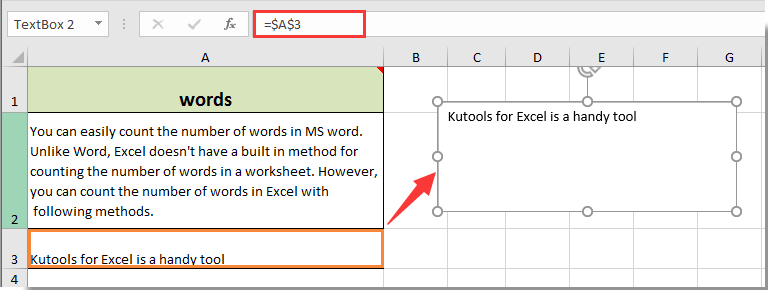
Once you complete this step, the textbox will immediately display the contents of the cell you linked (for example, Cell A3). Whenever you update the value in A3, the update will instantly appear in the textbox; there is no need for further manual intervention.
Advantages: This approach is straightforward, does not need any coding, and is suitable for most dynamic labeling needs.
Drawbacks: The content shown in the textbox directly mirrors the linked single cell—if you want to display values from multiple different cells, or apply complex conditional formatting/logic, you’ll need more advanced approaches such as combining formulas in a helper cell or using VBA, described below.
Practical tips:
- If you want to display concatenated or formatted data (e.g., combining text and value), you can use a formula (e.g., =A1 & " units sold") in a different cell and link the textbox to that result cell.
- Textboxes linked in this way can be freely formatted (size, color, border) but only show plain, unformatted cell values (cell formatting itself won’t transfer).
- To link to a cell on another worksheet, you can reference like =Sheet2!A1.
Troubleshooting and reminders:
- If clicking in the formula bar does not allow you to enter a formula, ensure the textbox is selected by its border (not inside it).
- Linked textboxes cannot display multiple cells directly; combine values in a helper cell if needed.
- If you cut and paste the linked cell to a new location, the link may break and need to be re-established.

Unlock Excel Magic with Kutools AI
- Smart Execution: Perform cell operations, analyze data, and create charts—all driven by simple commands.
- Custom Formulas: Generate tailored formulas to streamline your workflows.
- VBA Coding: Write and implement VBA code effortlessly.
- Formula Interpretation: Understand complex formulas with ease.
- Text Translation: Break language barriers within your spreadsheets.
VBA code – Programmatically link and update textbox content based on cell value
In some cases, you may require more flexibility than the formula bar method allows—for example, concatenating values from multiple cells, applying conditional logic, dynamic formatting, or automatically syncing content between worksheet changes. With VBA, you can programmatically control textboxes, updating their content any way you wish whenever cell values change. This is particularly suitable for custom dashboards, interactive reports, or situations where non-standard formatting or complex logic is required.
How it works: The following VBA sample will synchronize a textbox’s display text with the value of a specified cell every time you change that cell’s value. You can expand this method to combine multiple cells, format text, or apply conditional logic as needed.
- First, ensure that the Developer tab is enabled in your Excel ribbon. If not, right-click any existing tab, select "Customize the Ribbon," and check "Developer".
- Insert a Text Box from the Insert > Shapes section as usual.
- Click Developer > Visual Basic to open the VBA editor window.
- In the VBA editor, double-click the worksheet where you placed the textbox (for example, Sheet1) under "Microsoft Excel Objects".
- Copy and paste the following code snippet into the code window:
Private Sub Worksheet_Change(ByVal Target As Range)
    On Error Resume Next
    xTitleId = "KutoolsforExcel"
    If Not Intersect(Target, Me.Range("A3")) Is Nothing Then
        Me.Shapes("TextBox1").TextFrame.Characters.Text = Me.Range("A3").Value
    End If
End Sub
This code links the shape named "TextBox1" to cell A3: whenever A3 is updated, the textbox automatically reflects the new value.
How to execute the code:
- After entering the code, press Ctrl + S to save your workbook as a macro-enabled file (*.xlsm).
- Make sure the textbox is actually named "TextBox1". If you change the default name, update the code accordingly.
- Return to your worksheet and modify cell A3. You should see the textbox update instantly.
Parameter explanations and flexible extensions:
You can edit Me.Range("A3") to track a different cell, or use additional logic for complex multi-cell concatenation, e.g.:
Sub UpdateTextBox()
    Dim textBoxText As String
    On Error Resume Next
    xTitleId = "KutoolsforExcel"
    textBoxText = Me.Range("A3").Value & " | " & Me.Range("B3").Value
    Me.Shapes("TextBox1").TextFrame.Characters.Text = textBoxText
End Sub
Tips and common issues:
- TextBox shape names (like "TextBox1") are case sensitive and must match the object’s actual name. Right-click the textbox and check the Name Box for its identifier.
- If nothing happens, ensure macros are enabled in Excel. Re-check whether the Worksheet_Change code is placed in the correct sheet code window, not in a module.
- To update textboxes based on multiple cell changes, expand the
Intersectlogic or loop through multiple cells as needed.
Summary suggestions:
- Try formula linking for simple, single-cell dashboard displays or annotation, as it is simple, safe, and requires no macros.
- For advanced use cases—combining several cell values, conditional formatting, or dynamic content changes—consider using the VBA method outlined above.
- Always save original workbooks before implementing VBA to avoid unwanted data loss and enable easy rollback.
Best Office Productivity Tools
Supercharge Your Excel Skills with Kutools for Excel, and Experience Efficiency Like Never Before. Kutools for Excel Offers Over 300 Advanced Features to Boost Productivity and Save Time. Click Here to Get The Feature You Need The Most...
Office Tab Brings Tabbed interface to Office, and Make Your Work Much Easier
- Enable tabbed editing and reading in Word, Excel, PowerPoint, Publisher, Access, Visio and Project.
- Open and create multiple documents in new tabs of the same window, rather than in new windows.
- Increases your productivity by 50%, and reduces hundreds of mouse clicks for you every day!
All Kutools add-ins. One installer
Kutools for Office suite bundles add-ins for Excel, Word, Outlook & PowerPoint plus Office Tab Pro, which is ideal for teams working across Office apps.





- All-in-one suite — Excel, Word, Outlook & PowerPoint add-ins + Office Tab Pro
- One installer, one license — set up in minutes (MSI-ready)
- Works better together — streamlined productivity across Office apps
- 30-day full-featured trial — no registration, no credit card
- Best value — save vs buying individual add-in