How to print sheet name or a list of sheet names in Excel?
When working with multiple worksheets in an Excel workbook, it is common to print individual sheets for sharing or archiving. However, by default, Excel does not include the worksheet name on printed pages, which can make it difficult to identify the origin of a printout, especially in large workbooks with similar data structures across sheets. Whether you need each page to display its sheet name, or you want to generate and print a complete list of all sheet names for reference, there are several practical methods to achieve this in Excel. In this article, we will explain several different approaches to print sheet names on your worksheet pages and to print a comprehensive list of your workbook’s sheet names, so you can choose the solution that best meets your needs.
Print sheet name with changing the print page setup
Print sheet name by inserting the sheet name in a cell with Kutools for Excel
Print sheet name in a cell using an Excel formula
Print a list of sheet names with VBA code
Print a list of sheet names with Kutools for Excel
Print sheet name with changing the print page setup
To print your worksheet with its name automatically included, you can change the print page setup options so that the sheet name appears in the header or footer of every printed page. This approach is useful when you want each printout to show which worksheet it originated from, such as for compliance or organizational purposes. This method is built into Excel and works in all recent versions, ensuring compatibility and no need for additional tools.
1. Click File > Print > Print Setup. See screenshot:
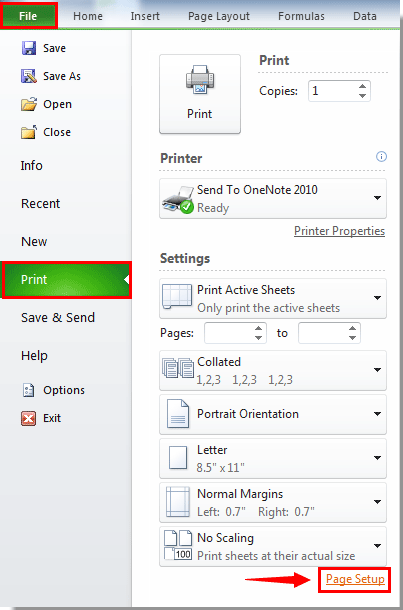
If you are using Excel 2007, click the Office button, then select Print > Print Preview. Then, click Page Setup in the Print Preview tab. This displays the options needed for configuring header and footer settings.

2. In the Page Setup dialog box, select the Header/Footer tab. If you prefer the sheet name in the header, click the Custom Header button; for insertion in the footer, click Custom Footer. Here, as an example, click Custom Header. See screenshot:

3. In the Header dialog, click into the Left section box (or use the Center section or Right section as you need). Then, click the Insert Sheet Name button (represented by a spreadsheet icon), which adds the sheet name code into the selected area. Finally, click OK to confirm. See screenshot:
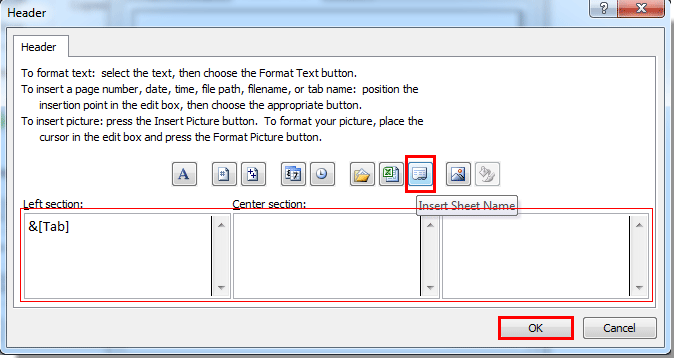
Note: The sheet name will print in the header or footer section you select. You can also combine the sheet name with custom text or dates in these sections for added clarity, for example, "Sheet:[Sheet Name]" or "Printed on: [Date]".
4. When you return to the Page Setup dialog, click OK to apply the change. From now on, whenever you print the worksheet, the current sheet name will appear in your chosen header or footer section on every printed page. This setting is worksheet-specific, so you would need to repeat the steps for other sheets if necessary.
If the sheet name does not appear as expected, check that you have not accidentally overwritten the header/footer or selected the wrong section in Page Setup. Also, see the Print Preview before printing to confirm the change.
Print sheet name by inserting the sheet name in a cell with Kutools for Excel
The Insert Workbook Information utility of Kutools for Excel provides a quick way to insert the active worksheet name into any cell you specify, making it easy to customize the placement of the sheet name in your worksheet. This can be especially helpful when you want the sheet name to appear as data within your print area—such as in the report title, cell blocks, or custom headers/footers—which is not possible with the built-in header/footer options alone.
1. Click Kutools Plus > Insert Workbook Information from the Excel ribbon to open the relevant dialog box.

2. In the Insert Workbook Information dialog box, select Worksheet name under the Information section. Then, define the target cell for the sheet name in the Range field—for instance, A1 if you want it at the top of your report. Click OK when finished.

3. The sheet name now appears in the specified cell. When you print the worksheet, the sheet name will be included as part of your regular print area. You may wish to format the cell (e.g., bold, larger font) to make the sheet name stand out on the printout.
Note: If you want the sheet name in the worksheet's header or footer using Kutools, check the Header or Footer options. This will automatically insert the sheet name info into these areas. Remember that changing sheet names later will require updating or reinserting the information for accuracy.
Kutools for Excel - Supercharge Excel with over 300 essential tools, making your work faster and easier, and take advantage of AI features for smarter data processing and productivity. Get It Now
Print sheet name in a cell using an Excel formula
If you prefer a method that does not require add-ins, Excel provides a formula-based solution to display the sheet name directly in a spreadsheet cell. This approach ensures the sheet name updates automatically if you rename your worksheet, making it flexible for reports and dashboards. It's useful when you want the sheet name as part of your printed worksheet content or within a tabular area.
1. Select the cell where you want the sheet name to appear (for example, cell A1), and enter the following formula:
=MID(CELL("filename",A1),FIND("]",CELL("filename",A1))+1,255)This formula extracts the sheet name from the full file path and sheet information provided by the CELL function. It works only after the workbook has been saved at least once.
2. Press Enter to complete the formula. The cell now displays the current sheet name. To print the worksheet with the sheet name included, make sure the formula result cell is visible in your print range.
Tip: If you copy this formula to other sheets, it will dynamically display each worksheet’s name. If the result shows as blank or an error, save your workbook first, since the formula depends on the file path being available.
Print a list of sheet names with VBA code
Printing a summary list of all worksheet names in a workbook is particularly useful for large Excel files, such as for documentation, auditing, creating an index, or file organization. Excel does not provide a built-in command to generate such a list, but you can easily do this with a simple VBA macro, which automates populating a list of all sheet names into a worksheet. You can then print this summary list for reference or distribution. This method is flexible and can be used in any workbook, though some users may prefer add-ins for additional options or convenience.
1. Press Alt + F11 to open the Microsoft Visual Basic for Applications window. If the Developer tab is not shown in your Excel ribbon, you can also access the VBA editor via right-clicking on your worksheet tab and selecting "View Code".
2. In the VBA environment, click Insert > Module. Then copy and paste the following VBA code into the new module window:
VBA: List all worksheet names
Sub GetSheets()
	Dim Rng As Range
	Dim WorkRng As Range
	On Error Resume Next
	xTitleId = "KutoolsforExcel"
	Set WorkRng = Application.Selection
	Set WorkRng = Application.InputBox("Out put to (single cell)", xTitleId, WorkRng.Address, Type: = 8)
	Set WorkRng = WorkRng.Range("A1")
	xNum = Application.Sheets.Count
	For i = 1 To xNum
		WorkRng.Value = Application.Sheets(i).Name
		Set WorkRng = WorkRng.Offset(1, 0)
	Next
End Sub
Note: Always save your workbook before running VBA code. You may choose to back up your file to prevent unintentional changes.
4. Press F5 to execute the code. A dialog box labeled KutoolsforExcel will prompt you to specify the starting cell where you want the sheet names to be listed. After selecting your desired cell, click OK to proceed.

5. The code will fill the selected column (starting from your specified cell) with all sheet names in your workbook. Now you can print this sheet just like any other worksheet.
Tip: If nothing happens after you run the code, double-check that macros are enabled in your Excel security settings. It's also advisable to avoid overwriting important data when selecting the destination cell.
Print a list of sheet names with Kutools for Excel
For users who frequently need to list and print all sheet names, the Create List of Sheet Names utility of Kutools for Excel provides a convenient and efficient way to do so, eliminating the need for manual input or complex code. The feature is especially helpful when managing large workbooks, creating contents pages, or providing an overview for sharing with others. Additional options allow you to insert hyperlinks to each sheet or customize the output formatting as well.
Kutools for Excel - Packed with over 300 essential tools for Excel. Make Excel tasks faster, easier, and more efficient. Download now!
1. On the Excel ribbon, click Kutools Plus > Worksheet > Create List of Sheet Names.

2. In the Create List of Sheet Names dialog, adjust the settings according to your requirements (for example, output location, whether to include hyperlinks, or which sheets to display). Once set, click OK.

After confirming, Kutools will generate a new worksheet containing a table with all sheet names from your workbook. You can now easily print this generated list as you would any worksheet report.

Note: If your workbook contains hidden sheets, you can customize the output to list only visible sheets or include all sheets (including hidden ones). Having hyperlinks in the list allows for quick sheet navigation directly within the workbook.
Kutools for Excel - Supercharge Excel with over 300 essential tools, making your work faster and easier, and take advantage of AI features for smarter data processing and productivity. Get It Now
Should you ever encounter issues such as sheet names not updating automatically after renaming, check if you are using static (rather than formula-based) values or if an add-in/manual update is required. For print layout problems (like sheet names not appearing despite setup), always preview before printing and double-check header/footer settings and print area selections. If macro security blocks VBA solutions, ensure your macro settings allow program execution, or use an add-in approach like Kutools for Excel for convenience and reliability. Adjust the solution according to your workflow habits—for occasional one-off needs, built-in or formula methods may suffice, while for more frequent or batch operations, using Kutools or VBA will usually be faster and more flexible.
Related articles:
Best Office Productivity Tools
Supercharge Your Excel Skills with Kutools for Excel, and Experience Efficiency Like Never Before. Kutools for Excel Offers Over 300 Advanced Features to Boost Productivity and Save Time. Click Here to Get The Feature You Need The Most...
Office Tab Brings Tabbed interface to Office, and Make Your Work Much Easier
- Enable tabbed editing and reading in Word, Excel, PowerPoint, Publisher, Access, Visio and Project.
- Open and create multiple documents in new tabs of the same window, rather than in new windows.
- Increases your productivity by 50%, and reduces hundreds of mouse clicks for you every day!
All Kutools add-ins. One installer
Kutools for Office suite bundles add-ins for Excel, Word, Outlook & PowerPoint plus Office Tab Pro, which is ideal for teams working across Office apps.





- All-in-one suite — Excel, Word, Outlook & PowerPoint add-ins + Office Tab Pro
- One installer, one license — set up in minutes (MSI-ready)
- Works better together — streamlined productivity across Office apps
- 30-day full-featured trial — no registration, no credit card
- Best value — save vs buying individual add-in