How to insert/apply bullets and numbering into multiple cells in Excel?
In Microsoft Word, adding bullets and numbering to paragraphs is straightforward and offers a range of formatting options. However, achieving similar effects directly in Microsoft Excel can be more challenging, as Excel does not provide built-in commands for bulleted or numbered lists within cells. Many users need to present lists, itemized tasks, or organized data in their workbooks, which makes clear and visually appealing formatting important. While copying bullets and numbering from Word is one workaround, Excel offers several practical solutions—both built-in and with the help of add-ins or formulas—to apply bullet points or numerical sequencing within cells efficiently. Below are various approaches to achieving this in Excel, each with its own set of advantages and considerations depending on your specific scenario.
- Apply bullets and numbering in cells with inserting symbols
- Apply bullets to multiple cells with Add Text utility of Kutools for Excel
- Apply bullets or numbering to multiple cells with Insert Bullets/Numbering features of Kutools for Excel
- Insert bullets or numbering in cells using Excel formulas
- Insert bullets and numbering in cells with VBA macro
Comparison of Methods for Inserting Bullets and Numbering in Excel
Excel does not provide the same built-in Bullets and Numbering commands available in Word, but there are several ways to create bulleted or numbered lists in cells. You can manually insert symbols, use formulas or VBA, or use Kutools for Excel to apply bullets and numbering to multiple cells more efficiently.
| Comparison | Excel Symbol | Kutools Add Text | Kutools Insert Bullet / Numbering | Excel Formulas | VBA |
|---|---|---|---|---|---|
| How it works | Manually insert a bullet-like symbol into a cell | Add a chosen symbol before the existing content of multiple cells | Apply a preset bullet or numbering style directly to selected cells | Combine bullet or sequence characters with cell values using formulas | Run a macro to add bullets or sequential numbers to a selected range |
| Multiple cells | Manual and repetitive for large ranges | ✔ Applies the same bullet to multiple selected cells at once | ✔ Applies bullets or numbering to multiple selected cells at once | Copy or fill the formula down the list | ✔ Processes a selected range in bulk |
| Numbering support | Requires manual entry | Primarily suited to adding the same bullet or text | ✔ Dedicated Insert Numbering feature for sequential numbering | ✔ Can generate sequential numbers with formulas | ✔ Can generate sequential numbers through a macro |
| Best for | Occasional or highly customized symbols | Adding a custom bullet or prefix to an existing range | Quickly creating consistent bulleted or numbered lists | Dynamic lists that need to update with source data | Customized and repeatable batch automation |
Apply bullets and numbering in cells with inserting symbols
Excel does not have a specific Bullet and Numbering command as found in Word, but you can visually simulate bullets by adding symbols directly into cells, which is a quick and control-oriented method suitable for individual or small groups of cells. This solution is effective in situations where you want to manually customize the appearance or add unique symbols for marking items.
1. Double-click the cell where you want to insert a symbol. Position the cursor at your desired insert location within the cell, then go to Insert > Symbol.
2. In the Symbol dialog, choose a suitable symbol to act as your bullet or number and click Insert.
For bullet styles, select Calibri from the Font: dropdown, and pick Geometric Shapes from the Subset: dropdown. You'll find various bullet-like characters.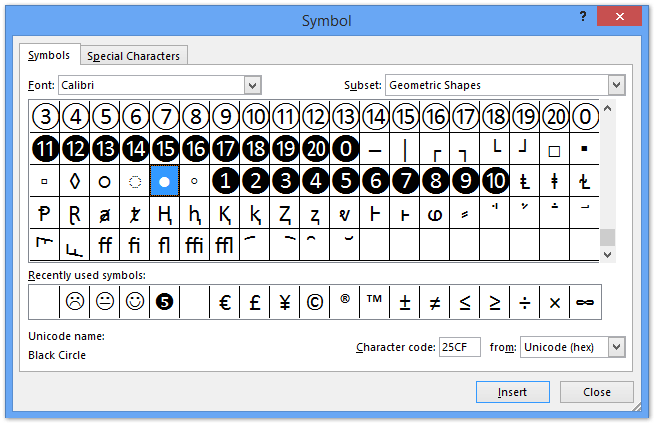

Excel inserts the symbol in the active cell. You can repeat these steps to add multiple bullet symbols where needed, and by inserting line breaks in a cell (see details here), you can place bullets on separate lines within one cell (helpful for multi-line lists).
Note: Shortcut keys are also available for quick symbol insertion. Click for a full list of alt-code shortcuts
This manual method gives you precise control over symbol positioning but can be tedious for large ranges. For faster approaches, see below.
Apply bullets to multiple cells with Add Text utility of Kutools for Excel
If you need to insert the same bullet mark across a group of cells at once, Kutools for Excel's Add Text utility provides a convenient way to append symbols to multiple cells, saving time and effort, especially for larger ranges or repeated formatting tasks. This method is ideal for range-based formatting, such as product lists, checklists, or status indicators.
1. Select the range of cells you wish to update with bullets, then go to Kutools > Text > Add Text.
2. In the Add Text dialog, perform the following:
More shortcut keys for special symbols are listed at http://www.alt-codes.net/
(1) In the Text box, type the symbol to be used as a bullet. For (●), press Alt + 41457 in sequence to insert that mark (see table for other options).
(2) Under the Position section, select "Before first character" to prepend the bullet to each existing cell value.
(3) Click Ok to instantly apply your chosen bullet symbol to all cells in the selected range.
This batch approach lets you quickly format tables, inventories, and long checklists. If cells are empty, the bullet will be the only content; if cells contain text, the bullet appears in front of it.

Kutools for Excel - Supercharge Excel with over 300 essential tools, making your work faster and easier, and take advantage of AI features for smarter data processing and productivity. Get It Now
Be cautious to confirm the selected range, as this operation will affect all specified cells. To prevent formatting errors, preview your symbol before clicking "Ok." If you need to remove added bullets later, Kutools also provides a "Remove Characters" tool that can help. For best results, check cell alignment and text wrapping for a clean look.
One click to Apply bullets and numberings into multiple cells with Kutools for Excel
With Kutools for Excel, you have access to specific features that provide a streamlined, single-click method to apply bullet points or numbering styles to multiple cells across your worksheet. This option offers efficiency when working with extensive rows or columns, such as following visual standards in reporting or automating lists in dashboards.
Select the cells you want to format with bullets, go to Kutools > Insert > Insert Bullet, then pick your preferred bullet style from the submenu. Instantly, all selected cells are updated with your chosen bullet at the beginning of the content.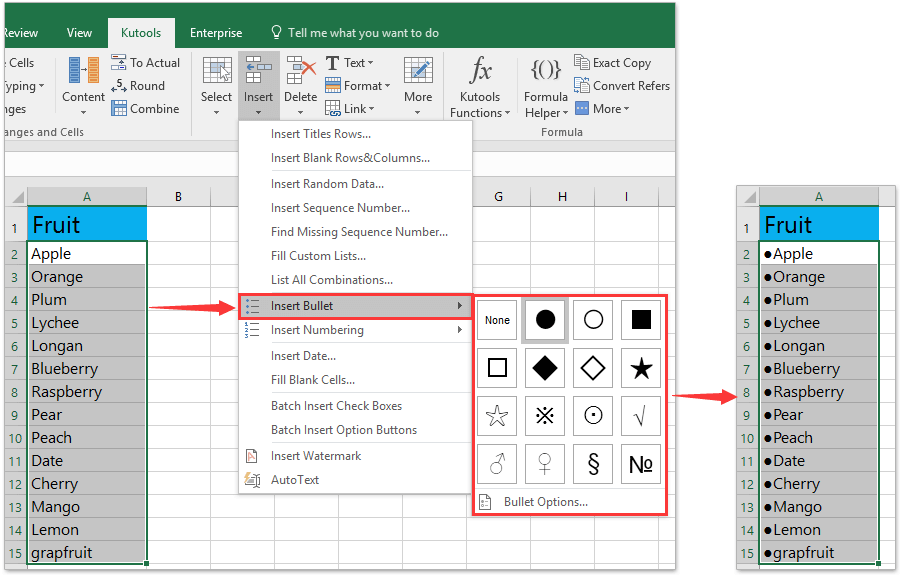
For automatic numbering, highlight your target cell range, click Kutools > Insert > Insert Numbering, and identify the numbering style from the submenu. Numbers will populate sequentially or in your selected format: 
This method is especially suitable for presentations, quantitative reports, or any scenario where fast, consistent bulleting or numbering is essential. The changes are instant and can be previewed before finalizing. If you accidentally format the wrong cells, you can undo the action with Ctrl+Z, or use the Kutools feature to reconfigure formatting.
For best results, double-check your cell selection, and ensure wrapped text is enabled if you have longer content, so your bullets and numbers display correctly.
Insert bullets or numbering in cells using Excel formulas
If you want to add bullets or sequence numbers programmatically and have dynamic updates as your cell values change, you can use Excel formulas. This approach is particularly useful when you have tables that expand or update regularly, or in dashboards where item numbering or list format needs to be automated.
1. To insert bullet points automatically, select the cell where you want the bullet (e.g., cell B1) and enter the following formula:
=CHAR(149)&" "&A12. Press Enter to see the result—this formula displays a bullet followed by the value of A1. If you want to apply it to multiple rows, copy and paste the formula down column B beside your list in column A. Adjust A1 to your starting row accordingly.
Numbering solution: To add sequential numbering automatically (like1.,2., ...), use the following formula in cell B1:
=ROW(A1)&". "&A1This formula will prefix each cell with its row number and a period. Press Enter, then drag or copy this formula as needed for more rows. For lists not starting from row 1, adjust the function accordingly (e.g., =ROW(A1)-ROW($A$1)+1 for custom starts).
Notes: If you skip rows or your data doesn't start at row 1, always verify your formula references. Formulas update dynamically as your data changes, making them ideal for tables linked to other worksheets or frequently refreshed lists.
Insert bullets or numbering in cells with VBA macro
For users who need to automate list formatting or work with extensive or frequently changing data, creating a VBA macro can be highly efficient. This method is best when you want to apply bullets or numbering to many cells in bulk or need flexible customization.
1. Go to Developer Tools > Visual Basic to open the Microsoft Visual Basic for Applications editor. Click Insert > Module, and in the module window, paste the following VBA code:
Sub InsertBulletsInRange()
    Dim Rng As Range
    Dim WorkRng As Range
    Dim cell As Range
    Dim Bullet As String

    On Error Resume Next
    xTitleId = "KutoolsforExcel"

    Set WorkRng = Application.Selection
    Set WorkRng = Application.InputBox("Select range to insert bullets:", xTitleId, WorkRng.Address, Type:=8)

    Bullet = Application.InputBox("Bullet character to insert (e.g., ●):", xTitleId, "●", Type:=2)

    For Each cell In WorkRng
        If cell.Value <> "" Then
            cell.Value = Bullet & " " & cell.Value
        End If
    Next
End Sub2. Click the  button to run the code. Select the range of cells when prompted, and enter your preferred bullet symbol when asked. The macro will insert the chosen bullet at the beginning of each non-empty cell.
Tips and troubleshooting: Make sure macros are enabled in your Excel settings. If you want to add numbering instead of bullets, use the following code instead:
Sub InsertNumberingInRange()
    Dim WorkRng As Range
    Dim i As Integer
    On Error Resume Next
    xTitleId = "KutoolsforExcel"
    Set WorkRng = Application.Selection
    Set WorkRng = Application.InputBox("Select range to insert numbering:", xTitleId, WorkRng.Address, Type:=8)
    i = 1
    For Each cell In WorkRng
        If cell.Value <> "" Then
            cell.Value = i & ". " & cell.Value
            i = i + 1
        End If
    Next
End Sub
This code asks you to select the range, then automatically numbers each cell with the format "1. value". You may customize the numbering style if needed.
Notes: Always backup your workbook before running macros, as changes cannot always be undone if overwritten. If an error occurs, check cell selection or bullet character input for compatibility issues.
When choosing a solution, consider the size of your data set, frequency of updates, and desired consistency in formatting. Manual symbol insertion works best for limited, customized formatting, while formulas and VBA code enable automation and repeatable results for larger or dynamic lists. Kutools for Excel offers simple, user-friendly tools for batch formatting and specialized needs, ensuring quick setup and adaptability for a range of scenarios. If you experience unexpected formatting results, double-check your selected ranges, formula references, or symbol compatibility to resolve issues promptly.
Demo: insert/apply bullets and numbering into multiple cells in Excel
Conclusion
Excel's Symbol feature is suitable for occasional or customized bullet insertion, but repeating the process across a large range can be time-consuming. For lists that need to update dynamically, formulas provide a practical built-in solution by combining bullet characters or sequential numbers with the original cell values.
Kutools for Excel's Add Text is useful when you want to add the same custom bullet or prefix to many existing cells at once. It provides more flexibility over the character being added and its position without requiring formulas or VBA.
Kutools for Excel's Insert Bullet and Insert Numbering provide the most direct approach for applying standard bullets or sequential numbering to multiple selected cells. Simply select the range and choose the desired style, making these tools especially convenient for quickly formatting long lists.
VBA is another option for bulk processing and offers greater customization, but it requires writing or maintaining macro code. It is better suited to users who need a reusable or customized automation workflow.
Best Office Productivity Tools
Supercharge Your Excel Skills with Kutools for Excel, and Experience Efficiency Like Never Before. Kutools for Excel Offers Over 300 Advanced Features to Boost Productivity and Save Time. Click Here to Get The Feature You Need The Most...
Office Tab Brings Tabbed interface to Office, and Make Your Work Much Easier
- Enable tabbed editing and reading in Word, Excel, PowerPoint, Publisher, Access, Visio and Project.
- Open and create multiple documents in new tabs of the same window, rather than in new windows.
- Increases your productivity by 50%, and reduces hundreds of mouse clicks for you every day!
All Kutools add-ins. One installer
Kutools for Office suite bundles add-ins for Excel, Word, Outlook & PowerPoint plus Office Tab Pro, which is ideal for teams working across Office apps.





- All-in-one suite — Excel, Word, Outlook & PowerPoint add-ins + Office Tab Pro
- One installer, one license — set up in minutes (MSI-ready)
- Works better together — streamlined productivity across Office apps
- 30-day full-featured trial — no registration, no credit card
- Best value — save vs buying individual add-in