How to save all images from a Word document
When working with Word documents that contain a significant number of images, saving each picture manually can be tedious and inefficient. Fortunately, several practical methods allow you to quickly extract all embedded images at once, streamlining the process and ensuring that no image is missed. In this tutorial, you’ll learn four effective solutions for saving every image from your Word document, each suited for different needs and scenarios.
Save all images using the Save As feature
Save all images with Kutools for Word
Save all images by changing the file extension
Use VBA code to automatically extract and save all images
Save all images using the Save As feature
The Save As feature provides a straightforward way to extract all images from a Word document at once. This approach is particularly useful if you prefer a method that doesn’t require any add-ins or advanced configuration. Here's how you can use it:

Office Tab
Tabbed navigation for Word, Excel, PowerPoint, and more—just like a web browser, with smooth switching in one window.
- Start by opening the document that contains the images you wish to save. Then navigate to File > Save As in the Word interface.
- From the Save as type drop-down list, choose Web Page (*.htm; *.html). This format exports the document in a way that separates images and other media into an external folder.
- Click Save.


After saving, a .htm file and a corresponding folder (named after your document) are generated in the location you specified. Inside this folder, you’ll find all images extracted from the document in their original formats. This method is quick and works for most standard Word documents. However, image naming can be generic, and some advanced image types may not be extracted perfectly in rare cases. For large documents, image sorting may require additional effort.
Save all images with Kutools for Word
Kutools for Word offers a dedicated feature called Export Picture/Table to Images that allows you to efficiently export all images from your document in just a few clicks. This method is especially useful for users who process documents with numerous images or need to customize export formats and destination folders.
Kutools for Word
Kutools for Word helps you handle everyday document tasks faster with practical tools built right into Microsoft Word—no coding, no complex setup.
- AI writing, polishing, translation, and summarization
- Batch find and replace across documents
- Merge and split Word documents easily
- Batch Word ↔ PDF conversion
- On the Word ribbon, click Kutools Plus > More > Export Picture/Table to Images.

- In the Export Picture/Table to Images dialog box, configure the extraction options carefully:
- Set Types to Pictures to include only images in your export.
- Select your preferred image format (such as PNG, JPG, or BMP) from the Export format drop-down list. Choosing the appropriate format ensures compatibility for future use.
- Click the
 button to specify a folder where all images will be saved. Confirm your selection to avoid exporting images to an unintended location.
- Click Export. All images from the document will be extracted and saved as individual files in your chosen folder.

 button to specify a folder where all images will be saved. Confirm your selection to avoid exporting images to an unintended location.
This solution enables batch image extraction, supports flexible formatting and provides additional benefits for handling tables or special graphics. If your document includes complex layouts or a mix of image types, Kutools helps simplify the overall process. Please ensure the target folder has write permissions to prevent errors during export.
Save all images by changing the file extension
If you prefer not to use additional software or built-in features, you can manually extract all images by converting the Word document file type. This method leverages the fact that .docx files are essentially ZIP archives containing all the document assets. While it's a bit technical, it's very effective for accessing original image files. Proceed as follows:
- Right-click your Word file and choose Rename.

- Modify the file extension by replacing .docx with .zip. Make sure you have file extensions visible in Windows Explorer.

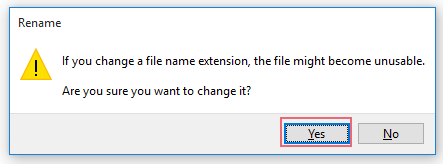
- Press Enter. If prompted with a warning message about changing the file type, click Yes to continue.
- Right-click the ZIP archive and select Extract to [file name] or use any compatible extraction tool.
- Inside the extracted folders, navigate to Word > Media. This directory contains all images embedded in the original document.


This method provides raw access to images in their original compression and quality. It's ideal for advanced users or bulk extraction. Take care not to modify files within the unzipped folder, as they may affect the ability to restore the document. If your system does not display file extensions by default, enable them for this process in Windows Explorer settings.
Use VBA code to automatically extract and save all embedded images
A VBA macro offers an automated solution for extracting and exporting all embedded images from your active Word document to a specified folder. This is particularly beneficial for users who frequently handle documents with numerous images and prefer a hands-off, repeatable process. The VBA approach is flexible—you can customize the export destination and run the extraction with minimal user interaction.
It is best suited for users who are comfortable with basic macro operations in Word. Before proceeding, ensure macros are enabled and you have permission to run VBA on your device. Note that this solution works for inline and floating images but may not extract shapes or charts as images.
1. Open the Word document containing the images to extract. Make sure the document is active and visible.
2. Press the Alt + F11 keys to open the Microsoft Visual Basic for Applications window.
3. In the VBA window, click Insert > Module. Then copy and paste the following VBA code into the Module panel:
VBA code: Extract and save all embedded images from the active document
Sub ExportImagesPreserveOriginal()
'Updated by Extendoffice.com
    Dim doc As Document
    Dim tempPath As String
    Dim exportFolder As String
    Dim fso As Object
    Dim htmlPath As String
    Dim imgFolder As String
    Dim file As Object
    Dim subFolder As Object
    Dim xTitleId As String
    Dim foundImages As Boolean

    On Error Resume Next
    xTitleId = "Kutools for Word"

    ' Ask user for destination folder
    exportFolder = InputBox("Enter the full folder path to save images:", xTitleId, "C:\ExtractedImages")
    If exportFolder = "" Then Exit Sub
    If Right(exportFolder, 1) <> "\" Then exportFolder = exportFolder & "\"

    Set fso = CreateObject("Scripting.FileSystemObject")
    If Not fso.FolderExists(exportFolder) Then fso.CreateFolder exportFolder

    ' Save current document as filtered HTML (temporary)
    Set doc = ActiveDocument
    tempPath = Environ("TEMP") & "\WordImageExport_"
    htmlPath = tempPath & Format(Now, "yyyymmdd_hhnnss") & ".htm"

    doc.SaveAs2 FileName:=htmlPath, FileFormat:=wdFormatFilteredHTML

    ' Find the generated "_files" folder that contains the images
    imgFolder = Left(htmlPath, Len(htmlPath) - 4) & "_files"

    foundImages = False
    If fso.FolderExists(imgFolder) Then
        For Each file In fso.GetFolder(imgFolder).Files
            If LCase(Right(file.Name, 4)) = ".jpg" Or _
               LCase(Right(file.Name, 4)) = ".png" Or _
               LCase(Right(file.Name, 4)) = ".gif" Or _
               LCase(Right(file.Name, 4)) = ".bmp" Then
                fso.CopyFile file.Path, exportFolder & file.Name, True
                foundImages = True
            End If
        Next file
    Else
        For Each subFolder In fso.GetFolder(fso.GetParentFolderName(htmlPath)).SubFolders
            If InStr(1, subFolder.Name, "_files", vbTextCompare) > 0 Then
                For Each file In subFolder.Files
                    fso.CopyFile file.Path, exportFolder & file.Name, True
                    foundImages = True
                Next file
            End If
        Next subFolder
    End If

    On Error Resume Next
    fso.DeleteFile htmlPath, True
    fso.DeleteFolder imgFolder, True

    If foundImages Then
        MsgBox "All images have been exported successfully to:" & vbCrLf & exportFolder, vbInformation, xTitleId
    Else
        MsgBox "No images found in the document.", vbExclamation, xTitleId
    End If
End Sub4. Press the F5 key to run the macro. When prompted, specify the destination folder (e.g., C:\ExtractedImages) where you want all images saved.
This macro will process all inline and floating images from the active Word document, copying each to a new file in your chosen folder. Make sure the folder exists and you have permission to write files. Resulting images will be saved in its original file format. If you encounter errors, verify folder paths and macro security settings.
This VBA approach is highly effective for repetitive tasks and large quantities of images. However, it may not extract other graphic types such as SmartArt or equations. For users unfamiliar with VBA, reviewing macro safety and backup practices is recommended before proceeding.
Best Office Productivity Tools
Kutools for Word - Elevate Your Word Experience with Over 100 Remarkable Features!
🤖 Kutools AI Features: AI Assistant / Real-Time Assistant / Super Polish (Preserve Format) / Super Translate (Preserve Format) / AI Redaction / AI Proofread...
📘 Document Mastery: Split Pages / Merge Documents / Export Selection in Various Formats (PDF/TXT/DOC/HTML...) / Batch Convert to PDF...
✏ Contents Editing: Batch Find and Replace across Multiple Files / Resize All Pictures / Transpose Table Rows and Columns / Convert Table to Text...
🧹 Effortless Clean: Sweap away Extra Spaces / Section Breaks / Text Boxes / Hyperlinks / For more removing tools, head to the Remove group...
➕ Creative Inserts: Insert Thousand Separators / Check Boxes / Radio Buttons / QR Code / Barcode / Multiple Pictures / Discover more in the Insert group...
🔍 Precision Selections: Pinpoint Specific Pages / Tables / Shapes / Heading Paragraphs / Enhance navigation with more Select features...
⭐ Star Enhancements: Navigate to Any Location / Auto-Insert Repetitive Text / Toggle Between Document Windows / 11 Conversion Tools...
🌍 Supports 40+ Languages: Use Kutools in your preferred language – supports English, Spanish, German, French, Chinese, and 40+ others!

Office Tab - Brings Tabbed interface to Office, Make Your Work Much Easier
- Enable tabbed editing and reading in Word, Excel, PowerPoint, Publisher, Access, Visio and Project.
- Open and create multiple documents in new tabs of the same window, rather than in new windows.
- Increases your productivity by 50%, and reduces hundreds of mouse clicks for you every day!
✨ Kutools for Office – One Installation, Five Powerful Tools!
Includes Office Tab Pro · Kutools for Excel · Kutools for Outlook · Kutools for Word · Kutools for PowerPoint
📦 Get all 5 tools in one suite | 🔗 Seamless integration with Microsoft Office | ⚡ Save time and boost productivity instantly
Best Office Productivity Tools
Kutools for Word - 100+ Tools for Word
- 🤖 Kutools AI Features: AI Assistant / Real-Time Assistant / Super Polish / Super Translate / AI Redaction / AI Proofread
- 📘 Document Mastery: Split Pages / Merge Documents / Batch Convert to PDF
- ✏ Contents Editing: Batch Find and Replace / Resize All Pictures
- 🧹 Effortless Clean: Remove Extra Spaces / Remove Section Breaks
- ➕ Creative Inserts: Insert Thousand Separators / Insert Check Boxes / Create QR Codes
- 🌍 Supports 40+ Languages: Kutools speaks your language – 40+ languages supported!