How to insert bullet points in text box or specific cells in Excel?
When working in Excel, it’s common to organize lists, highlight key points, or visually separate content using bullet points—just as you might in Word or PowerPoint. However, unlike typical word processors, Excel does not provide a dedicated button for bullet points in cells or text boxes, which can make the process less straightforward. This tutorial introduces practical and efficient ways to insert bullet points in Excel, whether for presentation, clarity, or to meet consistent formatting requirements in reports and dashboards. The methods covered address both standard and advanced scenarios, including options for handling large datasets or batch operations.
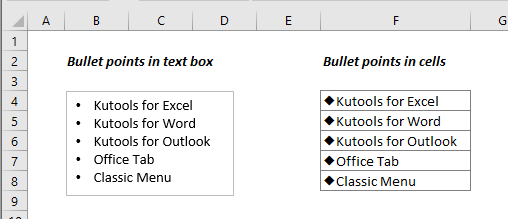
Insert bullet points in cells in Excel
Method A: Insert bullet points in cells with the Format Cells feature
Method B: Insert bullet points in cells with Shortcut
Method C: Insert bullet points in cells with the Insert Symbol feature
Method D: Insert bullet points in cells with formula
Quickly insert bullet points in cells with an awesome feature
Insert bullet points in multiple cells or text boxes via VBA macro
| Feature | Format Cells | Shortcut | Insert Symbol | Formula | Kutools for Excel |
|---|---|---|---|---|---|
| Best for | Applying the same bullet format to multiple cells at once | Quickly adding bullets to a few cells manually | Inserting customized bullet symbols | Adding bullets to a list dynamically with formulas | Quickly adding bullet points to one or multiple ranges |
| Batch processing | Yes | No | No | Yes | Yes |
| Bullet style flexibility | Limited | Moderate | High | Limited to the symbol used in the formula | High; provides multiple bullet styles |
| Main advantage | Fast and consistent for formatting multiple cells | Simple and quick for a small number of entries | Offers more bullet-symbol choices | Efficient for long lists and dynamic data | Adds bullets to selected cells in just a few clicks, with no formulas or manual entry |
| Main limitation | Bullet is part of the cell format rather than the actual text | Must be entered manually and requires a numeric keypad | Repetitive for large amounts of data | Requires a helper/output column and formula | Requires Kutools for Excel |
| Recommended use | Consistent bullet formatting across a selected range | Small lists or occasional manual entry | Customized bullet styles in a few cells | Large or frequently changing lists | Large ranges, multiple ranges, or frequent batch formatting |
Insert bullet points in text box in Excel
Text boxes in Excel are often used for explanatory notes, titles, or labels. If you wish to clearly format the contents, adding bullet points within a text box enhances readability and professionalism, especially for instructions, process steps, or itemized lists.
To insert bullet points within a text box, follow these steps:
1. Click to select the text box you want to edit, then highlight the content you wish to format with bullets. Right-click the selected text, choose Bullets from the context menu (if available), and select your preferred bullet style.
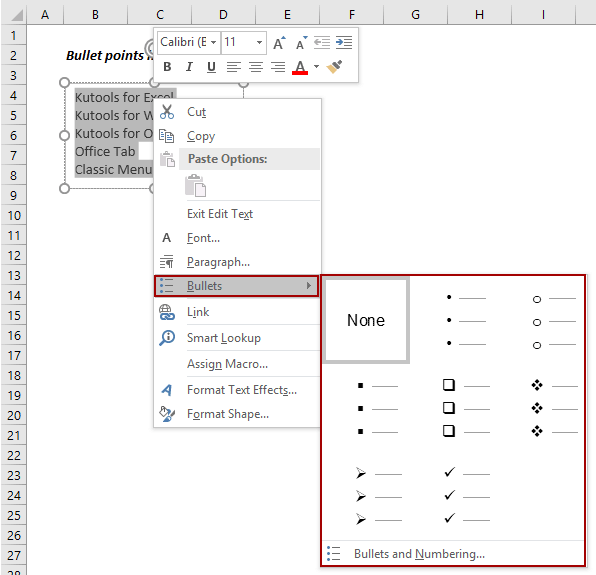
This action inserts a bullet point before each line of text in your selected text box, instantly improving the presentation and organization of your information.

Only several clicks to insert bullet points in selected cells at once:
The Insert Bullet utility of Kutools for Excel lets you quickly insert bullet points into cells across a selected range or even multiple ranges with only a few clicks, saving significant time when formatting lists or tables. This feature is especially valuable in large workbooks, routinely updated templates, or when preparing sharable summaries. See the below demonstration for reference:

Kutools for Excel - Supercharge Excel with over 300 essential tools, making your work faster and easier, and take advantage of AI features for smarter data processing and productivity. Get It Now
Insert bullet points in cells in Excel
Whether you're managing tasks, making itemized schedules, or simply want to create visually clear lists within worksheet cells, adding bullet points directly in cells is a common need. Below, several methods are provided to address various use cases—from manual entry to automated solutions for larger data sets.
Method A: Insert bullet points in cells with the Format Cells feature
This approach is suitable if you want all selected cells to have a uniform bullet formatting, especially for text-based lists or tables.
1. Select the cells where you want to insert bullet points (you can select non-adjacent cells using Ctrl+click). Right-click one of the selected cells and choose Format Cells from the context menu.

2. In the Format Cells window, switch to the Number tab. In the Category list, select Custom. Next, enter the following code into the Type field, then click OK.
• @

This custom format prepends a bullet point to every cell you selected, making them stand out visually.

Method B: Insert bullet points in cells with Shortcut
If you prefer manual input, you can use keyboard shortcuts to add bullet points. The Alt +7 shortcut on the numeric keypad inserts a standard bullet symbol (•). This is quick for individual entries, such as interactive list-making or ad hoc presentations.
1. Double-click the cell (or press F2) you want to edit, so the cursor appears inside.
2. Hold down the Alt key and, using the numeric keypad, press 7. Release the Alt key, and the bullet point will appear.

Note: The numeric keypad must be used for this shortcut; it will not work with the top-row numbers. Repeat these steps for each cell where you want to add a bullet point.
Pros: This approach gives you full control over where to add bullets, allows for custom spacing, and can be combined with other text. Cons: It can be slow for large data ranges and prone to human error from manual input.
Method C: Insert bullet points in cells with the Insert Symbol feature
For more flexibility or access to various types of bullet symbols, use the Insert Symbol function. This method is helpful when you want custom symbols or to avoid using keyboard shortcuts on devices lacking full keypads.
1. Activate the cell for editing by double-clicking (or pressing F2) in the cell you want to add a bullet point.
2. Go to the Insert tab in the Ribbon and click the Symbol button.

3. When the Symbol window opens, expand the Subset dropdown and select General Punctuation. Scroll to find the bullet •, then click Insert. Optionally, you can select other bullet shapes as needed for your formatting standard.

Note: For batch entry or large data sets, this process may be repetitive; consider using formulas, VBA, or Kutools for more efficiency.
Method D: Insert bullet points in cells with formula
For consistent formatting across a column or range—such as transforming a list into a bulleted format—you can use an Excel formula to generate bullet points automatically. This is particularly efficient when you have a list of items that needs the same formatting applied at scale.
1. Enter the following formula in the target cell, for example, D4:
=CHAR(149)&" "&B42. Press Enter to confirm. To apply the formula to additional rows, select the cell containing the formula (e.g., D4), then drag the Fill Handle down to cover the required range. This copies the formula and inserts bullet points for each corresponding value in column B.

Tips:
- The
CHAR(149)returns the • symbol in most fonts. Some font settings may display a different symbol or shape—confirm your worksheet’s font compatibility for best results. - If you want to add bullet points to values across different columns, adjust the cell references in the formula as needed.
- To use a different symbol, substitute the CHAR code or character accordingly (for example,
CHAR(183)for a middle dot).
Quickly insert bullet points in cells with an awesome feature
While the manual and formula-based approaches above work well for smaller or one-off lists, you may need to format a large number of cells or perform batch updates. In that case, the Insert Bullet utility in Kutools for Excel provides an automatic way to insert bullet points in one or multiple ranges with just a few clicks. Some advantages include: faster operation, support for different bullet styles, and compatibility with merged or multi-line cells.
1. Select the list of cells in which you want to insert bullet points, click Kutools > Insert > Insert Bullet. A submenu will appear where you can select your preferred bullet style.

The selected cells will instantly display bullet points, saving time compared to manual entry or repetitive formatting.
Kutools for Excel - Supercharge Excel with over 300 essential tools, making your work faster and easier, and take advantage of AI features for smarter data processing and productivity. Get It Now
Insert bullet points in multiple cells or text boxes via VBA macro
If you’re working with extensive data or repetitive tasks—such as inserting bullet points across hundreds of cells—a VBA macro provides an efficient, customizable solution. This approach allows you to automate the process fully, reducing manual input and the potential for errors, and is especially practical when handling standardized reports or when importing data without list formatting.
1. Click Developer Tools > Visual Basic. In the Microsoft Visual Basic for Applications window, click Insert > Module. Enter the following code into the Module panel:
Sub InsertBulletsInRange()
    Dim Rng As Range
    Dim WorkRng As Range
    Dim cell As Range
    Dim xTitleId As String

    On Error Resume Next
    xTitleId = "KutoolsforExcel"

    Set WorkRng = Application.Selection
    Set WorkRng = Application.InputBox("Select cell range", xTitleId, WorkRng.Address, Type:=8)

    For Each cell In WorkRng
        If cell.HasFormula = False Then
            cell.Value = "• " & cell.Value
        End If
    Next
End Sub
2. Click the  button to run the macro. A dialog will prompt you to select the target range for adding bullet points. After confirming, all cell contents in the selected range will be prefixed with a bullet (•).
Conclusion
Adding bullet points to Excel cells can make lists, notes, and worksheet content easier to read and organize. The best method depends on whether you are working with a few cells, a large range, or data that changes frequently.
Format Cells is useful for applying consistent bullet formatting to multiple cells, while Shortcut and Insert Symbol are convenient for occasional manual entry. Formulas work well for dynamic lists that need to update with source data. For faster batch processing, Kutools for Excel lets you add different bullet styles to one or multiple ranges in just a few clicks, without formulas or repeated manual entry.
Tip: If you only need bullets for display, Format Cells may be sufficient. If the bullet needs to become part of the actual cell content, consider using a shortcut, symbol, formula, or Kutools instead.
Choose the manual methods for small lists, formulas for dynamic data, or Kutools when you need a quick and flexible way to add bullet points across larger or multiple ranges.
Related articles
Allow only numbers to be input in text box
If you want to allow only numbers to be typed into a text box, the method in this article will do you a favor
Automatically resize the text box to fit the content in Excel
The text box size is fixed after inserting it in a worksheet. So the size won’t adjust to fit the text you inserted or deleted. This article aims to show you methods of automatically resizing the text box to fit the content in Excel.
Find and replace specific text in text boxes
This article provides the VBA method in detail to help you find and replace texts in text boxes only.
Insert picture into text box in Excel
By default, we can insert a picture or image into a worksheet as quickly by using the Insert function, but, this feature is not applied to inserting a picture into a textbox. With this article, you will learn how to insert a picture into a textbox as you need.
Best Office Productivity Tools
Supercharge Your Excel Skills with Kutools for Excel, and Experience Efficiency Like Never Before. Kutools for Excel Offers Over 300 Advanced Features to Boost Productivity and Save Time. Click Here to Get The Feature You Need The Most...
Office Tab Brings Tabbed interface to Office, and Make Your Work Much Easier
- Enable tabbed editing and reading in Word, Excel, PowerPoint, Publisher, Access, Visio and Project.
- Open and create multiple documents in new tabs of the same window, rather than in new windows.
- Increases your productivity by 50%, and reduces hundreds of mouse clicks for you every day!
All Kutools add-ins. One installer
Kutools for Office suite bundles add-ins for Excel, Word, Outlook & PowerPoint plus Office Tab Pro, which is ideal for teams working across Office apps.





- All-in-one suite — Excel, Word, Outlook & PowerPoint add-ins + Office Tab Pro
- One installer, one license — set up in minutes (MSI-ready)
- Works better together — streamlined productivity across Office apps
- 30-day full-featured trial — no registration, no credit card
- Best value — save vs buying individual add-in