How to create a desktop shortcut for Outlook calendar/specific folder?
By default, when you launch Microsoft Outlook—whether by double-clicking its icon on the desktop or selecting it from the Start menu—it opens your Inbox, which is set as the default folder for your primary email account. However, some users may want to access a different folder directly for convenience, such as their Calendar, Contacts, Tasks, or any custom folder. For instance, if your daily workflow revolves around scheduling appointments or reviewing upcoming events, opening the Calendar folder directly can streamline your process. This tutorial outlines practical solutions to open a specific Outlook folder quickly by either creating a new desktop shortcut or modifying your existing shortcut. These approaches can improve efficiency and ensure you’re taken straight to the folder you need without extra navigation.
Create a new desktop shortcut for Outlook calendar/specific folder
Change original desktop shortcut for Outlook calendar/specific folder
Create a new desktop shortcut for Outlook calendar/specific folder
This method demonstrates how to add a dedicated shortcut to your desktop for a particular Outlook folder, such as Calendar, Tasks, Contacts, or any other folder you frequently use. This is especially helpful if you want fast access without navigating from the default Inbox each time you start Outlook.
1. Begin by locating the folder containing the Microsoft Outlook program. Open File Explorer, then paste the following path into the address bar and press Enter:
C:\Program Files\Microsoft Office\Office15 
Notes:
(1) If you're using Outlook 2016, update the path to Office16. For Outlook 2010, use Office14. If you have a different version, adjust the folder name accordingly (e.g., Office19 for newer subscriptions).
(2) If Microsoft Office or Outlook was installed to a custom directory, navigate to that location instead.
(3) You may want to check your installed version through Outlook (File > Office Account) before proceeding, to make sure you’re using the correct folder path.
2. Once you locate the folder, find the Outlook application file (OUTLOOK.EXE). Right-click it and select Send to > Desktop (create shortcut) in the context menu. This action creates a shortcut on your desktop. 
3. After creating the desktop shortcut, locate it on your desktop. Right-click the shortcut and select Properties from the context menu. 
4. In the Properties dialog box, click the Shortcut tab. In the "Target" field, add a space and then /select outlook:calendar to the end of the path. Click OK to save changes. This modification will direct Outlook to open the Calendar folder by default. 
Notes:
(1) After updating, the line could read (for Outlook 2016):
"C:\Program Files\Microsoft Office\root\Office16\OUTLOOK.EXE" /select outlook:calendar
The actual Office version number (16,15, etc.) should match your installation.
(2) If your target folder’s name contains spaces, enclose the folder name in quotation marks. For example: "C:\Program Files\Microsoft Office\root\Office16\OUTLOOK.EXE" /select "outlook:Sent Items"
(3) For subfolders, specify the main folder and then a slash for the subfolder. Example: "C:\Program Files\Microsoft Office\root\Office16\OUTLOOK.EXE" /select outlook:Contacts/B
(4) Be careful to include the space between OUTLOOK.EXE" and /select. Mistyped command lines may result in errors or Outlook refusing to launch.
5. While the desktop shortcut is still selected, right-click and choose Rename to give it a meaningful name, such as "Outlook_Calendar" or "Outlook_Tasks". This will help you quickly identify the shortcut among other desktop icons.
For instance, you may rename it to Outlook_Calendar. 

After these steps, double-clicking the newly created shortcut will open Outlook directly to your specified folder (e.g., Calendar) instead of your Inbox. This saves you time and helps prevent distractions by focusing on the folder you require most.
Depending on system security settings, you may be prompted for permission when launching Outlook via shortcut for the first time—if so, confirm that you trust the shortcut and allow access.
Automatically reply with the default email account in Outlook
By default, Outlook detects the account tied to an active email and replies using that account automatically. However, if you want to always reply using your default account regardless of the message's original mailbox, you can use Kutools for Outlook's "Always reply with default account" feature. This ensures consistency and greater control, especially useful for users who manage multiple mailboxes or send from shared folders. 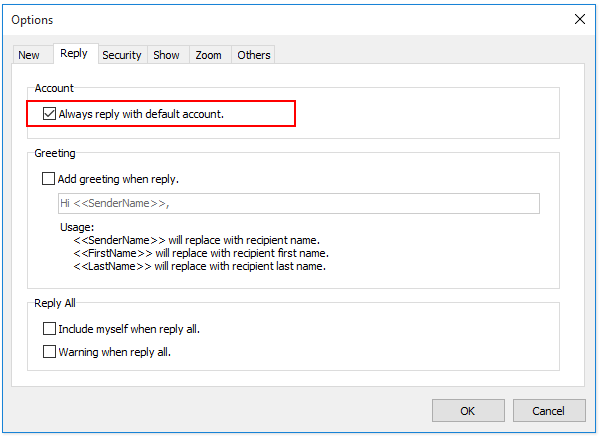
Change original desktop shortcut for Outlook calendar/specific folder
Alternatively, you can configure Outlook to open a specific folder as the default start folder each time you launch the application. This is accomplished through the program's built-in options and does not require editing shortcuts or creating new icons.
This method is particularly suitable for those who prefer using the standard Outlook startup process, and want to change the folder that loads by default—such as when their workflow shifts from Inbox to Calendar, Contacts or another mailbox folder for a period.
1. In Outlook, click File in the top left corner, then select Options from the menu.
2. In the Outlook Options dialog box, click Advanced in the left sidebar. Under the Outlook start and exit section, click the Browse button. 
3. The Select Folder dialog box will appear. Select the folder you wish Outlook to display at startup, then click OK. 
You can select any available folder, including Calendar, Contacts, Tasks, custom subfolders, or even folders belonging to other email accounts. Be sure the folder exists and is accessible to avoid startup errors.
4. Click the OK button in the Outlook Options dialog box to finalize your changes. The next time you start Outlook, it will open directly to the folder you've chosen.
This method is efficient if you need to switch default start folders temporarily—such as for project work, busy scheduling periods, or when collaborating within shared folders. It eliminates the need to create multiple desktop shortcuts, but you will need to repeat these steps to revert to your original start folder.
Summary recommendation: If you frequently jump between folders, using custom desktop shortcuts is most flexible. If your workflow centers on one folder for a long duration, changing the default start folder may be preferable.
Use VBA code to open Outlook directly to a specific folder
For users who need more advanced control—such as launching Outlook to a specific subfolder based on context, automating folder access at startup, or integrating with scripts—a VBA approach is available. This solution can be customized and is useful for IT professionals or those comfortable with basic programming. It adds flexibility where standard shortcut or settings may be limited.
1. Before you begin, open Outlook and select the folder you wish to target (e.g., Calendar or a custom subfolder). Then, press Alt + F11 to bring up the Microsoft Visual Basic for Applications editor in Outlook.
2. In the VBA editor, click Insert > Module. Then copy and paste the following VBA code into the newly created module.
VBA code: Open Outlook directly to your chosen folder
Sub OpenSpecificOutlookFolder()
    Dim myNamespace As Outlook.NameSpace
    Dim myFolder As Outlook.Folder

    On Error Resume Next
    xTitleId = "KutoolsforOutlook"

    Set myNamespace = Application.GetNamespace("MAPI")

    ' Example opens Calendar; change "Calendar" to another folder name as needed
    Set myFolder = myNamespace.GetDefaultFolder(olFolderCalendar)

    If Not myFolder Is Nothing Then
        myFolder.Display
    Else
        MsgBox "Unable to open the specified folder.", vbExclamation, xTitleId
    End If

    Set myFolder = Nothing
    Set myNamespace = Nothing
End Sub3. Once the code is in place, press F5 to run the macro. Outlook will switch to (or display) the folder specified in the code (such as Calendar). If you need to target a different folder, modify olFolderCalendar to match another predefined folder constant, such as olFolderInbox, olFolderContacts, or use GetFolderFromID for custom folders.
Remember: Always select or specify the target folder in the VBA code before executing. You can run this macro anytime, or assign it to a button for quick folder switching, adding further efficiency to your workflow.
Advantage: VBA solutions can automate the process, be customized for complex setups, or used in combination with other scripts.
Limitation: This solution does not create a desktop shortcut, but allows folder switching from within Outlook.
Related Articles
Best Office Productivity Tools
Experience the all-new Kutools for Outlook with 100+ incredible features! Click to download now!
📧 Email Automation: Auto Reply (Available for POP and IMAP) / Schedule Send Emails / Auto CC/BCC by Rules When Sending Email / Auto Forward (Advanced Rules) / Auto Add Greeting / Automatically Split Multi-Recipient Emails into Individual Messages ...
📨 Email Management: Recall Emails / Block Scam Emails by Subjects and Others / Delete Duplicate Emails / Advanced Search / Consolidate Folders ...
📁 Attachments Pro: Batch Save / Batch Detach / Batch Compress / Auto Save / Auto Detach / Auto Compress ...
🌟 Interface Magic: 😊More Pretty and Cool Emojis / Remind you when important emails come / Minimize Outlook Instead of Closing ...
👍 One-click Wonders: Reply All with Attachments / Anti-Phishing Emails / 🕘Show Sender's Time Zone ...
👩🏼🤝👩🏻 Contacts & Calendar: Batch Add Contacts From Selected Emails / Split a Contact Group to Individual Groups / Remove Birthday Reminders ...
Use Kutools in your preferred language – supports English, Spanish, German, French, Chinese, and 40+ others!


🚀 One-Click Download — Get All Office Add-ins
Strongly Recommended: Kutools for Office (5-in-1)
One click to download five installers at once — Kutools for Excel, Outlook, Word, PowerPoint and Office Tab Pro. Click to download now!
- ✅ One-click convenience: Download all five setup packages in a single action.
- 🚀 Ready for any Office task: Install the add-ins you need, when you need them.
- 🧰 Included: Kutools for Excel / Kutools for Outlook / Kutools for Word / Office Tab Pro / Kutools for PowerPoint