How to go back to previous/last sheet with shortcut in Excel?
When working with Excel workbooks that contain a large number of worksheets, navigation can quickly become challenging. Sometimes, you may need to return to the last or previous sheet—whether for copying data, referencing information, or simply resuming work on an earlier tab. As the sheet names accumulate and crowd the Sheet bar, picking out the proper worksheet becomes tedious and time-consuming. Efficiently switching between sheets without manually searching the tab bar can significantly speed up your workflow and reduce errors.
Excel does not provide a native shortcut key for instantly returning to the previous or last active sheet, which often leads users to perform multiple clicks or lose track during frequent navigations. To address this common issue, the following practical solutions offer methods to shortcut the process and quickly move between the last used worksheet and the current one. Each approach introduces distinct benefits and some specific considerations, ensuring you find a method that best matches your working style and technical needs:
➤ Go back to previous/last sheet by shortcut with Kutools for Excel (only one click)
Additionally, in some cases, alternative techniques such as using Excel’s formula functions or third-party add-ins may offer supplementary approaches for navigating sheets. Relevant links to such solutions can be found in the table of contents above.
| Feature | VBA + Custom Shortcut | Kutools Switch Between Last and Current Sheet |
|---|---|---|
| Go back to the last visited worksheet | ✔ | ✔ |
| Toggle between current and previous worksheet | ✔ | ✔ |
| Built-in keyboard shortcut | Requires assigning a custom shortcut | Built-in shortcut (Win + A) |
| One-click operation | ✘ | ✔ |
| Requires VBA setup | ✔ | No need |
| Requires Developer tab | ✔ | No need |
| Works immediately after installation | Built-in | ✔ |
| Number of setup steps | Multiple VBA configuration steps | No configuration required |
| Best for | Users comfortable with VBA customization | Anyone who frequently switches between two worksheets |
| Ease of use | Moderate | Very easy |
Go back to previous/last sheet with VBA
Using VBA (Visual Basic for Applications), you can create a customized macro that tracks worksheet navigation and enables you to switch instantly between the last used sheet and your current sheet within the same workbook. This method is suitable if you are comfortable with enabling and editing macros in Excel. The VBA approach provides the flexibility to assign your preferred shortcut keys, automating the switch operation and minimizing manual searching.
1. Press Alt + F11 to open the Microsoft Visual Basic for Applications window. This action launches the VBA Editor, where you can insert and modify custom code for your workbook.
2. In the Project panel on the left side, double-click ThisWorkbook. This location is used to handle workbook-level events, which is necessary for tracking when worksheets are activated. Paste the following code into the window that opens:
VBA1: Go back to previous/last sheet
Private Sub Workbook_SheetDeactivate(ByVal Sh As Object)
LastSheet = Sh.Name
End Sub
The above code records the current and previous worksheet names, making it possible to jump back to the last sheet you visited.
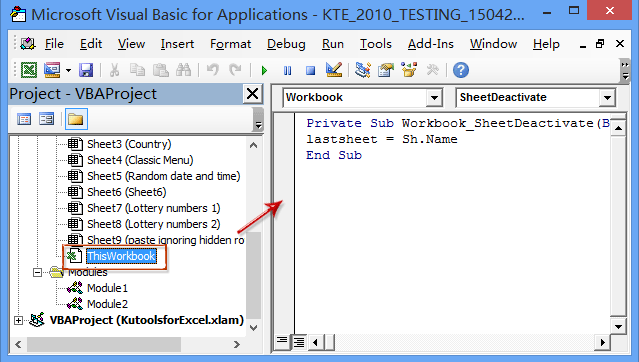
3. While ThisWorkbook remains selected in the left bar, click Insert > Module to create a new module. In the code window for this Module, paste the following code:
VBA2: Go back to previous/last sheet
Public LastSheet As String
Sub Select_Last()
Application.Sheets(LastSheet).Select
End Sub
This procedure is used for switching back to the previous sheet when executed.
After pasting each code snippet, make sure that you have entered the code in the correct locations—event-handling code goes in ThisWorkbook, and procedures that can be run as macros go in Module. This separation is important for the macro to function correctly.
You can now run the macro by pressing the F5 key in the VBA Editor or by clicking the Run button on the toolbar. This immediately makes Excel switch from the active sheet to the previously used sheet within the workbook.
To streamline this process even further—especially if you want to use keyboard shortcuts for rapid sheet switching—follow the remaining steps:
4. In Excel, click Developer > Macros. This opens the Macro dialog box, which lists all macros available in the workbook.
Note: If you do not see the Developer tab on the Ribbon, you may need to enable it first. See this guide: How to show/display developer tab in Excel Ribbon.
5. In the Macro dialog box, select the macro named Select Last, then click the Options button.
6. In the Shortcut key field, assign a shortcut (such as Ctrl + b) to the Select Last macro. Click OK to save your changes and close the dialog box.
Tip: Choose a shortcut that does not conflict with Excel's built-in shortcuts for smooth operation.
7. Close the Macro dialog box once the shortcut key is set.
From this point onwards, you can easily navigate between the current and previous worksheet by pressing the shortcut keys you assigned (for example, Ctrl + b). This is especially helpful when you routinely work across multiple sheets or need to copy and compare data quickly. If you find the shortcut is not working as expected, double-check your macro security settings and ensure macros are enabled for your workbook.
Advantages: The VBA method can be fully customized and does not require any add-ins. The main drawback is the need to enable macros, which may be restricted in some corporate policy settings. Also, saving your Excel file as a macro-enabled (.xlsm) format is necessary to preserve the code.
Common troubleshooting points include macro security restrictions, incorrect placement of code (event code must be in ThisWorkbook and the macro in Module), or shortcut conflicts. Always save a backup before editing any VBA code.
Go back to previous/last sheet by shortcut with Kutools for Excel

If you have installed Kutools for Excel, navigation between worksheets becomes even more convenient. Kutools provides the dedicated Switch between last and current sheet utility, designed to let users switch instantly between their most recent and current sheets with a single click or a simple keyboard shortcut.
The feature is especially useful for users who regularly jump between non-adjacent sheets or work in larger workbooks, as it eliminates the need for manual searching or additional setup steps. It is ideal for those who prefer ready-made solutions without programming or enabling macros.
Kutools for Excel - Packed with over 300 essential tools for Excel. Make Excel tasks faster, easier, and more efficient. Download now!
Simply click the  button located in the Navigation Pane, or press Win + A on your keyboard to switch between the last and current worksheet. The shortcut allows you to toggle back and forth instantly, making repetitive data entry or referencing tasks much smoother.
Note: Once Kutools for Excel is installed, the Navigation Pane appears automatically. If you do not see the Navigation Pane or the button, activate it by clicking Kutools > Navigation (or View > Navigation). Then click the  button on the far left of the Navigation Pane to ensure full access to all navigation functions.
The main advantage of the Kutools approach is its reliability and user-friendly interface, requiring no coding or macro security adjustments. However, Kutools is a third-party add-in and must be installed first; availability and version requirements should be checked to ensure compatibility with your version of Excel.
Tip: If the shortcut or Navigation Pane is not immediately responsive, verify that Kutools is properly installed and enabled. If necessary, restart Excel or reinstall Kutools. Also, confirm the assigned shortcut keys in the Kutools options if you wish to customize them for even faster access.
Kutools for Excel - Supercharge Excel with over 300 essential tools, making your work faster and easier, and take advantage of AI features for smarter data processing and productivity. Get It Now
Both methods described above allow you to return quickly to the previous or last used worksheet, addressing daily practical navigation demands and helping prevent mistakes caused by selecting the wrong sheet in crowded workbooks. If you need to switch between two specific sheets repeatedly, or navigate workbook windows more efficiently, see the Related Articles section below for additional techniques.
Demo: one click to go back to previous/last sheet
Related articles:
Toggle / switch between two sheets back and forth
Navigate between windows in Workbooks
Best Office Productivity Tools
Supercharge Your Excel Skills with Kutools for Excel, and Experience Efficiency Like Never Before. Kutools for Excel Offers Over 300 Advanced Features to Boost Productivity and Save Time. Click Here to Get The Feature You Need The Most...
Office Tab Brings Tabbed interface to Office, and Make Your Work Much Easier
- Enable tabbed editing and reading in Word, Excel, PowerPoint, Publisher, Access, Visio and Project.
- Open and create multiple documents in new tabs of the same window, rather than in new windows.
- Increases your productivity by 50%, and reduces hundreds of mouse clicks for you every day!
All Kutools add-ins. One installer
Kutools for Office suite bundles add-ins for Excel, Word, Outlook & PowerPoint plus Office Tab Pro, which is ideal for teams working across Office apps.





- All-in-one suite — Excel, Word, Outlook & PowerPoint add-ins + Office Tab Pro
- One installer, one license — set up in minutes (MSI-ready)
- Works better together — streamlined productivity across Office apps
- 30-day full-featured trial — no registration, no credit card
- Best value — save vs buying individual add-in