How to rename a Word document?
Renaming a Word document might seem like a basic task, but doing it correctly—and efficiently—can significantly improve your digital organization. Depending on whether your file is currently open or closed, the process varies. This guide details all proven methods and highlights common pitfalls to avoid.

Rename a Word Document While It’s Open
Rename a closed Word document
When a Word file is not open, renaming it is quick and risk-free because the file isn’t locked by Microsoft Word.
- Open the folder containing the Word document you want to rename.
- Click on the document and press F2 to enter edit mode.
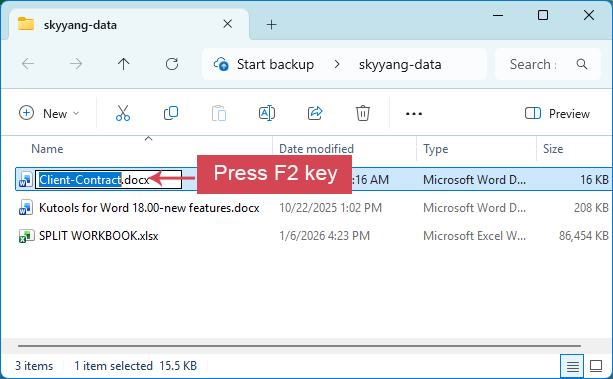
- Type the new name and press Enter to complete the rename.
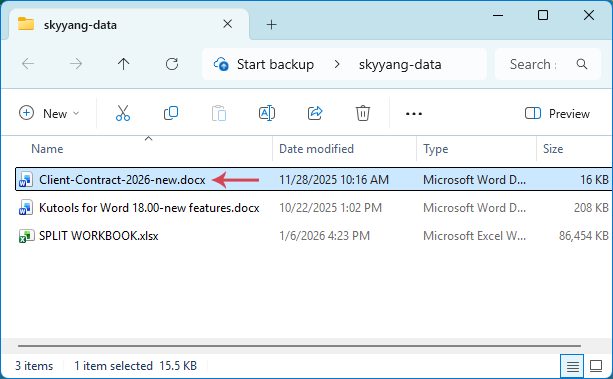
- Simple renaming
- Files not currently in use
- Avoiding accidental overwrite issues
Rename a Word Document While It’s Open
If the document is already open in Word, you should never rename it directly from File Explorer. Instead, use one of the safe methods below.
Method 1: Rename Using the Save As Feature
The Save As feature is the most reliable built-in way to rename a Word document while it is open. Instead of changing the original file name directly, Word creates a new copy with the name you specify, ensuring your original document remains intact. This method is especially useful when you want to keep different versions of the same file or avoid accidental data loss.
- Open the Word document. Click File > Save As.
- In the Save As window, choose the folder where you want to save the file, and then enter a new file name.
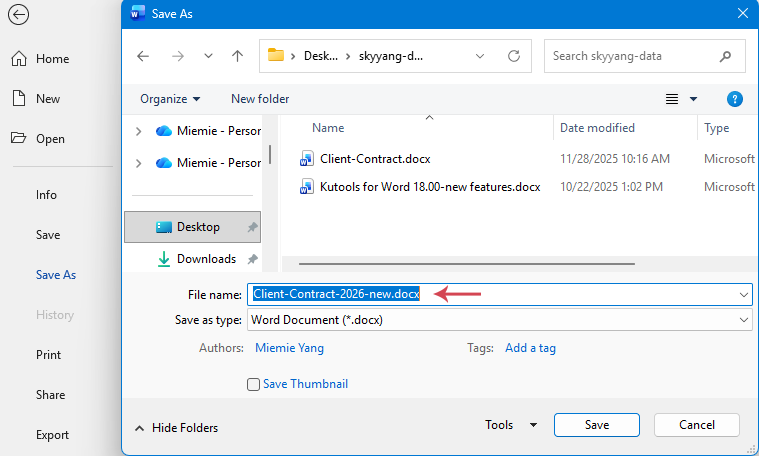
- Click the Save button.
Result:
Word creates a new file with the new name. The original file remains unchanged unless you delete it manually.
Method 2: Rename a Word Document Using Kutools for Word
If you frequently rename documents or want a faster workflow, Kutools for Word offers a dedicated rename feature—no Save As loops required.
- Open your Word document. Go to the Kutools Plus tab, click Rename feature, see screenshot:

- In the popped out Rename box, enter the new name and click OK to confirm.
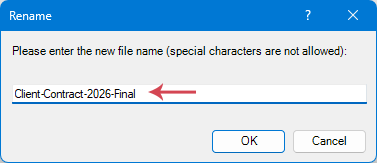
Result:
This renames the file instantly without creating a duplicate.
- Rename the current document directly
- No duplicate file creation
- Ideal for professional or repetitive tasks
Method 3: Rename Using Office Tab
Applications like Office Tab add a browser-like tabbed interface to Office. They often include a right-click menu option on the document tab itself to "Rename." Similar to Kutools, this function performs an internal Save As operation, creating a new file with the desired name.
- Right-click the document tab located at the top of your workspace. Select Rename from the context menu.
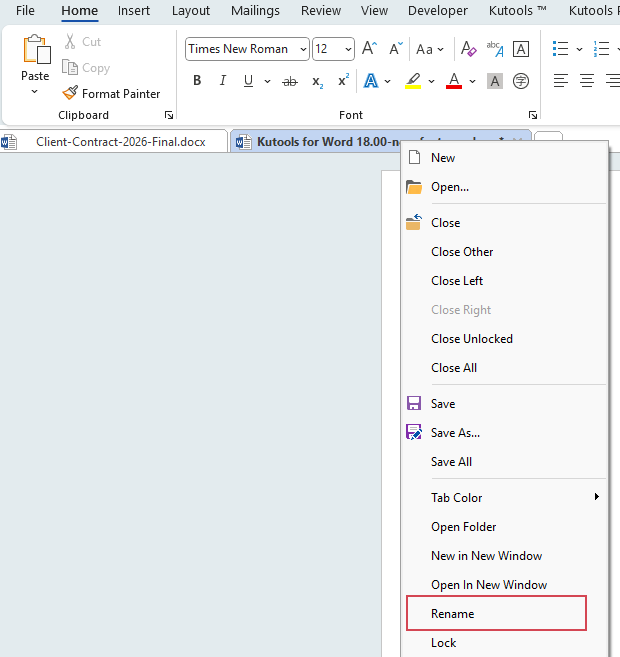
- In the popped out Office Tab box, enter the new name and click OK to confirm.
Result:
This renames the file instantly without creating a duplicate.
- Browser-style tabs for Word documents
- Switch between files instantly
- Reduce window clutter
- Boost productivity in Word, Excel, PowerPoint, and more
Common Mistakes When Renaming Word Documents
Summary
- ✔ Closed file → Rename directly in File Explorer
- ✔ Open file (built-in) → Use Save As
- ✔ Advanced productivity → Use Kutools for Word or Office Tab
Best Office Productivity Tools
Kutools for Word - Elevate Your Word Experience with Over 100 Remarkable Features!
🤖 Kutools AI Features: AI Assistant / Real-Time Assistant / Super Polish (Preserve Format) / Super Translate (Preserve Format) / AI Redaction / AI Proofread...
📘 Document Mastery: Split Pages / Merge Documents / Export Selection in Various Formats (PDF/TXT/DOC/HTML...) / Batch Convert to PDF...
✏ Contents Editing: Batch Find and Replace across Multiple Files / Resize All Pictures / Transpose Table Rows and Columns / Convert Table to Text...
🧹 Effortless Clean: Sweap away Extra Spaces / Section Breaks / Text Boxes / Hyperlinks / For more removing tools, head to the Remove group...
➕ Creative Inserts: Insert Thousand Separators / Check Boxes / Radio Buttons / QR Code / Barcode / Multiple Pictures / Discover more in the Insert group...
🔍 Precision Selections: Pinpoint Specific Pages / Tables / Shapes / Heading Paragraphs / Enhance navigation with more Select features...
⭐ Star Enhancements: Navigate to Any Location / Auto-Insert Repetitive Text / Toggle Between Document Windows / 11 Conversion Tools...
🌍 Supports 40+ Languages: Use Kutools in your preferred language – supports English, Spanish, German, French, Chinese, and 40+ others!

Office Tab - Brings Tabbed interface to Office, Make Your Work Much Easier
- Enable tabbed editing and reading in Word, Excel, PowerPoint, Publisher, Access, Visio and Project.
- Open and create multiple documents in new tabs of the same window, rather than in new windows.
- Increases your productivity by 50%, and reduces hundreds of mouse clicks for you every day!
✨ Kutools for Office – One Installation, Five Powerful Tools!
Includes Office Tab Pro · Kutools for Excel · Kutools for Outlook · Kutools for Word · Kutools for PowerPoint
📦 Get all 5 tools in one suite | 🔗 Seamless integration with Microsoft Office | ⚡ Save time and boost productivity instantly
Best Office Productivity Tools
Kutools for Word - 100+ Tools for Word
- 🤖 Kutools AI Features: AI Assistant / Real-Time Assistant / Super Polish / Super Translate / AI Redaction / AI Proofread
- 📘 Document Mastery: Split Pages / Merge Documents / Batch Convert to PDF
- ✏ Contents Editing: Batch Find and Replace / Resize All Pictures
- 🧹 Effortless Clean: Remove Extra Spaces / Remove Section Breaks
- ➕ Creative Inserts: Insert Thousand Separators / Insert Check Boxes / Create QR Codes
- 🌍 Supports 40+ Languages: Kutools speaks your language – 40+ languages supported!
Table of contents
- Rename a closed Word document
- Rename a Word Document While It’s Open
- By using Save As feature
- By using Kutools for Word
- By using Office Tab
- Common Mistakes When Renaming Word Documents
- Summary
- The Best Office Productivity Tools
Kutools for Word
Brings 100+ advanced features to Word
- ⬇️ Free Download
- 🛒 Purchase Now
- 📘 Feature Tutorials
- 🎁 60-Day Free Trial