Reuse company logos or formatted images instantly in Word using Kutools
With Kutools for Word’s "AutoText" feature, you can save your company logo or any formatted image (such as badges or header graphics) as reusable building blocks. Once saved, you can insert it into any document with a single click, while keeping the original size, placement, alignment, and layout perfectly intact.
Kutools removes repetitive formatting work and ensures your frequently used images are always ready to use. Even better, AutoText entries can be exported and imported across devices, so your saved images remain fully reusable and accessible no matter where you’re working.
Step-by-step guide to reusing company logos or formatted images using Kutools for Word
- Open the AutoText pane
- Save the logo or image as an AutoText entry
- Insert the saved logo or formatted image
- Update the logo or image AutoText entry
- Use AutoText entries across devices
Open the AutoText pane
- Open the Word document that contains the image you want to save as an AutoText entry.
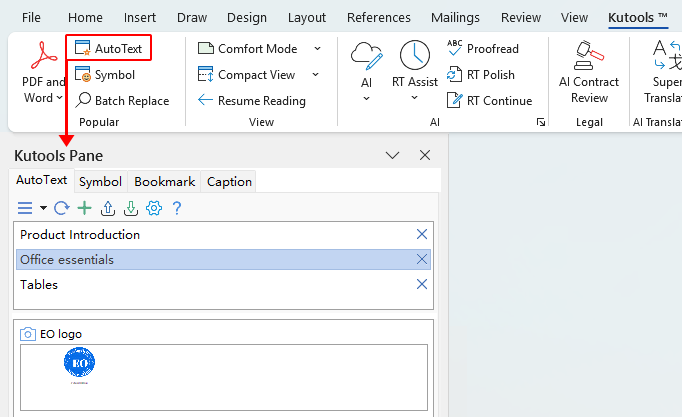
- Navigate to the Kutools tab and click AutoText to open the AutoText pane.
Save the logo or image as an AutoText entry
Note: Before saving your logo or any image as an AutoText entry, insert it into the document and adjust its size, alignment, wrapping, and position exactly the way you want it to look each time you reuse it.
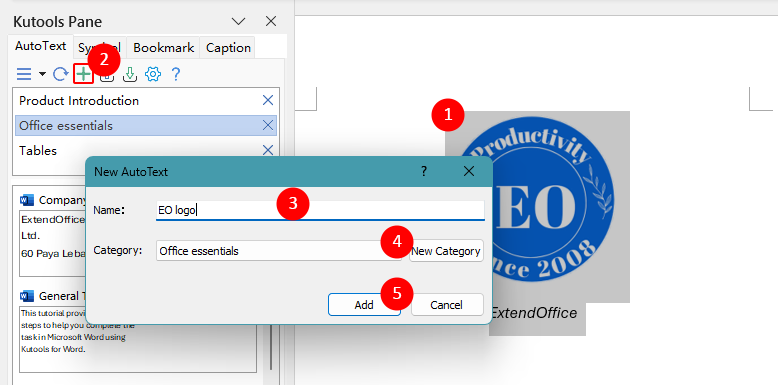
- Select the logo or formatted image in the document (include any surrounding text or spacing you want to reuse together).
Tip: Select the entire paragraph, not just the image, if you want AutoText to preserve its alignment and spacing (e.g., centered, left-aligned, right-aligned, or spaced-out images).
- In the AutoText pane, click the New AutoText button on the toolbar.
- In the "New AutoText" dialog that appears, enter a clear "Name" such as "Company Logo", "Header Logo", or "Brand Footer Image".
- Choose an existing "Category" or create one to keep assets organized.
- Click Add to save the selected content as an AutoText entry.
Insert the saved logo or formatted image into any document
- Place the cursor at the position where you want the table to appear:
- For a body image, click in the main document area where it should go.
- For a header or footer logo, double-click inside the header or footer area first.
- Open the AutoText pane (if it is not already open) with Kutools > AutoText.
- Expand the category that contains your logo or image, then click it to insert the logo or image at the cursor position with its saved formatting.
Update the logo or image AutoText entry
- Insert the existing logo AutoText entry into a document from the AutoText pane.
- Adjust the image's formatting - such as size, alignment, or layout - or replace it with the updated image if needed.
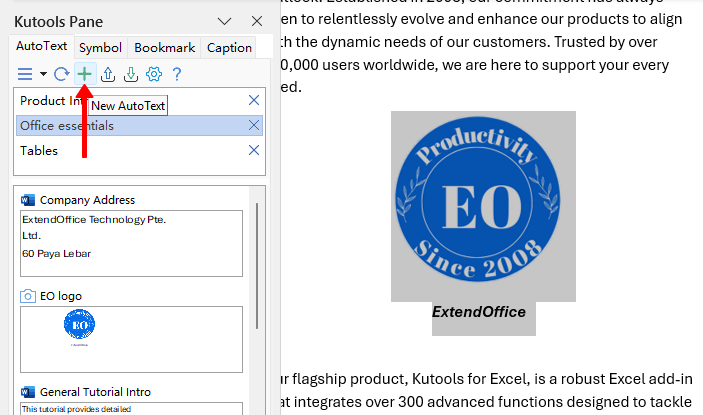
- Select the updated logo, then click the New AutoText button and save it using the same name and category to overwrite the previous entry.
Use AutoText entries across devices
After you create an AutoText entry, it is available in any Word document on the same computer as long as Kutools for Word is installed and enabled. This lets you reuse your saved content instantly without recreating or reformatting it each time.
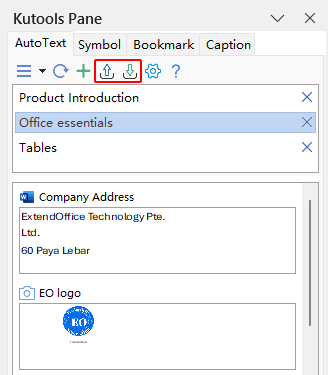
If you work on more than one device, Kutools allows you to take your AutoText library with you. Simply export your AutoText entries from one computer and import them on another using the “Export” and “Import” options in the AutoText pane. This keeps all your reusable items - images, tables, paragraphs, and more - consistent across your devices.
Best Office Productivity Tools
Kutools for Word - Elevate Your Word Experience
🤖 Kutools AI Features: AI Assistant / Real-Time Assistant / Super Polish (Preserve Format) / Super Translate (Preserve Format) / AI Redaction / AI Proofread...
📘 Document Mastery: Split Pages / Merge Documents / Export Selection in Various Formats (PDF/TXT/DOC/HTML...) / Batch Convert to PDF...
✏ Contents Editing: Batch Find and Replace across Multiple Files / Resize All Pictures / Transpose Table Rows and Columns / Convert Table to Text...
🧹 Effortless Clean: Sweap away Extra Spaces / Section Breaks / Text Boxes / Hyperlinks / For more removing tools, head to the Remove group...
➕ Creative Inserts: Insert Thousand Separators / Check Boxes / Radio Buttons / QR Code / Barcode / Multiple Pictures / Discover more in the Insert group...
🔍 Precision Selections: Pinpoint Specific Pages / Tables / Shapes / Heading Paragraphs / Enhance navigation with more Select features...
⭐ Star Enhancements: Navigate to Any Location / Auto-Insert Repetitive Text / Toggle Between Document Windows / 11 Conversion Tools...
🌍 Supports 40+ Languages: Use Kutools in your preferred language – supports English, Spanish, German, French, Chinese, and 40+ others!

Office Tab - Tabs for Office, Power for You
- Enable tabbed editing and reading in Word, Excel, PowerPoint, Publisher, Access, Visio and Project.
- Open and create multiple documents in new tabs of the same window, rather than in new windows.
- Increases your productivity by 50%, and reduces hundreds of mouse clicks for you every day!

✨ Kutools for Office – One Installation, Five Powerful Tools!
Includes Office Tab Pro · Kutools for Excel · Kutools for Outlook · Kutools for Word · Kutools for PowerPoint
📦 Get all 5 tools in one suite | 🔗 Seamless integration with Microsoft Office | ⚡ Save time and boost productivity instantly
Best Office Productivity Tools
Kutools for Word - 100+ Tools for Word
- 🤖 Kutools AI Features: AI Assistant / Real-Time Assistant / Super Polish / Super Translate / AI Redaction / AI Proofread
- 📘 Document Mastery: Split Pages / Merge Documents / Batch Convert to PDF
- ✏ Contents Editing: Batch Find and Replace / Resize All Pictures
- 🧹 Effortless Clean: Remove Extra Spaces / Remove Section Breaks
- ➕ Creative Inserts: Insert Thousand Separators / Insert Check Boxes / Create QR Codes
- 🌍 Supports 40+ Languages: Kutools speaks your language – 40+ languages supported!
Table of Contents
- Open the AutoText pane
- Save the logo or image as an AutoText entry
- Insert the saved logo or formatted image
- Update the logo or image AutoText entry
- Use AutoText entries across devices
- The Best Office Productivity Tools
Kutools for Word
Brings 100+ advanced features to Word
- 🧩 Overview
- 📥 Free Download
- 🛒 Purchase Now
- 🎁 60-Day Free Trial available