How to create grid paper/square template in Excel?
By default, Excel displays worksheet cells in rectangular shapes, which are suitable for typical data entry and analysis tasks. However, some situations—such as drawing diagrams, working with coordinate grids, or designing certain forms—require cells that appear as perfect squares to simulate grid paper. For example, educators preparing math worksheets, engineers sketching simple layouts, or planners designing checklists may need square cell layouts for clarity and neatness. This guide will explain practical methods to transform an Excel worksheet into grid paper, ensuring uniform square cells, and show you how to save your customized grid as a reusable template.
- Create a grid paper template with shape of square in Excel (7 steps)
- Create a grid paper template with Kutools for Excel (3 steps)
- Alternative: Use VBA to batch adjust cell sizes for grid paper
Create a grid paper template with shape of square in Excel
This approach allows you to visually measure and match the dimensions of the worksheet cells to a perfect square. By creating a square shape and then manually adjusting row height and column width, you can align the whole sheet to look and function like grid paper. This method offers flexibility, but requires careful measurement and manual adjustment to ensure precision.
1. Go to the Insert tab, click on Shapes, and select Rectangle from the drop-down menu.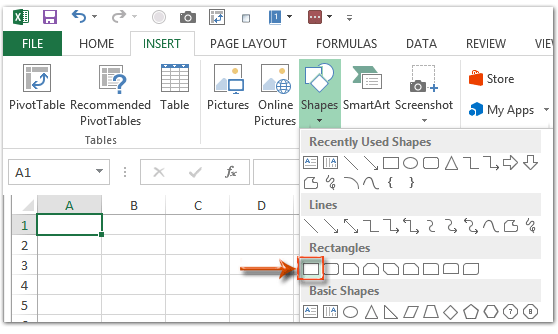
2. Once you have drawn the rectangle on the worksheet, set its height and width to the same numerical value in the Size group located on the Format tab. For example, you may enter both height and width as 1 inch or 2 cm, depending on your requirements.
The rectangle will immediately change to a square once equal values are set for both dimensions.
3. Drag and move the square you created to the upper-left corner of your worksheet. Then, right-click on the shape and choose Size and Properties from the dropdown menu to access further settings.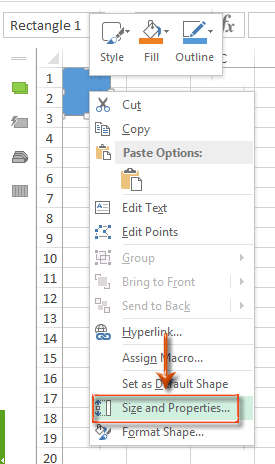
4. Adjust the properties for your square as follows:
A. In Excel 2013 and later, access the Format Shape pane, click the Size & Properties tab, then choose Properties and check Don’t move or size with cells.
B. In Excel 2010, open the Format Shape dialog box, select Properties from the sidebar, check Don’t move or size with cells, then close the dialog.
C. For Excel 2007, use the Size and Properties dialog box, select Properties at the top tab, check Don’t move or size with cells, and close the dialog.
This step is important: It ensures your reference square remains unchanged as you modify the worksheet cells, avoiding accidental movement or resizing during adjustments.
Excel 2013 and higher version:
Excel 2007 and 2010: 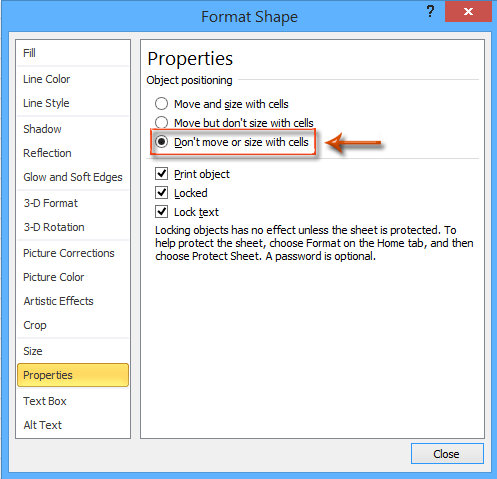
5. Highlight the entire worksheet using one of these methods:
A. Click any cell in the worksheet, then press Ctrl + A, which selects all cells.
B. Alternatively, click the small arrow button located at the top-left corner where the row and column headers meet.
6. Position your mouse over the right border of the Column A header. When it changes to a double-headed arrow, click and drag to adjust Column A’s width to match the reference square’s side length. Repeat the process by hovering over the bottom border of Row 1’s header, then drag to adjust its height to the same value as the square.
Practical tip: Double-check both the column width and row height values, as Excel uses different units. You may need to toggle between pixels, inches, or points depending on your Excel setup—and for precise matching, use the Format Cells feature to enter exact values. Consistency ensures all cells will align as true squares.
7. Save your customized grid paper for future use as a template: In Excel 2013 and later, click File > Save > Computer > Browse. In Excel 2007 or 2010, click the File or Office button, then Save.
8. Within the dialog box that appears, enter a descriptive name for your grid paper in the File name field. To make sure it is saved as a template, click the Save as type drop-down menu, then select Excel Template (*.xltx). Finally, click Save.
Tips and troubleshooting:
- Always verify that both row height and column width match exactly, otherwise the squares may appear slightly distorted—especially when printing.
- If you find manual adjustment challenging, zoom in for better precision, or use the Format Cells dialog for numeric entry.
- This method is universally applicable in all versions of Excel, though dialog appearances may vary.
- Saving as a template allows for easy reuse; templates can be shared or duplicated for various purposes.
- Cons: Manually matching the sizes can take time, and minor miscalculations may cause inconsistencies across the sheet, especially with larger ranges.
Create a grid paper template with Kutools for Excel’s Adjust Cell Size feature
The manual method above gives you flexibility, but achieving perfect precision for square cells may be challenging and time-consuming, especially for large worksheets. If you want greater accuracy and efficiency, the Adjust Cell Size tool in Kutools for Excel streamlines this process. This feature enables you to quickly set column width and row height to exactly the same value, creating evenly sized square cells throughout the worksheet in just a few steps.
1. Select the entire worksheet. Do this by clicking the arrow at the intersection of the row and column headers in the upper-left corner of your worksheet.
2. Open the Kutools tab, then click Format > Adjust Cell Size.
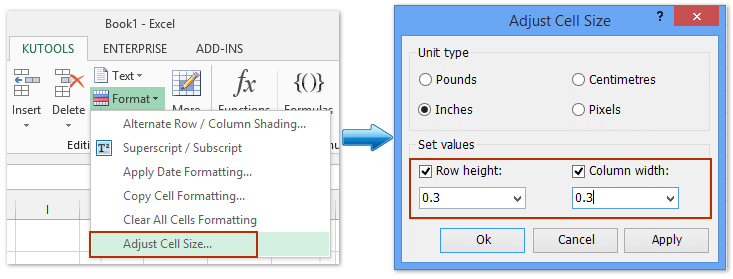
3. In the Adjust Cell Size dialog box, select your preferred Unit type (inches, centimeters, or pixels), and then input the same numeric value for both row height and column width in the Set values fields. For example, entering 0.5 for both will ensure each cell will be uniform square of 0.5 units. Click OK to apply the settings instantly—your worksheet cells will all be sized perfectly as squares.
Advantages of this approach:
- Efficient and accurate—ideal for large worksheets, quick setup, or repetitive tasks.
- The unit type adjustment allows for easy matching to print settings or physical paper sizes.
- Minimizes error and manual labor, making it accessible even for beginners.
Possible cons: This method requires Kutools for Excel to be installed. While it simplifies the process, users without the add-in will have to use manual techniques.
For further use or to share with others, you can save your newly formatted sheet as a template by following the same save steps described above.
Kutools for Excel - Supercharge Excel with over 300 essential tools, making your work faster and easier, and take advantage of AI features for smarter data processing and productivity. Get It Now
Alternative: Use VBA to batch adjust cell sizes for grid paper
For users who need to set up square cells across large areas—and want to automate the resizing process—a VBA macro offers efficiency. This method is particularly practical if you regularly need grid sheets of different sizes or want precise control.
1. Open the Visual Basic editor by clicking Developer Tools > Visual Basic. In the new Microsoft Visual Basic for Applications window, click Insert > Module, then copy and paste the following VBA code into the module:
Sub SetGridPaperCells()
'Updated by Extendoffice
    Dim ws As Worksheet
    Dim rng As Range
    Dim gridSize As Double
    Dim col As Range
    Dim row As Range
    Dim xTitleId As String
    Dim testWidth As Double

    On Error Resume Next
    xTitleId = "Kutools for Excel"
    Set ws = ActiveSheet

    gridSize = Application.InputBox("Enter grid cell size (in points):", xTitleId, 20, Type:=1)
    If gridSize <= 0 Then Exit Sub

    Set rng = Application.InputBox("Select the grid area:", xTitleId, ws.UsedRange.Address, Type:=8)
    If rng Is Nothing Then Exit Sub

    Application.ScreenUpdating = False

    testWidth = gridSize / (ws.Range("A1").Width / ws.Columns("A").ColumnWidth)

    For Each col In rng.Columns
        col.ColumnWidth = testWidth
    Next col

    For Each row In rng.Rows
        row.RowHeight = gridSize
    Next row

    Application.ScreenUpdating = True
    MsgBox "Cells resized to square shape successfully!", vbInformation, xTitleId
End Sub
2 To run the macro, click the  button (or press F5) in the VBA editor. The program will prompt you to enter the desired side length (in points), then select the worksheet area to format. After confirming, your selected range will be adjusted so all cells are set to equal size, forming a grid.
Advice and troubleshooting:
- If you encounter errors, make sure the correct worksheet is active and the selected cell range is valid.
- Default settings use points, which may look different than inches/centimeters depending on Excel display; adjust values as needed for print layouts.
Summary and suggestions:
Whether you choose manual adjustment, Kutools for Excel, or VBA automation depends on your worksheet size, your familiarity with Excel tools, and whether you need speed or customization. Always check the print preview and test your template for your intended application (drawing, teaching, checklist, or planning). For templates in shared environments, use built-in protection or read-only settings to prevent accidental changes.
Demo: create grid paper/square template in Excel
Related articles:
How to make a read-only template in Excel?
How to protect/lock an Excel template being overwritten with password?
How to find and change default save location of Excel templates?
Best Office Productivity Tools
Supercharge Your Excel Skills with Kutools for Excel, and Experience Efficiency Like Never Before. Kutools for Excel Offers Over 300 Advanced Features to Boost Productivity and Save Time. Click Here to Get The Feature You Need The Most...
Office Tab Brings Tabbed interface to Office, and Make Your Work Much Easier
- Enable tabbed editing and reading in Word, Excel, PowerPoint, Publisher, Access, Visio and Project.
- Open and create multiple documents in new tabs of the same window, rather than in new windows.
- Increases your productivity by 50%, and reduces hundreds of mouse clicks for you every day!
All Kutools add-ins. One installer
Kutools for Office suite bundles add-ins for Excel, Word, Outlook & PowerPoint plus Office Tab Pro, which is ideal for teams working across Office apps.





- All-in-one suite — Excel, Word, Outlook & PowerPoint add-ins + Office Tab Pro
- One installer, one license — set up in minutes (MSI-ready)
- Works better together — streamlined productivity across Office apps
- 30-day full-featured trial — no registration, no credit card
- Best value — save vs buying individual add-in